
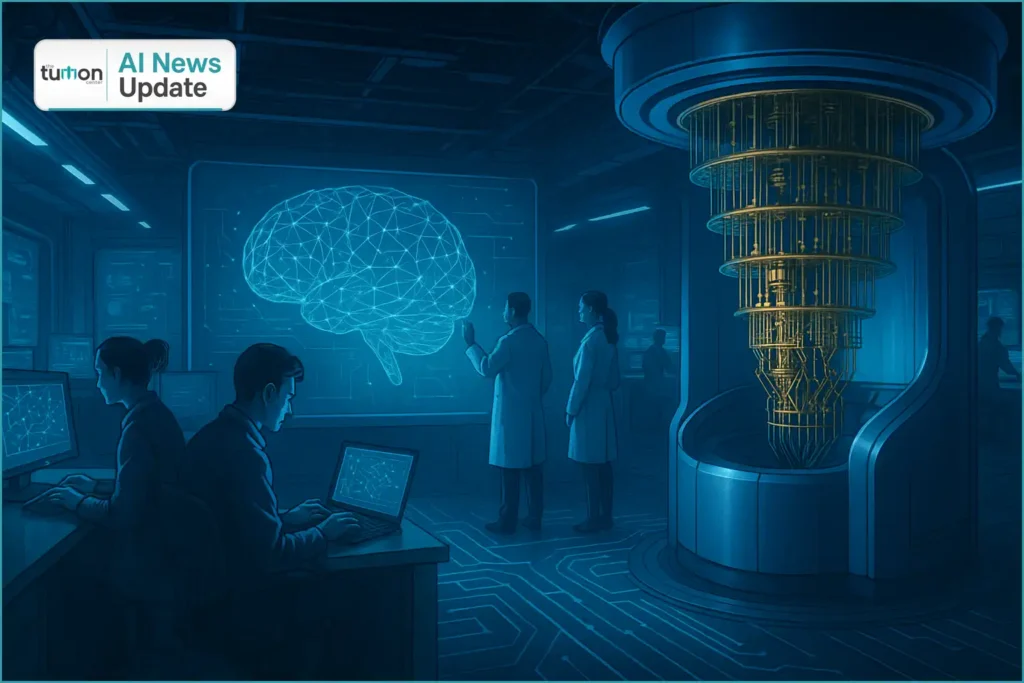
Today in AI – 5 Quick Global Updates
The AI beat moves fast — here are five important headlines you need to know today.
- China mandates that state-funded data centres use only domestically-made AI chips.
- Scientists at University of Washington’s Institute for Protein Design use AI to design antibodies from scratch.
- A “mind-captioning” system decodes brain signals into sentences — raising huge ethical questions.
- The free-market vs regulation debate heats up: US leads in AI innovation, China/EU lag behind.
- Google launches new AI chip (TPU Ironwood) to challenge NVIDIA’s dominance.
Introduction
The pace of change in artificial intelligence is nothing short of breathtaking. What was futuristic a few years ago is now part of daily strategy for businesses, governments and educators. For content-creators like you, educators like you, and students like you, staying ahead is no longer optional — it’s a necessity. These five bullet-points capture shifts that ripple across research labs, boardrooms, classrooms and policy halls.
“`
Key Developments
First, geopolitical stakes. China has issued guidance requiring **new state-funded data centres** to **use only domestically-made AI chips**. The move signals an intensification of tech-sovereignty in the AI era.
Second, in the life sciences: researchers led by Nobel Laureate David Baker’s lab at the University of Washington used AI to design antibodies from scratch — a remarkable jump from traditional wet-lab methods.
Third, in neuroscience: A team has demonstrated a system that captures brain-activity signals and translates them into coherent sentences — essentially “mind-reading” via AI. The implications for accessibility are profound, but so are the risks.
Fourth, in economic-policy frameworks: A commentary argues that the United States’ open-market AI approach gives it a strategic lead in innovation, while China’s top-down model and Europe’s heavy regulation are slowing momentum.
Fifth, in hardware and platform play: Google has rolled out a powerful new AI chip, “Ironwood”, aimed at challenging NVIDIA’s dominance in AI training and inference — a clear sign that hardware is back in the driver’s seat.
Impact on Industries and Society
Each one of these developments intersects with industries integral to education, content-creation, enterprise and societal transformation. For example: in the education sector, the hardware arms-race means cheaper, faster compute for AI-based tutoring tools and interactive avatars. The biotech advancements translate into tomorrow’s medical-education modules and research-driven curricula. The “mind-captioning” breakthrough touches accessibility—imagine students with severe disabilities using thought-driven interfaces.
In business, the chip-sovereignty move in China raises supply-chain risks for Indian and global players. Content creators must now factor in disruptions beyond software — hardware, regulation and geopolitics matter. For society, the governance of brain-AI interfaces raises urgent questions about privacy, autonomy and human-agent boundaries.
Expert Insights
“If you don’t build or control the compute stack, you are at the mercy of someone who does.” — paraphrased from commentary on the US vs China AI race.
Even in domains like antibody design, experts highlight that AI doesn’t replace experts—it augments them. The University of Washington team emphasised that human-in-the-loop remains critical.
India & Global Angle
For India, these items carry multiple angles. China’s chip move signals regional supply-chain shifts that could affect Indian hardware imports and AI infrastructure planning. The mind-captioning research opens up opportunities for inclusive education and disability-tech in India. Meanwhile, Indian ed-tech start-ups must watch the hardware race: cheaper, efficient AI compute means more scalable solutions. At a policy level, India must balance regulation with innovation — hedging against the same trap Europe faces.
Policy, Research, and Education
Governments everywhere must revisit strategy. Regulation is no longer just about data-privacy or ethics; it now extends to chips, national infrastructure, brain-interfaces. Research institutions are racing to partner with industry on everything from materials to algorithmic safety. In education, this is a call to arms: curricula must include hardware-AI awareness, ethical-AI foundations and multi-disciplinary literacy. For instance, an Indian university might now include an “AI hardware ecosystem” lecture alongside “AI ethics”.
Challenges & Ethical Concerns
With the mind-captioning breakthrough comes the risk of mind-reading without consent. Regulatory regimes are not yet prepared. The hardware race could widen inequality: countries with deep pockets dominate compute, others lag. Also, AI in antibody design raises concerns about dual-use (bio-threats) and speed of deployment without oversight.
Future Outlook (3–5 Years)
- Compute-sovereignty will become a national-security axis in AI states.
- Educational and accessibility solutions powered by brain-AI interfaces will begin to scale — but with heavy regulation.
- Biotech accelerated by AI will turn from lab-proofs to commercial therapy-pipelines faster than expected.
Conclusion
For content creators, educators, students, and innovators, the message is clear: stay curious, stay agile. The AI world isn’t waiting for us to catch up — it’s two steps ahead. But that’s not a reason to be intimidated. It’s a reason to engage. Build your literacy around hardware, ethics, data, interfaces and industry. Because tomorrow’s opportunity doesn’t just lie in the software you build — it lies in the ecosystem you understand and shape.