
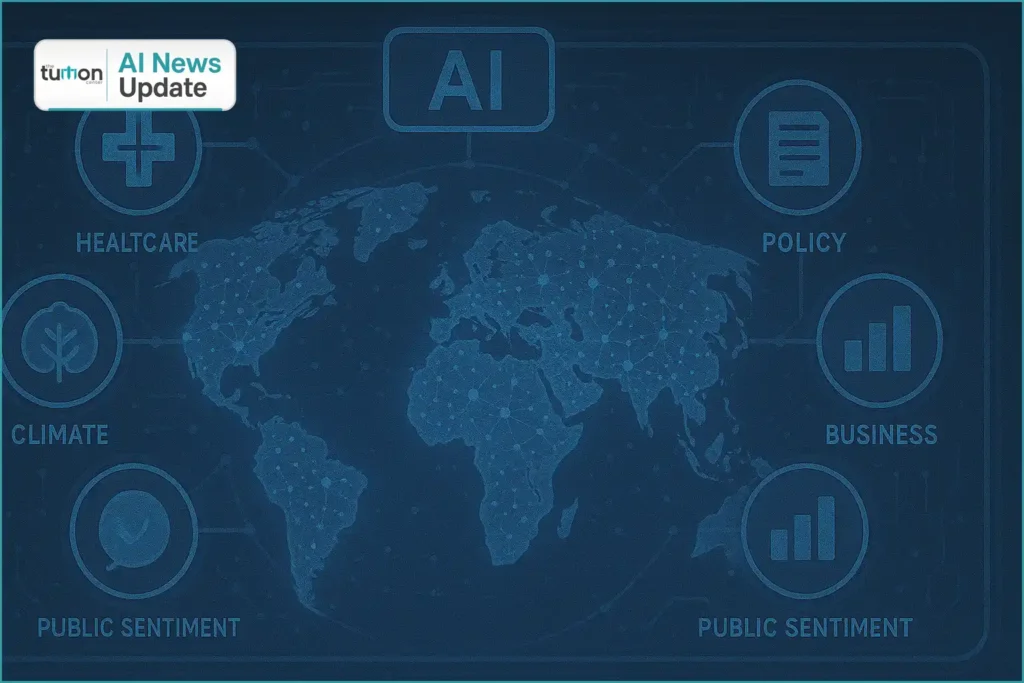
From WHO’s health-AI governance push to WMO’s early-warning agenda, Europe’s research strategy, accuracy alarms for AI assistants, and the new agentic workbench—here are the five forces remaking AI right now.
- Health: WHO and Korea’s regulator co-host AIRIS 2025 to move from principles to practice for safe, equitable medical AI.
- Climate: WMO backs AI-assisted forecasts as part of “Early Warnings for All,” aiming to save lives and livelihoods.
- Policy & Research: The European Commission unveils twin strategies—Apply AI and AI in Science—including the RAISE initiative.
- Accuracy & Trust: The largest cross-language study yet finds major assistants misrepresent news 45% of the time; Pew shows concern outpacing excitement globally.
- Workflows: Agentic browsers and enterprise agent platforms preview a shift from “ask & read” to “set goal & supervise.”
Introduction
Every once in a while, separate headlines start telling the same story. This month’s signals—from a WHO-led forum on health-AI regulation to the UN weather agency’s AI adoption plan, Europe’s science strategy, and new evidence on AI assistant accuracy—converge on a single message: AI is no longer an optional feature. It is becoming the connective tissue of public services, scientific discovery, and daily work. That changes what it demands of all of us, from students and developers to regulators and CEOs: literacy, evaluation, oversight, and the humility to design for humans first.
Key Developments
1) Health governance rises: AIRIS 2025
In Incheon, the World Health Organization and Korea’s Ministry of Food and Drug Safety convened AIRIS 2025 under the banner “Regulation for AI, Together for Tomorrow.” The focus wasn’t just on what AI can do in medicine (diagnostics, triage, imaging, workflow automation), but how to make it safe, effective, ethical, and equitable across health systems with very different capacities. Delegates from regulators, academia, and industry debated standards for transparency, bias testing, human oversight, and post-deployment monitoring—essentially, how to translate broad AI principles into measurable practice. :
Why this matters for India: AI-enabled screening and telemedicine are already bridging access gaps, but scaling them responsibly requires evaluation protocols that work in district hospitals as well as apex centers. The equity framing at AIRIS aligns with India’s digital health stack ambitions: it’s not enough to build powerful tools; they must be provably safe and fair in the contexts where they’ll be used.
2) Climate & weather: AI for early warnings
The World Meteorological Congress endorsed concrete actions to use AI to improve weather forecasts and early warnings—without replacing traditional methods. The emphasis is on reach and timeliness: getting better alerts to more people, faster, including in regions with sparse data or limited forecasting capacity. For climate-vulnerable countries, the ability to harness AI for trajectory prediction, impact modeling, and multilingual alerting could save lives and billions in economic losses. :contentReference[oaicite:8]{index=8}
India, facing cyclones, floods, and heat waves, sits at the center of this use case. Integrating AI into IMD and disaster management workflows—from nowcasting to evacuation logistics—could tighten the loop between detection and action. Crucially, WMO stresses complementarity: AI augments forecasters rather than displacing them, which matches how public institutions build trust in high-stakes systems.
3) Policy & research: Europe’s twin strategies and RAISE
On October 8, the European Commission set out two linked strategies: Apply AI (to accelerate adoption in key sectors) and AI in Science (to reinforce Europe’s leadership in scientific discovery with AI). The research track includes RAISE—a virtual institute designed to pool compute, data, and talent across borders so scientists can adopt state-of-the-art AI methods, while upholding European values and governance. For everyone else, the signal is strategic: leading economies are now building the infrastructure—computational, institutional, and regulatory—to turn AI from isolated projects into national capability.
Why India should watch: Europe’s approach emphasizes not just model training, but the ecosystem that makes applied AI reliable—shared resources, evaluation standards, and open science incentives. India’s strengths (talent, startups, digital public infrastructure) could pair with such frameworks via collaborations and joint benchmarks that keep models useful across languages and edge-cases.
4) Accuracy & trust: assistants under the microscope
The European Broadcasting Union and the BBC examined ~3,000 answers that leading assistants gave to news questions, across 14 languages. They found that about 45% contained at least one significant problem, with 81% showing some issue (from sourcing gaps to outdated facts). Reuters’ coverage underscored the democratic risk: as people turn to AI instead of search or direct outlets, misrepresentations and missing sources can distort public understanding. The study’s prescription: clearer sourcing, guardrails to separate opinion from fact, and platform accountability.
Zooming out, Pew’s global survey of 25 countries reports a sentiment gap: more people are concerned than excited about AI’s growing presence in daily life. That mindset shapes adoption. If students and general audiences distrust AI, they’ll either disengage—or rely on it without verification, which is worse. Institutions that want AI to lift outcomes must address quality with the same seriousness they bring to features.
5) Workflows: from “ask & read” to “set goal & supervise”
Against this backdrop, the tools themselves are evolving. Agentic systems—capable of reading pages, clicking buttons, filling forms, and reporting back—are moving into browsers and enterprise platforms. Done right, that can compress research, procurement, and support workflows dramatically; done poorly, it can amplify errors at machine speed. The lesson from the accuracy studies applies doubly here: verification and supervision are not optional.
Impact on Industries and Society
Healthcare & life sciences: AIRIS 2025’s pivot is from “ethics statements” to operational checklists: bias tests with local data; human-in-the-loop handoffs; adverse-event reporting for algorithms; and sunset clauses for models that drift. For India’s mixed health system, this supports deployment that works in tertiary centers and rural clinics alike.
Disaster resilience: WMO’s plan frames AI as a force multiplier for agencies already stretched thin. Better ensemble forecasts, impact-aware alerts, and citizen-scale delivery (vernacular languages, low-bandwidth channels) can reduce mortality and protect livelihoods in agriculture and fisheries.
Research & innovation: With RAISE, Europe is betting that the frontier of science will be computational—protein design, materials discovery, climate modeling, and more—if researchers can access compute and trustworthy tools. For Indian labs and startups, this hints at a world where cross-border shared infrastructure (and shared norms) is the competitive edge.
Education & skills: The trust gap means AI literacy must move beyond “how to prompt” to “how to prove.” Students should be taught to check sources, run spot-tests on outputs, and document what was changed after verification—skills that translate directly to the workplace.
Enterprise productivity: Agentic browsers and platforms can pre-fill admin steps, reconcile dashboards, and draft routine messages. But the KPI isn’t just speed; it’s action accuracy. Organizations will need approval gates, immutable logs, and rollback plans—plus roles like evaluation engineering and agent ops.
Expert Insights
“As AI becomes more sophisticated and its health applications expand, so must our efforts to make them safe, effective, ethical and equitable.” — WHO leadership at AIRIS 2025.
“AI can accelerate early warnings for all… save millions of lives and billions of dollars.” — World Meteorological Organization, World Meteorological Congress release.
“People are more concerned than excited about AI’s growth in daily life.” — Pew Research Center, global survey across 25 countries.
India & Global Angle
For India, the five updates are unusually aligned with national priorities. Health-AI governance speaks to the ethics and scale challenges of ABDM; AI-assisted warnings reinforce IMD and NDMA modernization; Europe’s science strategy invites collaborations that respect privacy and sovereignty while tackling shared problems; the accuracy studies mirror concerns in India’s multilingual news ecosystem; and agentic workflows could help MSMEs leapfrog administrative drag. The through-line is capacity: technical prowess and institutional competence.
Policy, Research, and Education
Policy: Move from voluntary principles to auditable requirements in high-risk domains. That means documented training data (or retrieval sources), bias and performance dashboards, and mandated incident reporting. For cross-border work, align around minimal-common standards so models trained in one region don’t fail silently in another.
Research: Encourage reproducibility with shared benchmarks and compute credits, particularly for multilingual and low-resource settings. Participate in RAISE-like consortia so Indian datasets and edge-cases are represented upstream.
Education: Bake “verification engineering” into curricula—from secondary school media literacy to university labs. Teach students to (a) state the claim, (b) check the source, (c) run a test, (d) record the change. Make disclosure of AI assistance normal, not punitive.
Challenges & Ethical Concerns
Accuracy & drift: If assistants can misstate news 45% of the time, agent systems that act need even stronger safeguards. Silent failures are the enemy: build interfaces that surface uncertainty, show sources by default, and slow down when consequences are high.
Equity: The same datasets that make AI powerful can encode structural bias. Governance must ensure models are validated on local populations and that opt-out and redress paths are real for patients and citizens. AIRIS’s equity emphasis is a start, not a finish.
Privacy & consent: Early-warning systems and health platforms process sensitive data. Privacy-preserving methods (federated learning, differential privacy) and minimized data retention should be default choices, not afterthoughts.
Misinformation: As more people encounter news via AI tools, platforms must separate citation from speculation. The Pew findings suggest that public buy-in depends on systems that show their work.
Future Outlook (3–5 Years)
- Health: Algorithm registries, post-market surveillance for models, and clinic-grade evaluation will become standard—especially where public funds are involved.
- Climate: AI-assisted alerts plug into local languages and last-mile channels (IVR, community radio, WhatsApp), closing the loop from forecast to action.
- Research: RAISE-style infrastructure normalizes shared compute and datasets; “evaluation as a service” becomes a research specialty.
- Trust: Assistants default to citations and uncertainty bands; regulators require impact and safety reports for high-risk deployments.]
- Work: Agentic tools integrate with enterprise approvals and logs; new roles—agent ops, evaluation engineering—enter standard org charts.
Conclusion
Behind the five updates is a simple pivot: AI isn’t just about capability; it’s about credibility. Health ministries, weather agencies, research councils, companies, and classrooms all arrive at the same requirement—be powerful and provable. If India’s students and professionals master that mindset early—ask, verify, measure, improve—they won’t just use AI; they’ll steer it. This is the work of the next few years: to architect systems that people can trust because those systems show their work and respect the contexts they serve.