
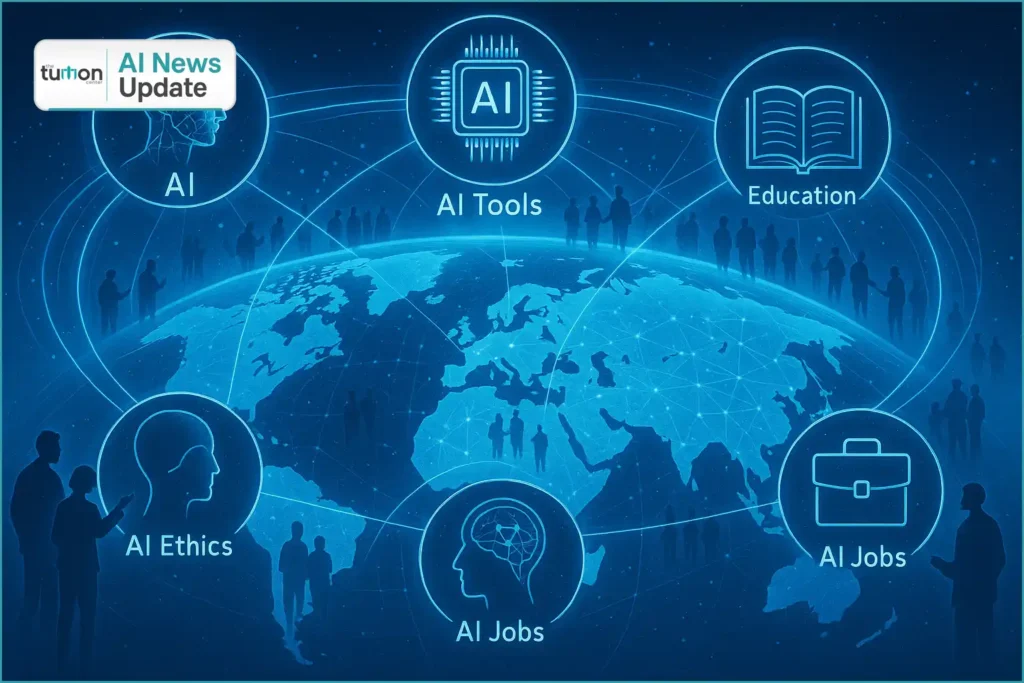
From empathy-driven algorithms to AI-governed classrooms, here are five major developments shaping how the world thinks, learns, and collaborates with intelligent systems.
- Education enters a new age with personalized AI tutors and emotion-aware classrooms.
- Healthcare sees precision diagnostics powered by multimodal AI models.
- Governments adopt AI charters and safety frameworks as global standards.
Introduction
The year 2025 marks a decisive turning point for Artificial Intelligence. No longer confined to laboratories or software stacks, AI now touches nearly every layer of society—from how we teach children to how nations govern technology ethics. The world has entered what many experts call the “Human-AI Era”: a time when machine intelligence is augmented by human creativity, emotion, and purpose.
Across the globe, five defining developments are steering this transformation. These updates aren’t just news headlines; they represent a deeper shift in how we define intelligence, trust, and responsibility in the digital age.
1. Education Transformed: Emotion-Aware Classrooms and AI Tutors
Classrooms have evolved beyond smart boards. Today’s intelligent education systems use AI tutors capable of understanding a student’s mood, tone, and confidence level. These emotion-aware systems adapt content in real time—making learning deeply personalized and empathetic.
Finland, Singapore, and India have become early leaders in implementing national AI literacy programs. Platforms inspired by UNESCO’s AI for Education framework are now training teachers to integrate generative AI into daily curricula. In India, the National Digital Education Architecture (NDEAR) has introduced “AI Mentor Pods”—personalized assistants that guide students through STEM, language learning, and even ethics discussions.
“The classroom of the future is not algorithmic—it’s emotional,” notes Dr. Fei-Fei Li, co-director of Stanford’s Human-Centered AI Institute. “We are teaching machines to care, and humans to think more deeply about what caring means.”
By 2030, experts predict that nearly 70% of students worldwide will interact daily with AI-powered educational tools. The challenge ahead lies in maintaining data privacy and ensuring equity in access.
2. Healthcare Revolution: AI’s Multimodal Diagnostic Leap
Healthcare is undergoing its own AI renaissance. With models that combine text, image, and genomic data, doctors can now receive diagnostic suggestions that mirror the reasoning of medical teams. From cancer detection to mental-health therapy bots, AI has become an indispensable partner.
Recent breakthroughs like DeepMind’s MedPalm-2 and Google’s Gemini Health platforms demonstrate how multimodal AI can interpret radiology scans, lab reports, and patient histories simultaneously. This “fusion thinking” enables faster, safer, and more consistent treatment recommendations.
Meanwhile, Indian research centers under the Ayushman Bharat Digital Mission are experimenting with AI models that predict disease outbreaks by analyzing anonymized health records and climate data. Such integration could prevent millions of deaths from vector-borne diseases.
“AI won’t replace doctors,” says Dr. Eric Topol, author of Deep Medicine. “But doctors using AI will replace those who don’t.”
As policymakers tighten rules on medical data governance, a new field—“Explainable Healthcare AI”—is emerging, ensuring that machines can justify every decision in human-readable language.
3. Governance & Ethics: The Rise of AI Charters
With innovation comes responsibility. In 2025, over 60 countries signed or adapted their own versions of an AI Governance Charter—a set of ethical, safety, and transparency principles aligned with UNESCO, the OECD, and the G20 Digital Economy Taskforce. These frameworks prioritize fairness, auditability, and data dignity.
The European Union’s AI Act—considered the world’s first comprehensive AI law—has inspired similar legislation across Asia and Africa. India’s own “AI Assurance Mission,” announced under the Ministry of Electronics and IT, mandates bias audits and algorithmic transparency for public-facing systems.
Private sector adoption is equally strong. Tech giants now host internal “Ethics Boards” that approve or veto AI deployments. Startups, meanwhile, are hiring Chief Trust Officers—professionals who combine technical, legal, and human-rights expertise.
“The next global superpower will not be the one with the biggest AI, but the one with the most ethical AI,” remarks Audrey Azoulay, Director-General of UNESCO.
While governance strengthens, the challenge remains to harmonize standards across borders. Global cooperation in this decade could determine whether AI becomes humanity’s bridge or its barrier.
4. Creative Intelligence: Artists and Coders Merge
In 2025, creativity itself is being rewritten. The rise of text-to-video platforms like OpenAI’s Sora and Runway’s Gen-2 has made cinematic storytelling accessible to everyone. Musicians are co-composing with models that understand rhythm and mood; writers are partnering with narrative-aware LLMs that draft scenes in their personal style.
This new creative ecosystem blurs the boundary between art and code. Universities are now launching “Computational Creativity” degrees, merging design, psychology, and computer science. The World Economic Forum predicts that creative-AI skills—prompt design, story orchestration, ethical remixing—will be among the top five employable skills by 2027.
However, the debate over originality continues. Legislators worldwide are exploring “AI Copyright Codes” to ensure artists are credited and compensated fairly. Open datasets like Creative Commons AI aim to build a future where innovation and integrity coexist.
“Art made with AI is not artless—it’s infinite,” says Sougwen Chung, artist and researcher at MIT Media Lab. “The question is no longer who made it, but why it moves us.”
5. Enterprise Evolution: The Age of AI Agents
Businesses have entered the era of “Agentic AI.” Instead of merely automating tasks, companies deploy fleets of autonomous digital workers capable of negotiating, scheduling, analyzing, and reporting with minimal supervision. From finance to logistics, these agents collaborate across platforms, guided by human oversight dashboards.
Startups like Adept, Anthropic, and Google DeepMind are at the forefront, developing frameworks where AI can reason about actions rather than just predict text. The new frontier is process understanding—AI that comprehends organizational workflows as systems of cause and effect.
For India, this transformation could add over $450 billion to GDP by 2030, according to NASSCOM. SMEs adopting AI agents for customer support and supply-chain optimization report 40–60% operational efficiency gains. Yet, the human role remains irreplaceable: creativity, empathy, and strategic judgment still anchor decision-making.
“Automation doesn’t remove people; it removes monotony,” says Sundar Pichai, CEO of Google. “The next generation of workers will manage swarms of AI teammates, not fear them.”
India & Global Angle
India’s AI journey is deeply intertwined with global progress. Through initiatives like AI4Bharat and Digital India FutureSkills, the government is creating multilingual models to bridge digital divides. Simultaneously, collaborations with the EU, UAE, and Japan are ensuring ethical AI exchange and joint R&D.
Globally, countries are recognizing the need for cultural diversity in datasets and decision-making. AI trained only on Western data cannot serve a global population. Thus, the next phase of research emphasizes local context learning—models that adapt to regional languages, customs, and governance priorities.
Policy, Research, and Education
Universities worldwide have restructured their curricula around AI literacy. Stanford’s “Human & Algorithmic Futures,” IIT Madras’s “Responsible AI Lab,” and Oxford’s “Ethics of Intelligence” programs are leading examples. The World Bank and UNESCO jointly sponsor grants for AI capacity-building in developing nations.
At the research frontier, scientists are exploring hybrid models that combine symbolic reasoning with neural networks—bridging the gap between logic and learning. This could lead to AI that not only predicts but also explains, argues, and reasons ethically.
Challenges & Ethical Concerns
Despite optimism, AI’s rapid adoption presents real challenges. Bias in training data can reinforce inequalities. Surveillance misuse threatens privacy. The energy cost of large models contributes to carbon footprints. And the rise of deepfakes poses societal risks to truth itself.
However, 2025 also marks a turning point toward “Green AI”—developing energy-efficient architectures and carbon-neutral training systems. Tech companies are now required by law in many regions to disclose their compute emissions, sparking a new era of sustainability accountability.
Future Outlook (3–5 Years)
- AI Fusion Ecosystems: Seamless integration of text, image, sound, and sensor data into unified reasoning systems.
- Trust as Currency: Ethical audits and transparent supply chains become mandatory for AI adoption.
- Human-AI Partnerships: Emotional intelligence and machine logic converge to co-create solutions in education, climate, and health.
Conclusion
In essence, AI in 2025 is not just evolving—it’s maturing. The world is shifting from experimentation to responsibility, from automation to augmentation. For students, educators, and professionals, this era offers a once-in-a-generation opportunity to shape intelligence that truly serves humanity.
As we step forward, the real question isn’t how smart machines will become—but how wise humanity will be in guiding them.
#AI #AIInnovation #FutureTech #DigitalTransformation #AIForGood #GlobalImpact #Education #LearningWithAI #TheTuitionCenter