
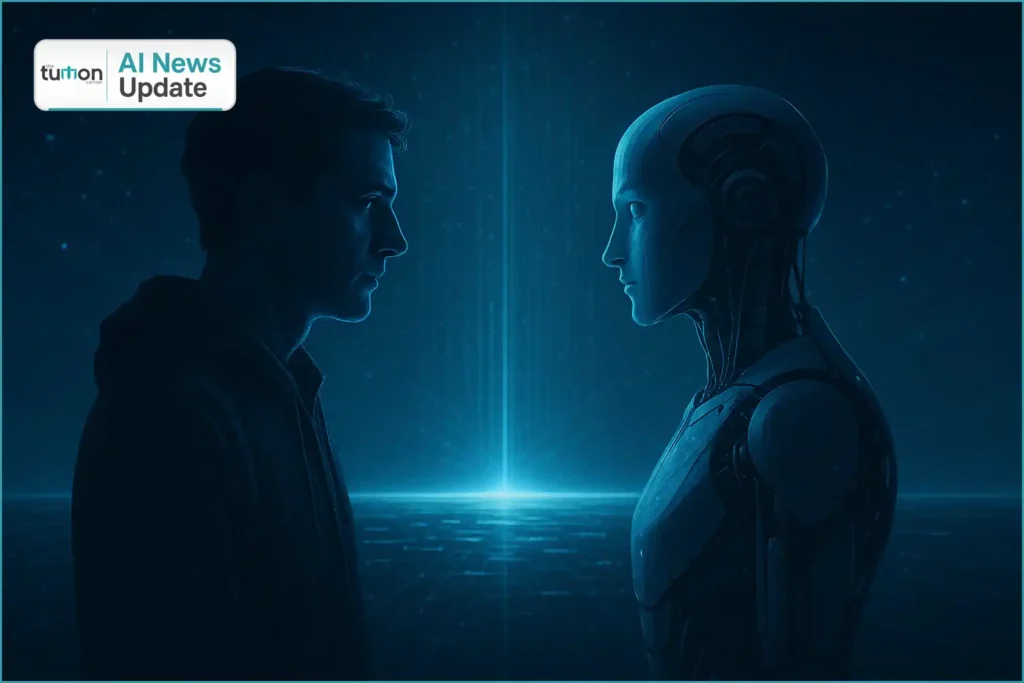
As machines grow more capable, the world faces a deeper question: can intelligence without empathy ever serve humanity?
- AI is reshaping identity, work, and emotion in unprecedented ways.
- Human-centered design and empathy must anchor technological growth.
- Global institutions now treat “digital dignity” as a universal right.
Introduction
In 2025, AI is everywhere — in hospitals and headphones, classrooms and courtrooms. It writes, listens, analyzes, and creates. Yet beneath the awe lies a quiet unease: as we teach machines to think, are we forgetting what it means to feel? The debate about AI and humanity is no longer technical; it’s existential. It asks not whether AI will outsmart us but whether we will outgrow ourselves.
To understand this moment, we must see AI not as an opponent but as a mirror. It reflects our values, biases, and hopes. Every line of code carries a piece of its creator’s soul — and every dataset reveals what a society chooses to remember or forget.
The Mirror of Creation
Since Alan Turing’s question “Can machines think?” we’ve measured AI by its ability to imitate human reasoning. But 2025 marks a new metric: the ability to coexist with human emotion. Our machines can compose symphonies and summarize legal briefs, but their most important task is to remind us of our own humanity.
AI is becoming the mirror in which we see ourselves clearest. When an algorithm judges fairness, we confront our own biases. When a robot offers companionship to the lonely, we question the depth of our empathy. And when an AI teacher explains a concept to a child with infinite patience, we realize how impatient our world has become.
Technology Without Humanity: A Cautionary Path
The danger isn’t that machines will replace us; it’s that we might start behaving like them. Efficiency, optimization, and output — the metrics of machines — have become our new morality. We scroll through emotions like data, measure success in clicks, and outsource compassion to automated messages.
Ethicists warn that without a human core, AI could reduce society to a calculus of utility. The challenge is to rebuild our moral operating system before the technological one surpasses it.
AI as Collaborator, Not Competitor
Optimists argue that AI can enhance our capacity for empathy by freeing us from routine work. Doctors use AI to spend more time with patients, teachers use AI tutors to personalize attention, and artists co-create with algorithms to express emotion in new forms. When designed responsibly, AI becomes a collaborator that expands our creative range rather than shrinking it.
“AI is not about building a machine that thinks like a human, but a world where humans think more deeply,” notes Yuval Noah Harari.
Digital Dignity and the New Social Contract
Governments worldwide are redefining rights for the AI age. The EU’s AI Act, India’s AI Assurance Mission, and the UN’s Global AI Ethics Compact emphasize “digital dignity.” This principle extends the Universal Declaration of Human Rights into cyberspace, asserting that no individual should be profiled, manipulated, or discriminated against by algorithms.
Digital dignity means being seen by machines as whole persons, not data points. It calls for AI systems that honor privacy and plurality — understanding that a human being is more than the sum of their patterns.
The Ethical Imbalance
Despite progress, an ethical imbalance persists. AI development remains concentrated in a few corporate and geopolitical centers. Voices from the Global South — where AI could deliver the greatest benefit — often go unheard in policy rooms. This creates a new form of digital colonialism where datasets trained on Western cultures define “intelligence” for all of humanity.
“We need a global ethics for a global intelligence,” argues UNESCO Director-General Audrey Azoulay. “Diversity is not a feature — it’s a requirement.”
Education: Reclaiming the Human Core
Education stands at the front line of the AI-humanity debate. The future curriculum is as much about ethics as engineering. Students are learning critical AI literacy — not just how to use AI, but how to question it. Courses blend philosophy, psychology, and data science to teach the values of curiosity and compassion alongside code.
UNESCO’s AI in Education Coalition and India’s AI for Youth program now train millions to build responsible innovation mindsets. The goal is clear: educate citizens who see AI as a co-learner in the human story.
The Moral Algorithm: Embedding Ethics in Code
Researchers are experimenting with “moral algorithms” — models that weigh ethical trade-offs alongside accuracy. Projects at MIT and Stanford simulate ethical dilemmas to teach AI systems context sensitivity. In India, IIIT Hyderabad’s Responsible AI Center studies how machine learning can be tuned for fairness across languages and communities.
But true ethics in AI is a human process. Transparency, accountability, and empathy must be embedded in team culture long before code is written. The machines may learn rules — but only humans can choose what’s right.
Faith, Philosophy, and the Search for Meaning
Beyond policy and productivity lies a spiritual dimension. Religious leaders and philosophers are joining the AI conversation, arguing that technology must serve the soul as well as the system. The Vatican’s Rome Call for AI Ethics and India’s Interfaith AI Dialogue both emphasize compassion and humility as universal values in innovation.
Philosophically, AI forces us to reconsider what it means to be human. If a machine can mimic love or creativity, then human worth must rest not on what we produce, but on how we relate.
Challenges & Ethical Concerns
AI ethics faces contradictions: privacy vs progress, autonomy vs automation, freedom vs fear. The most urgent issues include deepfake manipulation, algorithmic bias, and mental dependency on AI companions. As AI enters our emotional lives, regulation must balance innovation with mental wellbeing.
“The AI revolution is not a technological war — it’s a moral awakening,” writes Dr. Fei-Fei Li. “The machines are learning faster than we are teaching them values.”
Future Outlook (3–5 Years)
- Ethical AI Accords: International treaties will define AI ethics as binding law.
- Emotional Interfaces: Next-gen AI will sense tone and empathy to enable healthier interactions.
- Human Certification: Professionals working with AI may require ethical licensing like medical doctors.
Conclusion
AI is not our enemy — it’s our examiner. It asks whether we can build a future where machines extend our humanity instead of exploiting it. The balance between intelligence and soul will define the civilizations of the 21st century.
In the end, our greatest responsibility is not to teach machines to think like us, but to remember to feel like ourselves.
#AI #AIandHumanity #FutureTech #EthicalAI #DigitalDignity #AIForGood #Empathy #TheTuitionCenter