
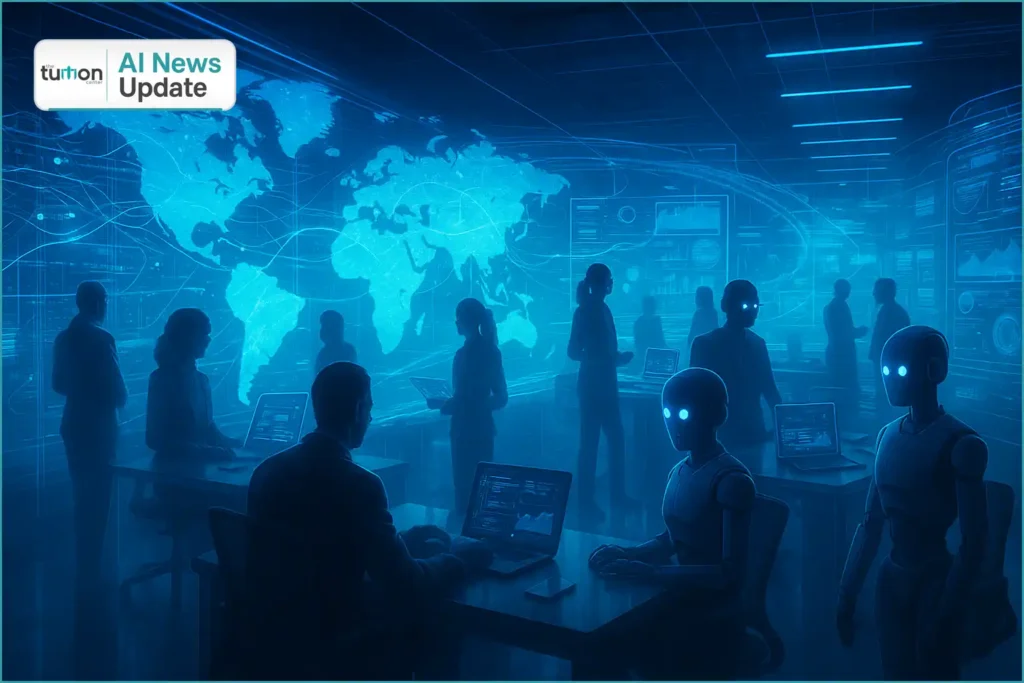
Automation isn’t taking away jobs — it’s transforming them. The next industrial revolution is not about replacing humans, but redefining what it means to work, create, and lead.
- Over 60% of global enterprises now deploy AI copilots in everyday workflows.
- Emerging economies like India are leading the reskilling movement for AI literacy.
- The new “AI economy” values creativity, emotional intelligence, and adaptability above repetitive skillsets.
Introduction
Work, as humanity has known it for centuries, is being rewritten. In factories and offices, classrooms and clinics, a silent revolution is unfolding — powered not by machines replacing people, but by algorithms working beside them. Artificial Intelligence is no longer a futuristic abstraction. It has become the invisible partner driving productivity, innovation, and new definitions of value.
The world of 2025 is experiencing what economists call the Great Reshuffle — a massive realignment of skills, industries, and human purpose. Where automation once symbolized fear, augmentation now represents opportunity. The conversation has shifted from survival to synergy.
From Automation to Augmentation
In the 2010s, automation replaced millions of routine jobs. But in the 2020s, AI is enhancing rather than eliminating work. This shift — from task replacement to task reimagination — defines the Augmentation Era. AI tools now support teachers designing lessons, lawyers summarizing cases, and marketers predicting audience behavior.
McKinsey’s 2025 Global Workforce Report reveals that 40% of work activities have partial automation potential, but less than 10% can be fully automated. The remaining 90% require uniquely human judgment, creativity, or empathy — qualities that machines amplify, not replace.
“AI will not take your job. A human using AI will,” says Andrew Ng, founder of Coursera. “The new divide is not between rich and poor, but between those who use AI and those who don’t.”
Key Developments
Three major developments define this new era:
- AI Copilots Everywhere: From Microsoft Copilot to Google Gemini and Anthropic Claude Workbench, AI assistants are integrated into every productivity suite. They draft emails, design presentations, and analyze data — freeing employees for higher-level thinking.
- Reskilling at Scale: Governments and universities are investing in national AI literacy missions. India’s FutureSkills Prime platform alone has trained over 4 million professionals in AI fundamentals and prompt engineering.
- Human-AI Collaboration Frameworks: Organizations now define AI ethics and governance roles, ensuring transparent, explainable, and bias-aware systems.
Economic Impact: The Productivity Paradox
According to PwC’s 2025 AI Index, global GDP could increase by $15.7 trillion by 2030 through AI-driven productivity. Yet, this productivity surge is accompanied by a paradox: while automation boosts efficiency, it can also intensify inequality if access and training lag.
High-income nations reap automation dividends faster, while emerging economies face uneven adoption. However, India, Indonesia, and Nigeria are challenging this pattern by integrating AI into MSMEs and agriculture. Their hybrid economies prove that inclusive AI growth is possible through local innovation and public-private partnerships.
Redefining the Modern Worker
The worker of tomorrow is not a coder but a collaborator — someone who knows how to converse with machines, curate data ethically, and co-create solutions. Skills once considered “soft” — emotional intelligence, storytelling, ethics, adaptability — have become the new hard skills.
HR leaders now rank “AI collaboration literacy” among the top competencies for recruitment. Employees are trained not just to use AI tools but to question them, correct them, and guide them toward creative outcomes.
“Prompt engineering is the new PowerPoint,” remarks Satya Nadella, CEO of Microsoft. “It’s how tomorrow’s professionals will express ideas and design intelligence.”
The Rise of Micro-Entrepreneurs
AI democratization has unleashed a new class of creators — micro-entrepreneurs who use AI to run small global businesses. With minimal capital, individuals create content, apps, and consultancy services powered entirely by generative AI. Platforms like ChatGPT Team, Notion AI, and Synthesia enable one-person media companies to compete with large teams.
This shift parallels the digital revolution of the 2000s but with higher velocity. The global freelance AI economy is projected to reach $1 trillion by 2028, creating decentralized ecosystems of innovation.
India & the Global South: A New Growth Engine
India stands at the epicenter of the AI-driven economic transition. Its young population, English proficiency, and expanding digital infrastructure make it the fastest-growing AI workforce hub. Startups are creating localized AI solutions for healthcare, agriculture, and education, turning social problems into scalable opportunities.
Initiatives like AI for All (NITI Aayog) and IndiaAI Mission have positioned the country as both producer and exporter of responsible AI solutions. The government’s National Strategy for AI 2.0 integrates sustainability and ethics as twin pillars of growth.
Across Africa and Southeast Asia, similar models are emerging — proving that inclusive AI can bridge rather than widen economic divides.
Corporate Transformation: Leadership in the Age of AI
AI has redefined what it means to lead. Traditional hierarchies are giving way to data-informed decision-making and creative experimentation. CEOs now lead “AI-first” organizations that emphasize continuous learning and responsible automation.
Global firms like Unilever, Infosys, and Accenture have adopted AI ethics boards to oversee deployment. Their mantra: “Trust is the new productivity.” Employees are encouraged to question AI decisions, not blindly obey them.
“The companies that will thrive are those where humans feel more valued, not less,” says Arvind Krishna, CEO of IBM. “AI should make organizations more human, not mechanical.”
Sector-Wise Impact
- Education: AI tutors personalize learning paths; teachers focus on mentorship.
- Healthcare: Diagnostic copilots reduce errors and expand rural access.
- Finance: Predictive analytics and fraud detection reshape banking efficiency.
- Manufacturing: Smart factories use digital twins for predictive maintenance.
- Media & Creativity: AI editing and voice generation enable smaller teams to produce global content.
Policy and Regulation
Governments are responding with frameworks to ensure equitable transition. The G20 AI Policy Compact, signed in 2025, calls for ethical automation, digital upskilling funds, and international labor protections. The International Labour Organization (ILO) is drafting global AI workforce standards to prevent exploitative data labeling and ensure algorithmic fairness.
India’s Skill India Digital initiative, in collaboration with global edtech partners, is rolling out micro-credentials in AI ethics and sustainability — turning regulation into reskilling.
Challenges & Ethical Concerns
While AI offers economic acceleration, risks remain: job displacement in low-skill sectors, algorithmic bias in hiring, and wage polarization. There’s also psychological pressure — workers must continuously adapt to evolving tools. “Reskilling fatigue” is real, and mental-health frameworks are needed to support transitions.
Data ownership also raises ethical concerns. As AI systems analyze employee productivity, questions of surveillance and consent grow louder. The future of work must include digital rights as labor rights.
Future Outlook (3–5 Years)
- AI Literacy as Basic Skill: Just as reading became universal after the printing press, AI fluency will become essential by 2030.
- Hybrid Workforces: Humans will manage teams of AI agents performing specialized tasks.
- Purpose-Driven Economies: Companies will measure success not just in profit, but in societal and emotional impact.
Conclusion
The economic future is neither human nor machine — it’s hybrid. The winners of this revolution will not be those who resist automation, but those who humanize it. As AI reshapes markets and mindsets, empathy, ethics, and education remain the ultimate currencies of growth.
We are entering an age where intelligence is abundant, but meaning must still be made. The challenge for business and society alike is to ensure that as machines learn faster, humanity learns deeper.
🔖 Hashtags for Website + Social Media
#AI #FutureOfWork #DigitalTransformation #AIInBusiness #Automation #AIJobs #Innovation #TheTuitionCenter