
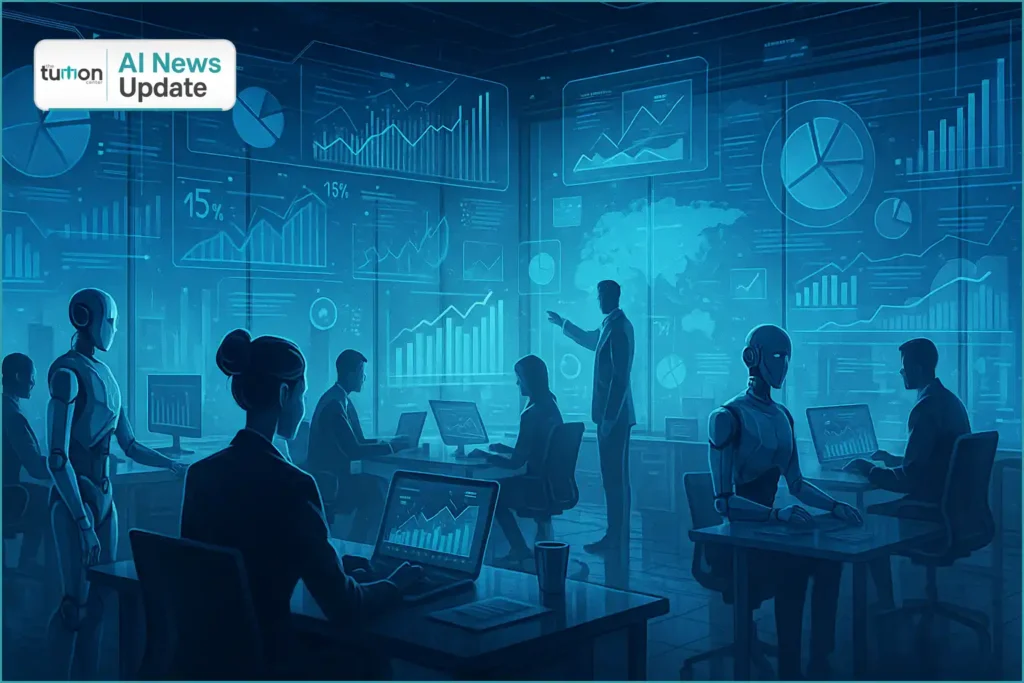
From productivity jumps to job redesign and reskilling mandates — how AI is changing not just what we work on, but who we are as workers.
- Industries most exposed to AI show **3× higher revenue per worker** compared to less exposed sectors.
- Using generative AI, workers report average time-savings of ~5.4% of work hours.
- At the same time, young workers (ages 22-25) in the most AI-exposed occupations experienced employment drop of ~6%.
Introduction
The narrative around artificial intelligence (AI) has long oscillated between two extremes: one of mass job-destruction, the other of boundless job creation. Today, what we’re seeing is subtler, more structural — and potentially more profound. The world of work is not being replaced in one go; rather it is being redefined. For students, educators, professionals and institutions — especially in fast-growing markets like India — this moment matters deeply. It matters for skills, careers, business models, organisational design, and ultimately what “work” will mean in the coming decade.
This article explores how AI is affecting business, jobs and the economy: the gains, the disruptions, the new roles and the critical actions needed. If you’re preparing for the future of work, or leading an institution that educates or employs the future workforce, this story is not optional — it’s essential.
Key Developments
A. Productivity and business value rise in AI-exposed industries. According to PwC’s 2025 Global AI Jobs Barometer, industries that are more deeply exposed to AI show nearly **three times** the revenue growth per employee compared with less-exposed industries. Similarly, using generative AI, the Federal Reserve Bank of St. Louis found workers reported time savings equivalent to a 1.1% increase in aggregate productivity. These signals show that AI is moving beyond pilot stage into real economic value creation.
B. Job exposure and shifting employment patterns. Research finds that while many roles are being augmented, not replaced, the disruption is real — especially for younger workers and those in early career stages. For example, administrative and programmatic tasks that are highly routinised are showing employment decline: a recent study found that workers aged 22-25 in the most “AI-exposed” occupations experienced a ~6% drop in employment. At the same time, the World Economic Forum reports that 40% of employers expect to reduce headcounts where AI can automate tasks.
C. Skills are becoming more important than credentials. In the AI economy, the premium is shifting from degrees to demonstrable skills: adaptability, prompt literacy, data-context skills, human-AI collaboration. Reports find that AI-complementary skills are rising in demand more than substitute skills. For businesses, this means workforce planning is moving fast: hiring is increasingly about “can you partner with AI?” rather than “what traditional role do you fill?”.
D. Redistribution of job tasks, not just job numbers. A key insight is that, so far, what is changing more than sheer employment numbers is the nature of tasks. AI is automating parts of work rather than whole jobs — freeing workers to focus on higher-value, more human tasks. The challenge: workers must upskill and redesign their roles. A report from Goldman Sachs estimates global unemployment might only rise modestly (up to ~0.5 percentage point) during the AI transition — but the disruption to roles, training and careers will be deeper.
Impact on Industries and Society
The shift in business, jobs and economy is already cascading across sectors:
- Technology & services sectors: These are front-line for AI adoption. For example, in high-volume outsourcing markets like India, companies are re-designing workflows to integrate AI. The ripple effects extend to talent, hiring, cost-structures and competitiveness.
- Manufacturing & logistics: AI combined with robotics and IoT is changing assembly lines, supply-chains and quality-control. The cost, speed and precision gains are real — but they require investment in workforce transition, new skill sets and system thinking.
- Education & training industry: Demand for AI-skills, continuous learning and micro-credentials is rising. Institutions need to move from “teach this subject” to “teach adaptability, collaboration with AI, human-plus-machine workflows”.
- Societal and macro-economic implications: Talent mismatches, regional disparities and workforce transitions pose challenges. If large segments of the workforce fail to adapt, risks include wage stagnation, job displacement and economic inequality. On the flip side, countries, regions and firms that adopt early and train well could gain significant competitive advantage.
Expert Insights
“AI holds the potential to shift the way people access and use knowledge … the result will be more efficient and effective problem-solving, enabling innovation that benefits everyone.” — McKinsey & Company
Also, Sam Altman of OpenAI warned that “customer-service jobs will be among the first to go” as AI drives a “historical” rate of job-turnover. These insights remind us: adaptation isn’t optional. Professions will evolve, but only if we choose to evolve with them.
India & Global Angle
For India, where millions of young workers are entering the job-market and the services sector has historically been a major employer, the AI transition presents both opportunity and urgency:
– Indian outsourcing and efficiency-intensive sectors face major redesign. As global clients demand AI-driven services, Indian firms must build AI capabilities and reskill their workforce, or risk losing competitiveness.
– At the same time, India’s demographic dividend means a large population ready to be skilled — but only if education, training and continuous learning frameworks align with AI-economy demands.
– Globally, nations with high AI-adoption and skill-readiness will likely out-perform others. That means countries, companies and educational institutions in India must not just adopt AI tools, but develop the human-AI roles of tomorrow: prompt-ops analysts, AI workflow designers, data-human integrators, ethics-governors, hybrid human-AI supervisors.
In short: the global economy is shifting. For India and the world, success isn’t just in deploying AI — it’s in redesigning work, upgrading skills, rethinking careers and ensuring no one is left behind.
Policy, Research, and Education
This transition requires alignment between business strategy, education policy and research:
- Governments must invest in reskilling and lifelong-learning infrastructure: micro-credentials, vocational training, mobility support for displaced workers.
– Research must focus not only on “which tasks AI automates?” but on “which human-plus-AI roles emerge?”, “what skills matter most?”, “how do we design transition pathways?”.
– Education institutions must pivot: from degree-centric models to skills-centric, from static curricula to dynamic modules (prompt-engineering, human-AI collaboration, data-context fluency). Students must prepare for change, not just “get a job”.
Challenges & Ethical Concerns
The opportunity is real — but so is the risk:
- Uneven impact: Early-career workers and lower-skilled workers face higher disruption. For example, older workers and those in less-exposed roles fared better in recent studies.
- Skills gap and access divide: If only those with resources access reskilling and AI-skills training, inequality may widen. The “AI productivity premium” may accrue only to a select few.
- Job polarisation: As routine tasks decline and high-end roles increase, middling roles may shrink, leading to wage and opportunity compression.
- Transition cost: Even if net employment stays stable, the cost of transition (retraining, job search, displacement) can be high for individuals and societies.
- Ethics & purpose: If work becomes purely “human-monitoring-AI” or “prompt-operator”, there is risk of de-skilling or diminished sense of purpose. The focus must remain on meaningful work, not just task-reallocation.
Future Outlook (3–5 Years)
- Majority of large-scale enterprises will embed AI workflows as standard across functions (HR, operations, customer-service, R&D), not just as pilot projects.
- New job categories will emerge around human-AI orchestration: e.g., AI-Workflow Planner, Prompt-Ops Analyst, Human-in-Loop Supervisor, AI-Ethics Auditor, Hybrid Specialist (domain + AI).
- Education models will shift: micro-credentials, stackable certifications, continuous learning will become the norm; static degrees will lose dominance in fast-moving AI-economy roles.
- Policy frameworks will grow: governments will roll out national AI-skill missions, reskilling mandates, support for displaced workers, and possibly automation taxes or incentives for human-augmented work.
- Work may reshape in time-structure: some organisations may adopt shorter work-weeks (4-day work week) as productivity rises; human roles focus on higher-value, strategic, judgement-oriented tasks rather than volume-driven tasks. (See predictions by Jensen Huang on four-day work week enabled by AI.)
Conclusion
The AI economy is no longer a tomorrow scenario — it’s actively reshaping how businesses operate, how jobs are defined, how skills are valued and how economies grow. For students, professionals, educators and institutions, the central question is no longer *Will AI affect my job?* but *How will I adapt to the new work paradigm?* How will I acquire relevant skills, redesign roles, build resilience, and participate in human-plus-AI systems rather than being sidelined by them?
In India and globally, the time is now to act: build AI literacy, embrace lifelong learning, foster human-AI collaboration, and design work that values human judgement, creativity and purpose. Because the future of work isn’t just about machines — it’s about redefining human contribution for the AI era. The question: will you lead the change or react to it?