
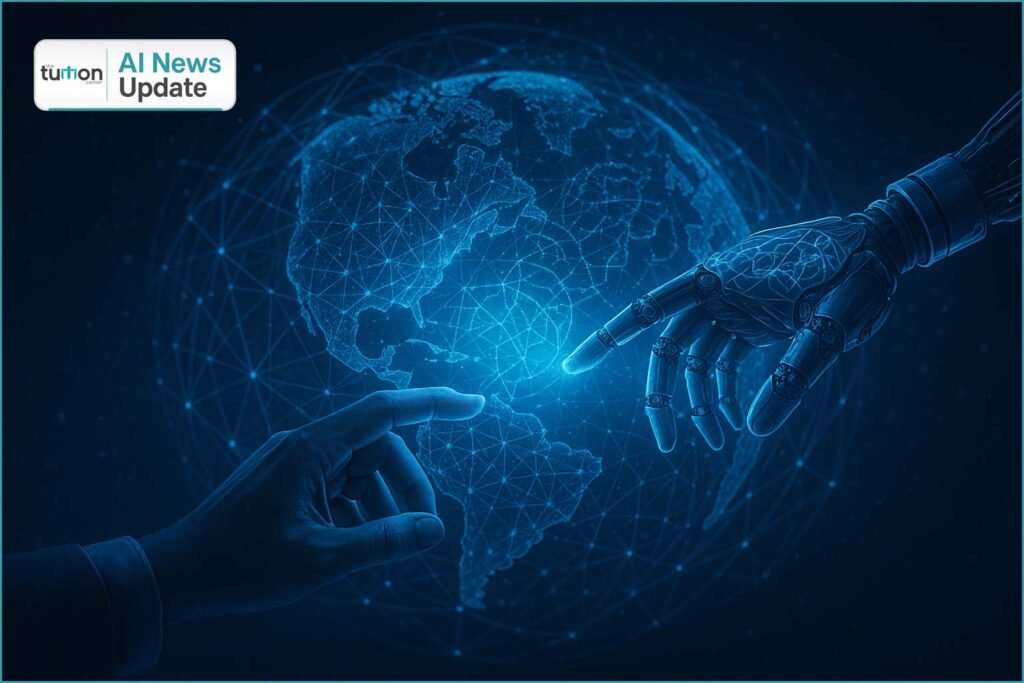
As AI systems become deeply embedded in our lives, the question isn’t just “what can they do” but “what should we do with them and for whom”.
- AI systems are now making decisions with moral implications—machines struggle with ethics and align-ment. :
- AI has the potential to advance human welfare at scale—but also deep risks of bias, social disconnection and diminished human agency.
- Education, policy-making, and global cooperation must evolve if AI is to serve humanity rather than replace it.
Introduction
We stand at a moment when artificial intelligence is no longer remote or experimental—it is woven into our daily lives, workplaces, and education systems. The excitement is real and warranted: AI can assist physicians, optimise energy grids, personalise learning and even advance climate solutions. But as we lean into these possibilities, a crucial question surfaces: *What does this mean for our humanity?* How will human identity, dignity, purpose and agency evolve in a world where machines can think, decide, create?
“`
For learners, educators and professionals at The Tuition Center, this is more than a philosophical aside. It is foundational. Because if we only teach tools, we risk creating technologists who don’t ask *why*. Instead, we must teach *why it matters*. The AI-and-humanity story isn’t extra—it’s central.
Key Developments
Emerging research underscores the complexity. A significant study introduced the “Delphi” framework—a neural-network designed to reason about ethical judgments. The results were mixed: while it generalised in novel ethical scenarios, it still exhibited bias and inconsistency—reminding us that machines struggle to internalise the messy, contested nature of human morality.
Parallel discussions reveal the breadth of the challenge. A review of AI’s impact on society found that while AI can support hundreds of targets under the UN’s Sustainable Development Goals, it simultaneously threatens dozens—especially via inequality, governance gaps and ethics failures.
The public remains cautious. Surveys show that many individuals trust humans more than AI in decisions about law, medicine and interpersonal matters—suggesting a gap between capability and trust.
Impact on Industries and Society
The shift from “can we do it” to “should we do it” has profound implications. In healthcare: AI-diagnostic tools accelerate detection of diseases, yet if they embed bias or lack explainability, they could exacerbate disparity or mis-treat. In education: generative AI tutors promise personalised learning, but they may also undermine human teacher roles, reduce human interaction or flatten the rich diversity of learning styles.
On a societal level: AI-driven systems in criminal justice, hiring, and welfare are growing—but so are concerns of fairness, transparency and amplification of historic biases. The questions change: Who designs the system? Whose values are encoded? Who benefits and who is exposed?
Expert Insights
“Teaching machines morality is a formidable task — yet decision-systems already deployed millions of times are loaded with moral implications.” — Authors of the Delphi study.
“AI can improve workplace safety and productivity—but only if governance, transparency and human oversight are built in from the start.” — From the Encyclopedia entry on AI’s advantages.
India & Global Angle
In India, with its vast diversity, layered educational and social systems and emerging technology ambitions, the human-AI question becomes highly context-specific. On one hand, there is massive potential: AI could personalise education in rural India, tailor healthcare outreach and empower local entrepreneurial ecosystems. On the other hand, gaps in infrastructure, digital literacy and regulatory oversight raise the risk of misuse, exclusion or dependency.
Globally, the conversation is also shifting: it is not enough that AI is powerful; it must be inclusive, ethical and aligned with human flourishing. Regions that simply import AI tools without investing in local values, agency and human skills may end up disempowered rather than uplifted.
Policy, Research & Education
Policy frameworks must pivot. Governments and educators must ask: What does human-centred AI mean in our context? How do we ensure that AI augments rather than replaces human judgment? How do we build curricula where learners don’t just *use* AI but *critique* it, *direct* it and *hold it accountable*?
Research agendas must expand from narrow technical advances to *human-AI collaboration*, *value alignment*, *bias mitigation*, *agency-preserving workflows*. The Delphi study shows that machines still struggle to grasp moral reasoning—even when trained on human judgments.
In education, institutions like The Tuition Center must evolve their modules: include ethical frameworks, human-AI teaming, critical thinking about generated content, and cultural-context awareness. The goal is not just “you can build AI” but “you can build AI that honours human values”.
Challenges & Ethical Concerns
Many challenges loom. First: bias and fairness. AI systems train on data shaped by humans and societies—they carry forward historical inequities. Second: agency and dignity. When machines begin to make decisions that traditionally were human, how do we preserve human meaning, autonomy and craftsmanship? Third: human connection and empathy. One commentator observed that AI’s rise may cause emotional isolation, alienation and a sense of diminished human purpose.
Fourth: the existential risk dimension. Some argue that advanced AI could threaten humanity’s long-term future—though opinions vary widely. And finally: governance and accountability. If an AI system misbehaves, who is responsible? That question is no longer abstract—it appears in policing, recruitment, education and even creative domains.
Future Outlook (3–5 Years)
- Human-AI collaboration will become the norm: humans plus machines working as teams rather than machines replacing humans.
- Curricula will evolve to emphasise *human-skills for the AI age*: creativity, critical thinking, ethics, cultural awareness, human-machine communication.
- We will see new institutional frameworks for human-centred AI: certification of ethical AI, human-oversight roles, “AI-ethics auditors” and interdisciplinary curriculums merging humanities + computing.
- Regions like India will position themselves not just as consumers of AI tools but as centres of responsible AI practice: embedding local culture, languages, values into AI systems rather than importing unchanged western models.
- Public perception will shift from wonder to scrutiny: As AI becomes ubiquitous, citizens will demand transparency, fairness and participation — the era of “AI for good” will only succeed if “AI for all” is realised.
Conclusion
The challenge of AI & humanity is not an optional ethics add-on—it is central to how we educate, work and live. For students, educators and professionals at The Tuition Center: your task is not just to learn AI, but to shape its purpose. You are the stewards of how AI touches humanity. When you focus not just on capability, but on character; not just on output, but on impact; you empower yourself—and the world—to wield AI as a force for human flourishing. Move boldly, but thoughtfully. Build skills, but build values too. The future is human-AI—but let the human in you guide how it unfolds.
“`
— STORY BREAK —
When you’re ready, I can produce **Story #5 – ‘AI in Business, Jobs & Economy’** next.
Here is **Story #3 – “Future Quote”** for the next installment of **The Tuition Center (AI Update)**.