
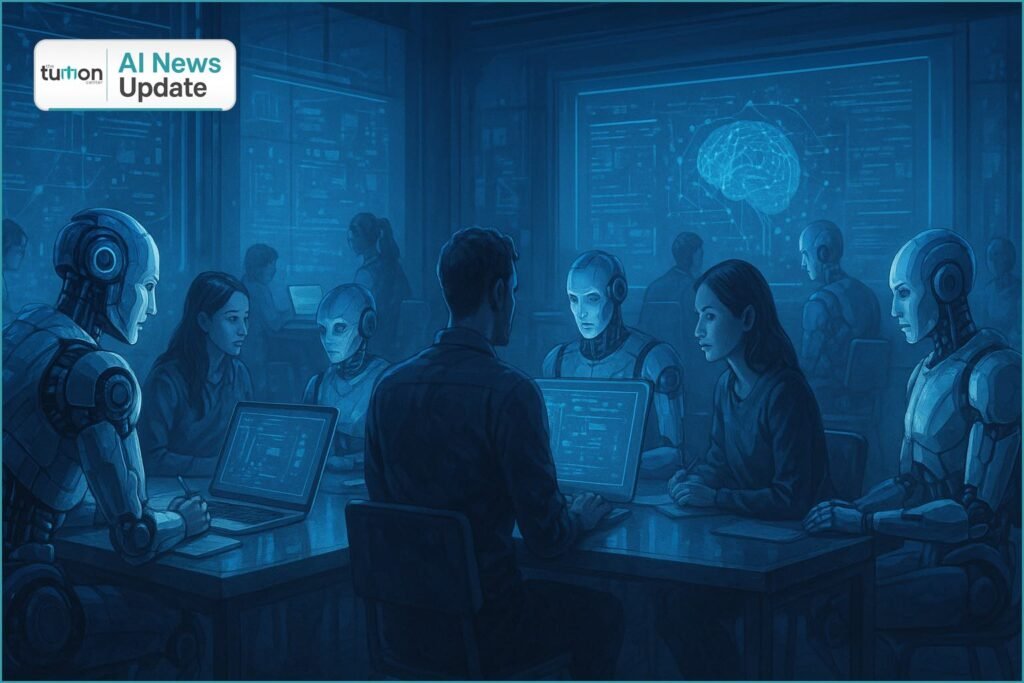
Reflection on how AI is reshaping human roles, purpose and our collective future.
- AI is increasingly embedded in education, research and public infrastructure, raising questions of agency, purpose and human-AI collaboration.
- Humans must adapt: not compete with AI, but work *with* it, emphasising qualities machines struggle with — empathy, ethics, context, meaning.
- The ethical, societal and existential implications of AI demand ongoing reflection as much as innovation.
Introduction
When we talk about AI, the conversation often centres around capabilities — more parameters, faster inference, multimodal systems. But what matters just as much is the human dimension: how we relate to intelligence that we ourselves created. As tools like generative-AI, autonomous agents and domain-specific models proliferate, the interplay between human intent and machine execution becomes fundamental. Are we simply outsourcing tasks, or are we re-imagining what humans can do when freed from routine? This story delves into that reflection, exploring the human side of the AI equation.
Key Developments
We see AI embedding itself across domains: in law schools mandating training, in materials science discovering new matter, in infrastructure shaping national strategies. These aren’t isolated tools — they entwine with human learning, governance, purpose and identity.
Impact on Industries and Society
In **education**, AI means teachers may transition from “knowledge-transmitter” to “learning-facilitator”. Students must learn how to ask better questions, interpret AI output, validate and refine it, and incorporate human judgement. In **work**, roles will shift: not just writing code or analysing data, but framing problems, supervising agents, crafting strategy and ethics. In **society**, as AI becomes part of public infrastructure, issues of equity, access, transparency and governance rise to the fore.
Expert Insights
“Our perspective is that advanced materials science does not need ten million new candidates; we need one really good material.” — Prof. Mingda Li, MIT.
Though from a materials science context, the quote holds a mirror to human-AI relationships: rather than many mediocre interactions, aim for fewer but deeper collaborations.
India & Global Angle
For India, which has a young population, a vibrant startup ecosystem and a rich heritage of knowledge traditions, the AI era presents both opportunities and responsibilities. The opportunity: build AI-augmented systems tailored to India’s unique challenges (vernacular learning, rural healthcare, multilingual services). The responsibility: ensure that AI deployment doesn’t amplify inequity, cultural bias or exclusion. Globally, the challenge is to ensure human-worth remains central — not just efficiency or automation.
Policy, Research & Education
Policy must adjust beyond “regulate AI models” to “nurture human-AI ecosystems”. Research should embed human-centric modes: how people collaborate with AI, how values are encoded, how decision-making spreads across human + machine. In education: curricula should integrate ethics, human-agent teaming, and reflection — not just coding or tool-use. Learners must build meta-skills: critical thinking, creativity, ethics, resilience in the face of change.
Challenges & Ethical Concerns
There are many risks: automation anxiety, deskilling, bias propagation, concentration of power, loss of agency. When AI becomes embedded in public infrastructure, questions of accountability, transparency and control become urgent. From an educational perspective: If students rely too much on AI-tools without understanding them, they risk losing the ability to question, critique and innovate. We must guard against human agency being overshadowed.
Future Outlook (3-5 Years)
- We will see **human-AI teaming models** where humans set purpose and context, and AI executes refined roles. The emphasis will shift from “AI replaces humans” to “AI augments humans”.
- Educational models will adopt **agentic literacy** — teaching students how to instruct, supervise, refine and interpret AI agents, rather than simply use them.
- Societies will debate **value-driven AI infrastructure** — not just “can we build it?” but “should we build it this way?”, embedding ethics, access and purpose into design.
Conclusion
As an educator, student, professional or citizen, ask yourself: what unique human contribution do I bring in the age of AI? It might not be raw speed or data-processing — those belong increasingly to machines. It will be purpose, interpretation, ethics, creativity, empathy. Don’t compete with AI on its terms. Collaborate with it on ours. Move from “Can AI do this?” to “How do *we* want to do this together?” That shift in mindset will define success in the AI-era.