
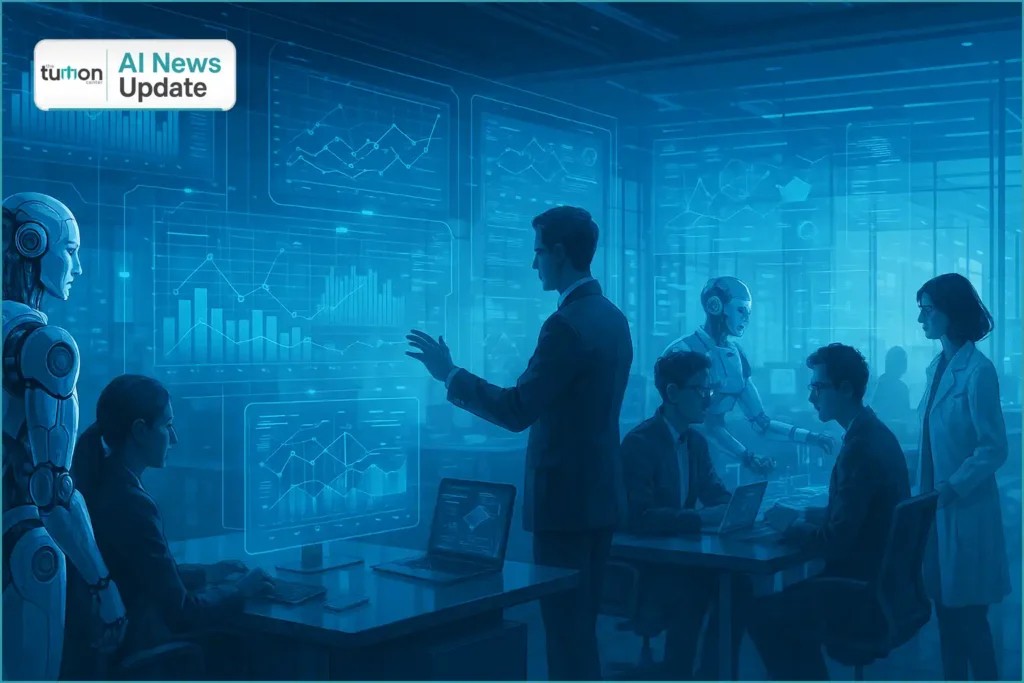
Artificial Intelligence is no longer replacing jobs — it’s redefining them. The future of work belongs to those who can collaborate with machines, not compete against them.
- Global AI adoption in enterprises surpasses 65% in 2025.
- Generative AI tools boost productivity by up to 40% across creative, legal, and data sectors.
- Reskilling becomes the most valuable investment of the decade.
Introduction
The 21st century workplace is transforming faster than any industrial revolution before it. Artificial Intelligence — once a futuristic concept — now sits at the heart of decision-making, creativity, and innovation. But unlike the automation fears of the past, today’s shift isn’t about replacement; it’s about *augmentation.* AI is evolving from a tool to a teammate, enabling humans to focus on what machines cannot: empathy, judgment, imagination, and moral reasoning.
Across boardrooms, classrooms, and startups, one truth is becoming clear: **AI is not taking jobs; it’s changing them.** The future workforce will be built not on competition between man and machine, but on collaboration — a partnership that enhances both productivity and purpose.
The Great Transition
According to McKinsey’s 2025 Global Workforce Report, more than **40% of all tasks** in administrative, legal, and design industries are now influenced by AI systems. Yet employment rates in high-skill creative and strategic fields continue to grow. Why? Because automation removes the mundane, leaving humans to do what only they can — think critically, communicate meaningfully, and create authentically.
Companies from Google to Accenture are reclassifying job roles to reflect this shift. “Prompt engineers,” “AI ethicists,” “data storytellers,” and “automation architects” are now mainstream titles. These roles blend technical literacy with human insight — a combination that defines the modern professional.
AI and the Business Mindset
AI’s impact on business isn’t limited to automation — it’s strategic. From predictive analytics to generative creativity, AI now drives decision-making at every level. In marketing, it designs campaigns. In finance, it forecasts risk. In supply chains, it predicts disruptions. The result? Businesses are becoming more *proactive* and less reactive.
However, the companies that truly thrive are those that see AI not as a cost-saving mechanism, but as a *growth partner.* They use AI to unlock new products, business models, and ecosystems. In 2025, 70% of Fortune 500 firms report higher profitability after integrating AI-driven strategies that emphasize human creativity at the core.
The Skill Revolution
AI has changed the definition of literacy. Knowing how to read, write, and code are no longer enough; now we must know how to **collaborate with algorithms.** This means mastering soft and hard skills simultaneously — empathy, adaptability, design thinking, and data reasoning.
Reskilling programs are booming. Platforms like Coursera, edX, and Google’s Skill Boost report record enrollments in “AI for Everyone” and “Prompt Engineering.” Governments and corporations alike are investing in *lifelong learning ecosystems.* In Singapore and the EU, state-backed funds now reimburse citizens for AI upskilling courses — recognizing learning as economic infrastructure.
Entrepreneurship in the AI Era
The barriers to entrepreneurship have never been lower. AI automates market research, branding, customer support, and even legal documentation. Startups that once needed teams of 20 now thrive with five. Founders no longer ask, “Can we afford this?” but rather, “Can we automate this?”
Generative AI tools like ChatGPT, Claude, and Jasper write proposals and investor decks; Runway and Synthesia create promo videos; ElevenLabs generates voiceovers; and Notion AI organizes workflows. The result: creativity has been democratized. The new entrepreneurial edge lies not in access to capital, but in access to curiosity.
Economics of Augmentation
AI-driven productivity gains are fueling a new economic cycle. According to PwC’s 2025 AI Impact Report, global GDP could rise by **$15.7 trillion** by 2030 due to AI adoption. The biggest beneficiaries? Industries that combine human empathy with machine precision — healthcare, education, design, and customer experience.
At the same time, AI is transforming global trade. Nations rich in data, compute, and innovation ecosystems are emerging as new economic superpowers. The “digital divide” is no longer about internet access — it’s about *AI fluency.* Economies that train citizens to think alongside machines will lead the next century.
Expert Insights
“The future employee is not human or machine — it’s human + machine. The partnership will define prosperity.” — Satya Nadella, CEO, Microsoft
“Automation doesn’t eliminate work; it eliminates dullness. The jobs left behind are more meaningful.” — Dr. Erik Brynjolfsson, Stanford Digital Economy Lab
“AI literacy is the new economic currency. The countries investing in it today will own the intellectual capital of tomorrow.” — Kristalina Georgieva, IMF Managing Director
AI and Human Purpose
While the economic metrics are impressive, the deeper question remains: what does this mean for human purpose? As machines take over repetitive functions, humanity gains time — our most precious resource. The challenge is how we use it. Will we fill it with creativity, community, and learning, or lose it to distraction?
The true potential of AI lies in enabling a *renaissance of meaning.* Freed from mechanical tasks, professionals can focus on empathy, mentorship, innovation, and ethics. A doctor can spend more time comforting patients; a teacher can spend more time inspiring students; a designer can spend more time imagining worlds, not wireframes. AI gives back time — it’s up to us to use it wisely.
Policy and Responsibility
Governments worldwide are waking up to this transformation. The EU’s “AI Act” mandates transparency in automated decisions. The U.S. National AI Strategy emphasizes ethical deployment and workforce retraining. And global alliances, from the OECD to the UN, are pushing for “human-centric AI economies.”
But policy alone can’t drive change. The private sector must champion ethical employment, transparent AI adoption, and continuous upskilling. The companies of the future will be those that measure success not just by revenue, but by *resilience* — their ability to evolve responsibly alongside technology.
Future Outlook (3–5 Years)
- Augmented Workplaces: AI assistants become standard collaborators in creative, financial, and legal professions.
- Universal Reskilling Programs: Governments and corporations integrate lifelong learning as part of employment contracts.
- AI-Powered Startups: 80% of new ventures use at least one generative AI tool as a core business function.
- Purpose-Driven Economies: Success metrics shift from profit to impact, well-being, and sustainability.
Conclusion
The rise of AI in business is not the end of human work — it’s the evolution of it. We are entering an era where every job will be an *AI job*, not because machines will do it for us, but because machines will do it *with* us. The winners of this era will not be the fastest coders or the richest corporations, but the most adaptable learners — those who combine curiosity with courage, and intelligence with empathy.
In the age of AI, humans are not obsolete; we are irreplaceable. The real revolution isn’t automation — it’s amplification. And the future of work belongs to those who understand that partnership, not perfection, is the new productivity.