
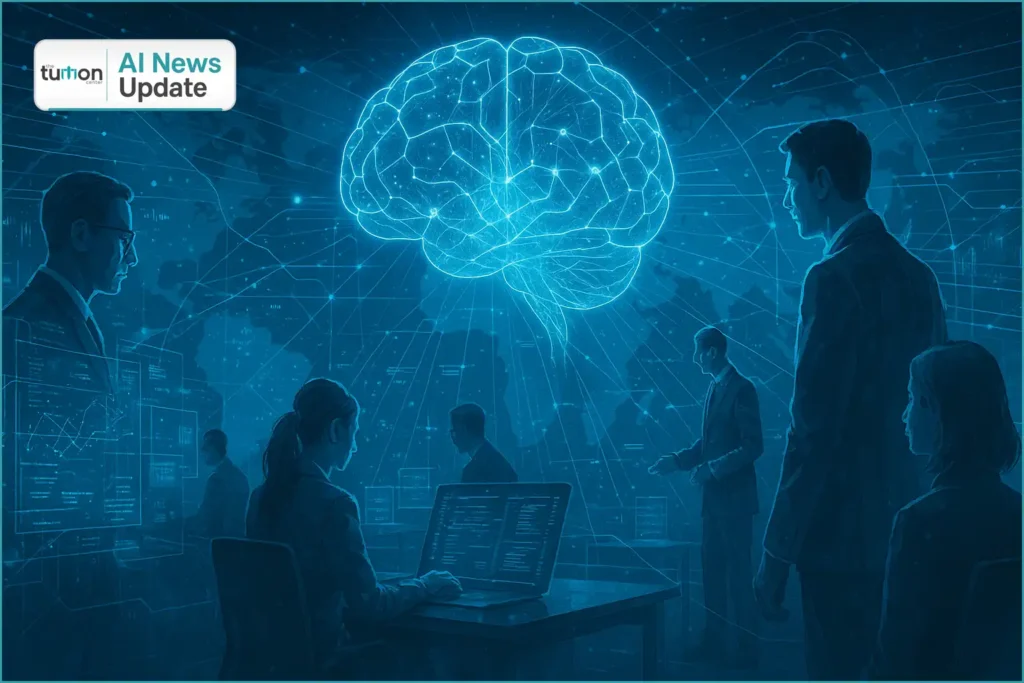
“The mission of AI is not to replace humans, but to understand and empower the human mind.” — Dr. Fei-Fei Li
- Dr. Fei-Fei Li’s Stanford AI Lab continues to shape AI ethics and education worldwide.
- Her quote inspires global dialogue on responsible AI and human-centric design.
- India adopts similar approaches in AI literacy and youth empowerment initiatives.
Introduction
Every era produces a sentence that captures its soul. For the age of Artificial Intelligence, Dr. Fei-Fei Li’s words may be that sentence: “The mission of AI is not to replace humans, but to understand and empower the human mind.” At a time when machines generate art, analyze genomes, and drive cars, her vision anchors the conversation back to empathy, education, and ethics.
Dr. Li, co-director of the Stanford Human-Centered AI Institute (HAI), has spent two decades advancing the idea that AI must be a mirror of our values, not a shadow of our fears. Her quote has appeared in policy papers, TED talks, and LinkedIn posts worldwide. But what does it mean in practice — and how are nations, startups, and students translating it into action?
The Origin of a Vision
Back in 2017, Dr. Li launched ImageNet, a dataset that revolutionized computer vision by teaching machines to see. Yet even as she drove that technical frontier, she warned that AI’s greatest risk was not failure but success without reflection. Her “Human-Centered AI” framework emerged as a response to the runaway automation narrative that dominated Silicon Valley.
Today, her future quote is studied in AI ethics courses alongside Asimov’s laws and Alan Turing’s test. It challenges engineers to ask not just “What can AI do?” but “What should AI do?”
Key Developments Inspired by the Quote
Since 2023, Stanford HAI has funded over 100 research projects exploring how AI can enhance mental health, education, and social equity. Among them is the Empathic Machine Project, a collaboration with Google Research that uses multimodal emotion recognition to support therapy and elder care.
In India, the AI4Youth and AI for All 2.0 programs echo this philosophy by training students to apply AI ethically in real communities. Globally, UNESCO’s “AI and the Rights of the Child” initiative draws on Li’s human-centered approach to ensure that AI for education remains inclusive and safe.
Amplifying Human Potential
Dr. Li’s vision centers on amplification, not automation. She believes that the future belongs to “cognitive partnerships” — humans and AI systems co-creating solutions that neither could achieve alone. Examples are everywhere: a teacher in Kenya using AI translation to teach multilingual classes; a doctor in Delhi deploying AI diagnostics to serve rural patients; artists using generative models to visualize ancestral stories.
By 2025, AI-assisted tools are expected to add nearly $7 trillion to the global GDP, according to PwC, but Dr. Li reminds us that true wealth is measured in human flourishing, not just market value. Her phrase “understand and empower the human mind” demands education systems that teach critical thinking and digital ethics as core competencies.
Impact on Industries and Society
In healthcare, human-centric AI means personalized care without de-personalizing the patient. In education, it means adaptive learning that respects each student’s pace. In governance, it translates to transparent algorithms that citizens can question. Businesses are shifting from “AI-first” to “human-first with AI assist.”
Societal benefits are visible in unexpected places. NGOs use AI to track deforestation and child nutrition; musicians use AI to revive endangered languages. Each application embodies Li’s message: technology should enhance our humanity, not erode it.
Expert Insights
“Fei-Fei Li’s framework changed how we teach AI. It moves students from coding to caring.” — Prof. Raghav Menon, IIT Madras
“When AI understands empathy, it stops being artificial and starts being intelligent.” — Dr. Sofia Klein, Cognitive Scientist, ETH Zurich
India and Global Angle
India’s education reforms increasingly mirror Li’s philosophy. NEP 2020 mandates AI literacy that balances skills with ethics. The AI Task Force under NITI Aayog recommends curricula that include “Human-Centered Design.” Meanwhile, Stanford HAI collaborates with IISc and IIIT-Hyderabad to develop AI curricula for social impact projects in agriculture and health.
Globally, the World Bank funds AI-for-Humanity accelerators in Latin America and Africa, training youth leaders to solve local challenges through data and design. The echo of Li’s words is now a chorus across continents.
Policy, Research and Education
Dr. Li advises both the U.S. White House and the U.N. on ethical AI guidelines. Her research influenced the “Blueprint for an AI Bill of Rights.” She champions policies that require algorithmic transparency and diverse datasets to combat bias. Her educational vision encourages students to see AI as a partner in problem-solving, not a shortcut to answers.
Many universities now run joint courses between computer science and philosophy departments — a trend Dr. Li predicted years ago. AI ethics is becoming as mainstream as data structures.
Challenges and Ethical Concerns
Fei-Fei Li’s vision faces the same challenges it seeks to solve. Bias, privacy breaches, and job displacement remain stubborn realities. Critics argue that “human-centric AI” can become a marketing phrase unless accompanied by accountability. To that end, her lab is developing open metrics to quantify human benefit in AI projects — a “well-being index” for algorithms.
Another concern is cultural diversity. Most AI ethics frameworks still reflect Western values. Dr. Li calls for a “global ethics federation” where each region defines its own context of human dignity. This pluralism, she says, is the only way AI can serve all humanity.
Future Outlook (3–5 Years)
- Ethical AI as Standard Curriculum: All major universities embed human-centric AI principles in tech education.
- AI Well-Being Indices: Governments adopt metrics to measure social impact of AI deployment.
- Cross-Cultural AI Ethics Boards: Global alliances create localized codes of conduct.
- Empathy Engines: AI systems trained to detect and respond to human emotion ethically.
- Education Reform: AI literacy moves from computer labs to every classroom subject.
Conclusion
Dr. Fei-Fei Li’s “Future Quote” is more than inspiration — it is instruction. It reminds the world that our algorithms reflect our intentions, and that progress without purpose is just motion. As students learn to code and leaders learn to regulate, this vision offers a moral north star: build AI that understands us so that we may better understand ourselves.