
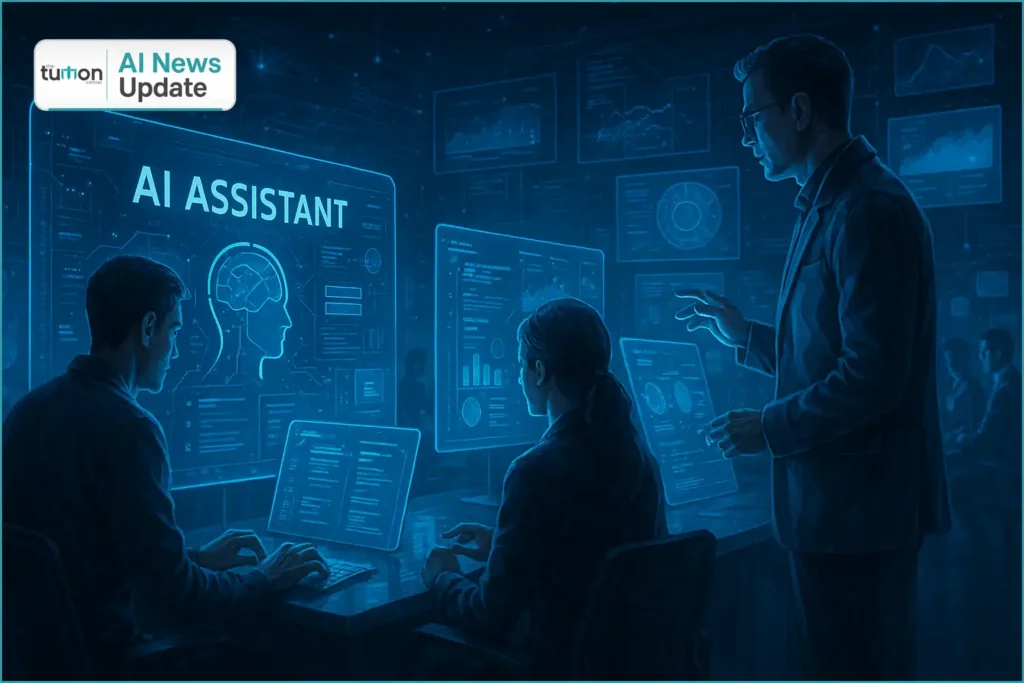
As artificial intelligence matures, the question is no longer whether it can think — but whether we can evolve alongside it with wisdom and empathy.
- AI models now match or exceed human performance in key reasoning tasks.
- Debates intensify over whether AI will coexist with or coevolve beyond human cognition.
- Thought leaders emphasize values, empathy, and education as the new frontiers of intelligence.
Introduction
Every technological revolution tests the boundaries of what it means to be human. Steam engines tested our strength. Electricity tested our reach. The internet tested our connectedness. And now, Artificial Intelligence is testing our consciousness. As AI systems learn, reason, and even emote, society faces a philosophical fork: should we strive for coexistence — peaceful parallel growth — or for coevolution, where humanity and AI merge in symbiotic progress?
This debate is no longer theoretical. In hospitals, AI assists in diagnosing diseases faster than doctors; in classrooms, it personalizes learning better than traditional systems; in art studios, it collaborates with creators to paint visions never before imagined. The line between tool and teammate blurs daily. The question, therefore, is not whether AI will change humanity, but whether humanity can change enough to live with AI.
From Automation to Augmentation
AI began as a promise of automation — to handle repetitive tasks and free humans for higher pursuits. But in 2025, the narrative has shifted. AI is no longer just automating work; it is augmenting thought. It is a co-thinker, a co-writer, a co-researcher. Systems like GPT-5, Gemini, and Claude 3.5 don’t merely follow commands; they participate in dialogue, generating ideas that surprise even their creators.
This shift mirrors humanity’s own evolutionary history. Our species has always thrived by extending intelligence beyond biology — through language, writing, printing, and computing. AI is simply the next extension, an exoskeleton for the mind. The challenge is to wield it wisely, lest the tool becomes the teacher before we learn humility.
The Emotional Equation
What distinguishes human intelligence is not logic but emotion. We love, fear, hope, and regret — traits that color our decisions in ways algorithms cannot easily emulate. Yet the frontier of affective computing is closing this gap. Emotional AI now reads micro-expressions, tone, and sentiment with unsettling precision. Customer service bots can detect frustration; virtual teachers can sense confusion; mental health assistants can offer comfort.
Is this empathy or simulation? Philosopher Joanna Bryson argues that AI may never truly “feel,” but it can model emotional intelligence well enough to support humans in distress. Others, like Ray Kurzweil, predict eventual convergence — synthetic empathy so refined it becomes indistinguishable from the real. In either case, emotion has become a design principle, not an afterthought.
Society at the Crossroads
Society’s response to AI reflects its moral maturity. Some nations embrace automation with optimism; others fear displacement and control. The same algorithm that writes poetry can also write propaganda. The same vision model that spots tumors can also power surveillance drones. Our collective choices determine which side of history AI will stand on.
Economists warn that without ethical foresight, inequality could widen. The top one percent may command AI’s productivity gains while others lose agency. But optimists point to new professions emerging: AI ethicists, prompt engineers, neuro-symbolic designers, and cognitive UX experts. In the long arc of progress, each industrial disruption has produced more creative opportunity than destruction. The key is reskilling at human speed for a machine-paced world.
India and the Global Movement
India sits at a fascinating intersection of scale, skill, and spirituality. With over a million engineers entering the workforce annually, the nation’s approach to AI is deeply humanistic. Initiatives like “AI for All 2.0” and “Responsible AI for Youth” focus not only on coding but on compassion. Students are taught to view AI as seva — service to society. In Kerala, AI literacy programs teach rural women to use chatbots for micro-entrepreneurship. In Gurugram, startups build ethical data annotation models employing marginalized communities.
Globally, similar movements are taking shape. Japan’s “Society 5.0” vision imagines AI as a social collaborator, not a competitor. In Europe, the AI Act enshrines dignity and transparency as legal obligations. Africa’s “Ubuntu AI” philosophy, rooted in the belief that “I am because we are,” reframes data not as property but as shared knowledge. The future of humanity with AI may not be a uniform path, but a mosaic of moral traditions.
Expert Insights
“The next great leap is not artificial intelligence but augmented humanity — the fusion of logic with love.” — Dr. Ananya Sharma, Cognitive Scientist, IISc Bengaluru
“If AI ever surpasses us in capability, it must still look up to us for purpose.” — Prof. Daniel Kahane, Oxford Centre for Ethics
Education – The Bridge of Understanding
Education is where coexistence becomes coevolution. Around the world, schools are reinventing curricula to blend human values with machine literacy. Finland introduced “AI Civics,” teaching children to debate ethical dilemmas generated by chatbots. India’s CBSE board has introduced modules on prompt engineering, AI safety, and digital empathy. Stanford’s Human-Centered AI Institute co-develops lesson plans with UNESCO to help teachers balance technology and tenderness in classrooms.
AI tutors now guide millions of learners through personalized journeys, adapting to learning styles while tracking cognitive load. Yet the best outcomes occur when human teachers use AI as a co-educator, not a substitute. In blended classrooms, students report higher engagement and empathy — a reminder that AI is at its best when it disappears into human experience.
Ethics, Trust, and the Soul of Technology
As AI encroaches on decisions once deemed moral or spiritual, questions of trust intensify. Should AI be allowed to judge court cases? Should it counsel patients or write news? Can a system that lacks mortality truly comprehend human suffering? Philosophers liken AI to a mirror — it reflects our ethics back at us. If we train it on bias, it amplifies bias. If we train it on compassion, it amplifies care. The moral burden lies not in the machine, but in its maker.
Dr. Fei-Fei Li often says, “AI is a reflection of humanity, not its replacement.” This view anchors the growing consensus that technology design must begin with social intention. Frameworks such as UNESCO’s “Ethics of AI” and India’s “Digital Nagrik” charter emphasize transparency, inclusivity, and accountability as civic duties of the digital era.
Challenges and Contradictions
Coexistence is easier preached than practiced. AI’s rapid evolution outpaces both policy and psychology. Workers fear redundancy, artists fear imitation, and policymakers fear misuse. The contradiction lies in wanting AI’s benefits without confronting its implications. As philosopher Yuval Noah Harari notes, “Once intelligence decouples from consciousness, the human story will never be the same.”
We stand at that precipice today. Yet within uncertainty lies opportunity — to redefine intelligence not as dominance, but as dialogue. The world doesn’t need a human-like AI; it needs a humanity that is more humane.
Future Outlook (3–5 Years)
- Human-AI Symbiosis: Professionals across fields learn to work in real-time tandem with AI co-agents.
- Ethical Governance: Nations adopt “AI Constitution” frameworks to align innovation with human rights.
- Neural Co-learning: Brain–computer interfaces and AI tutors accelerate cognitive rehabilitation and education.
- AI Mindfulness Movement: Global initiatives blend meditation with digital detox to balance emotional well-being.
- Artistic Co-creation: AI becomes a muse in literature, music, and cinema, expanding creative possibility.
Conclusion
AI and humanity are not in competition; they are in conversation. Whether we coexist or coevolve depends on our courage to see technology as a partner in purpose, not a rival in power. The more we teach machines about empathy, fairness, and curiosity, the more we will rediscover those virtues within ourselves. The era ahead will not be defined by artificial intelligence — but by amplified humanity.