
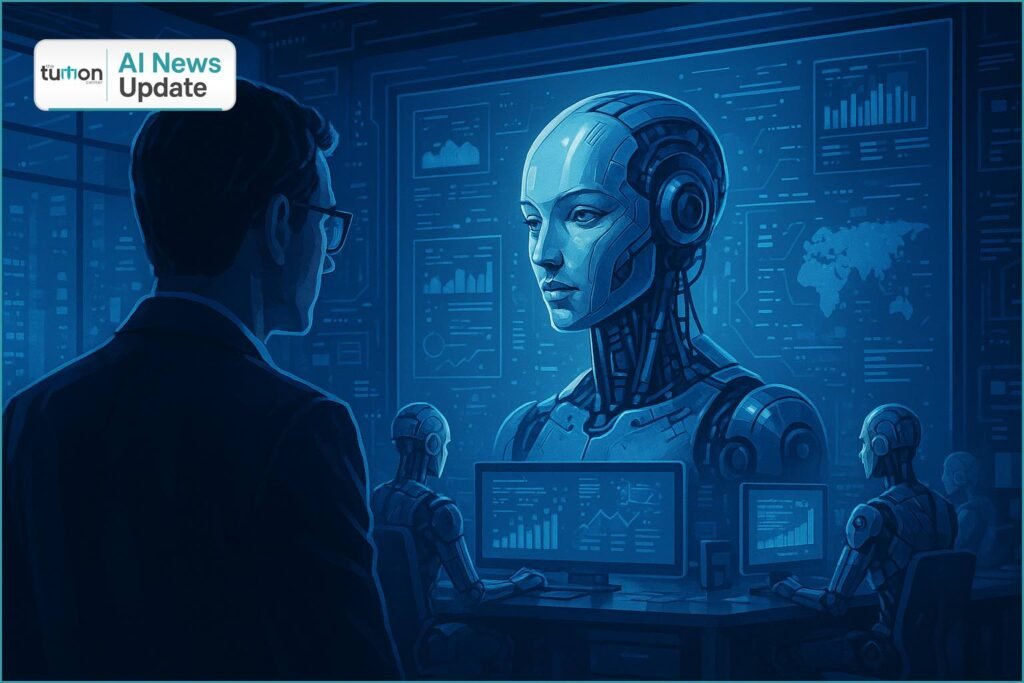
FlowMind AI isn’t just another chatbot — it’s a multimodal companion that listens, visualizes, and learns alongside you. Designed for creators, educators, and entrepreneurs, it represents the next step in AI-human collaboration.
- Launch Year: 2025 – Built by an ex-Google DeepMind and Anthropic team.
- Core Strength: Multimodal reasoning — combining text, image, and voice context.
- USP: Adaptive “Think Partner” mode that grows with user’s workflow and goals.
Introduction
Imagine a brainstorming session where your AI not only responds to your words but interprets your sketches, listens to your tone, and builds structured ideas out of chaos. That’s the promise of FlowMind AI, today’s featured tool. It’s part of a rising category of “multimodal think partners” that transcend text-based interaction. The tool represents a new frontier in human-AI collaboration — where imagination, design, and dialogue merge seamlessly.
“`
Key Developments
FlowMind AI emerged quietly earlier this year, gaining traction through communities of educators, designers, and small businesses. Its latest update — the “Think Partner 2.0” — introduced cross-modal continuity, meaning a user could start an idea in speech, sketch a wireframe, and have FlowMind translate it into a presentation or even a video script. This makes it not just a productivity tool but a co-creator that adapts to each user’s cognitive style.
The founders, former engineers from DeepMind, OpenAI, and Canva, envisioned FlowMind as a “bridge between mind and medium.” In an age of tool fragmentation — separate apps for writing, design, and strategy — FlowMind’s unification offers simplicity with sophistication.
Impact on Industries and Society
Education: Teachers use FlowMind to turn lesson plans into interactive visuals, automatically generating diagrams or quiz slides from voice notes. It’s bridging the gap between conceptual teaching and creative presentation.
Startups & Creators: Entrepreneurs deploy FlowMind for product ideation — from brand names to visual mockups — in minutes. Its strength lies in the iterative process: users can ask “what if” questions and visualize alternatives in real time.
Corporate Teams: Remote collaboration gets redefined when FlowMind acts as a memory layer — summarizing meetings, transforming sketches into workflows, and aligning everyone’s understanding through multimodal notes.
Healthcare & Research: Doctors and analysts use FlowMind to visualize patient data or literature reviews, letting the AI suggest models or graphs while maintaining accuracy through verifiable sources.
Expert Insights
“The most powerful AI tools are not the ones that replace your brain, but the ones that extend it. FlowMind is built on that principle.” — Dr. Fei-Fei Li, Stanford AI Lab
“In education, multimodal AI closes a long-standing gap — connecting how students see, say, and think. This is the literacy of the future.” — Prof. Pranjal Sharma, AI & Society Author
India & Global Angle
India’s edtech sector has embraced FlowMind with remarkable speed. Several CBSE and higher-ed institutions are testing it for curriculum visualization and teacher training. Meanwhile, globally, it’s being compared with OpenAI’s GPT-5 “Omni Mode” and Google’s Gemini Studio. The underlying trend is clear: AI is becoming sensorial — understanding beyond words.
FlowMind also represents a global shift from “chatbot” to “thought interface.” Instead of prompting, users converse in mixed media, often forgetting where human cognition ends and machine assistance begins.
Policy, Research, and Education
FlowMind’s design aligns with India’s National Education Policy (NEP) 2020 goals — experiential, inquiry-driven, and interdisciplinary learning. It empowers educators to create adaptive, accessible content for students of diverse learning abilities. Research-wise, it contributes to the “Human-AI Co-Creation” literature, where tools are evaluated by how well they augment—not automate—human creativity.
Government and private programs alike are showing interest in FlowMind’s “voice+vision learning” feature to localize AI education. The system supports 20 Indian languages and can visualize lessons in culturally contextual imagery — an inclusion leap for rural and multilingual classrooms.
Challenges & Ethical Concerns
Bias in visualization: AI-generated images can unintentionally reinforce stereotypes; FlowMind now includes a “Bias Lens” mode that prompts users to check diversity in outputs.
Data Security: The tool encrypts user sessions but still faces scrutiny from educators wary of cloud dependency.
Overdependence: As FlowMind simplifies ideation, students must balance convenience with cognitive effort — using it as an assistant, not an autopilot.
Future Outlook (3–5 Years)
- Integrated multimodal classrooms: FlowMind-style systems embedded directly into school LMS, supporting adaptive visual, auditory, and text-based learning.
- Voice-to-Visualization AI: Users describing ideas verbally that instantly render into professional-grade visual drafts.
- Collaborative ecosystems: AI tools synchronizing with each other — e.g., FlowMind + Notion + Figma — creating fluid, cross-tool cognitive spaces.
Conclusion
FlowMind AI isn’t just the “Tool of the Day” — it’s a glimpse of the next decade of human-computer collaboration. By dissolving the barrier between thinking and creating, it invites us to see AI not as an end, but as an amplifier of imagination. Whether in a classroom, a boardroom, or a creative studio, the best ideas will come not from AI alone, but from the flow between human intuition and machine precision.