
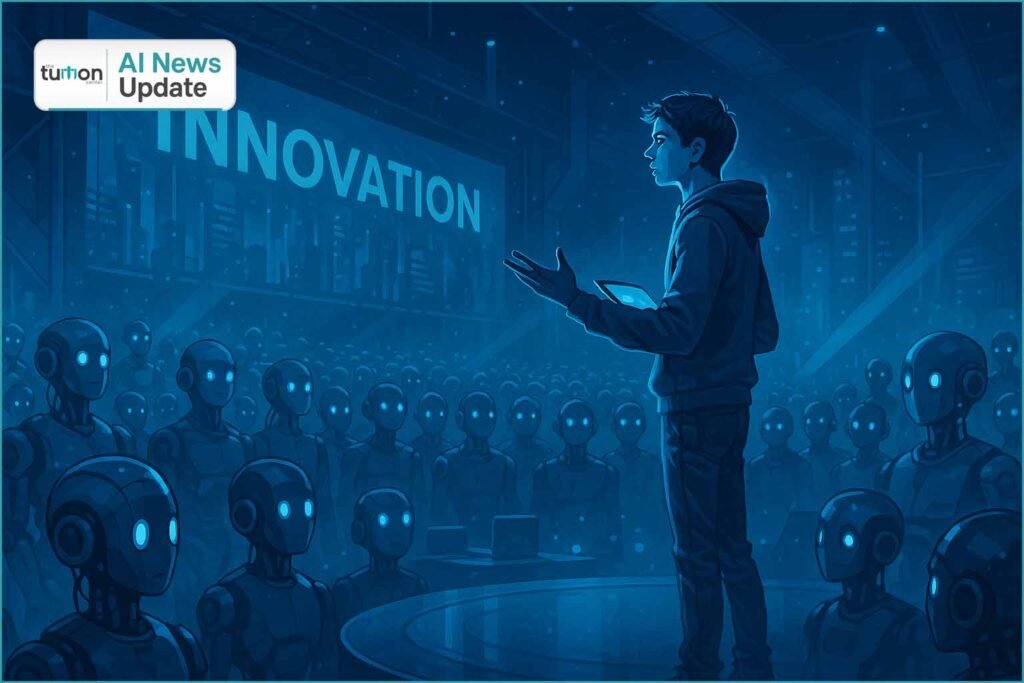
The next generation of founders isn’t just coding—they’re re-architecting the economy with intelligence as infrastructure.
- Over $190 billion in venture capital flowed into AI startups in 2025 (Source: Crunchbase AI Market Insights 2025).
- 72 countries now host AI-specific accelerators—up from 27 in 2022 (UN Innovation Report 2025).
- India entered the global top 5 AI startup ecosystems by deal volume (NASSCOM 2025 survey).
Introduction
Five years ago, building an AI startup meant chasing hype. Today, it means shaping history. 2025 is the year when intelligence became infrastructure—the operating system of the modern world. Startups no longer just plug AI into apps; they build the foundations on which industries now stand.
From New York to Bengaluru, founders in their twenties are raising global rounds, training foundation models, and deploying agentic systems at planetary scale. Every sector—healthcare, education, law, energy, logistics—is being re-coded by small teams using big compute and even bigger vision.
“`
Key Developments
- 1. Agentic Platforms Take Center Stage: Following the generative boom, the 2025 wave focuses on agentic ecosystems—startups like LangGraph Labs (USA) and KAI Systems (India) offer plug-and-play autonomous agents for enterprises.
- 2. Open-Weight Models Go Mainstream: The open-source AI movement exploded this year; community-trained models rival closed systems in quality and outperform them in adoption.
- 3. Compute as a Service (CaaS): Emerging startups democratise access to AI compute using decentralised GPU networks—reducing model-training costs by up to 70 percent.
- 4. EdTech + AI Fusion: Educational platforms now integrate adaptive tutors and voice-agents that personalise courses for 10 million + learners daily.
These developments prove one thing: the age of dependency on a few mega-AI players is over. The new builders are lean, open, and global from day one.
Impact on Industries and Society
AI startups are the new industrial revolutionaries. In finance, micro-AI advisors democratise portfolio management. In agriculture, drone-analytics companies optimise water and fertiliser use. In law, contract-AI firms cut review time from weeks to hours. Each innovation adds productivity and removes friction—creating both growth and displacement.
Socially, the startup wave is redistributing opportunity. A coder in Hyderabad can launch a global SaaS within months; a teacher in Kenya can monetise AI-generated curricula. Talent no longer needs to migrate; it needs to connect.
Expert Insights
“The most valuable AI startups of 2025 won’t be those that automate work—they’ll be those that augment workers,” notes Sequoia Capital’s Future of Work report 2025.
This shift matters. Automation is old news. Augmentation—AI that amplifies human potential—is the real business model of the decade.
India & Global Angle
India’s AI startup ecosystem has evolved from copycat apps to deep-tech innovation. According to NASSCOM, India hosts more than 4,700 AI-driven startups, with funding tripling in two years. Sectors like education, healthcare and agri-AI lead in deployment.
Globally, Silicon Valley, Tel Aviv and Singapore remain power centres, but new hubs are emerging in Lagos, São Paulo, and Jakarta. The AI economy is no longer geographic—it’s networked. Cross-border accelerators and AI fellows programmes allow talent from anywhere to pitch everywhere.
Policy, Research & Education
Governments now treat AI startups as strategic assets. India’s AI Innovation Mission offers tax credits and compute grants to deep-tech founders. The EU and Japan have green-compute subsidies for AI enterprises. Universities respond by launching “AI Entrepreneurship” degrees—training students in both coding and capital literacy.
For learners, this is a golden moment. Never before could a student build a multi-language AI app in a weekend and pitch it to investors worldwide. The barriers are gone; the expectations aren’t.
Challenges & Ethical Concerns
But speed has a shadow. The AI startup boom risks creating “solutionism without substance.” Too many founders rush to market without rigorous testing or ethics oversight. Investors chase valuation over verification. And open-source models can be weaponised as easily as they’re democratised.
There’s also the talent burnout problem: smaller teams run faster for longer, often ignoring mental health and governance. The solution? Ethical acceleration—growth with guardrails. Founders must learn compliance, AI ethics and sustainability as core skills, not afterthoughts.
Future Outlook (3 – 5 Years)
- Trend 1: The next unicorns will be agent ecosystem builders — offering AI as a co-founder, not a feature.
- Trend 2: Funding models will favour profitability and sustainability over hype; the “lean AI” era will begin.
- Trend 3: Hybrid education models will merge business incubation with AI training, blurring the line between student and startup founder.
Conclusion
AI startups are the new builders of civilisation. They aren’t waiting for permission—they’re building the future in real time. The code they write today will be the infrastructure of tomorrow’s economy. For learners and educators, the lesson is simple: entrepreneurship is education in its purest form. If you want to understand the future of AI, don’t read about startups—build one.