
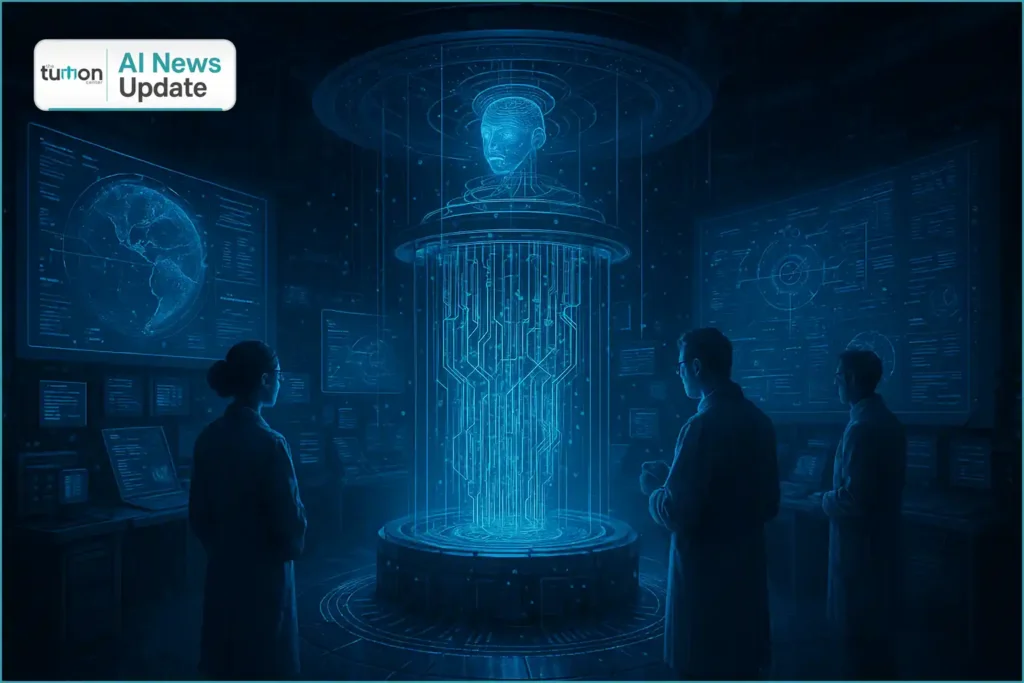
The fusion of quantum computing and artificial intelligence is unleashing unprecedented computational power — transforming medicine, energy, climate science, cryptography and materials research.
Key Takeaway: Quantum AI is no longer theoretical — it is emerging as the ultimate accelerator for scientific discovery, capable of solving problems impossible for classical computers.
- Quantum processors now support AI models that learn faster and simulate complex systems more accurately.
- Breakthroughs in drug discovery, climate modelling, cryptography and materials science show massive real-world potential.
- India and global research hubs are competing to lead the Quantum–AI race.
“`
Introduction
Every major technological age is defined by one breakthrough — electricity, the semiconductor, the internet, mobile computing, and now artificial intelligence. But as powerful as AI is, it faces one hard limit: computational complexity. Some calculations simply take too long, even on today’s fastest supercomputers. That limit has been the barrier for scientific breakthroughs for decades.
Quantum computing breaks that barrier. And when combined with AI, it unleashes something the world has never seen before: Quantum AI — systems that can learn faster, search deeper, simulate nature more accurately, and solve problems too complex for classical machines.
In 2025, Quantum AI is transforming from an academic concept into a practical reality. Research labs, universities, national agencies and startups are building hybrid quantum–AI systems capable of performing simulations, optimizations and calculations that accelerate discovery across sectors.
This is not incremental progress — it is exponential. Quantum AI has the potential to compress 50 years of scientific advancement into the next five.
Key Developments
1. Quantum-Accelerated Machine Learning Models
AI models running on quantum processors can explore vast solution spaces simultaneously, making them far better at optimization, pattern recognition and simulation-driven learning. These hybrid models outperform classical AI in certain scientific tasks by orders of magnitude.
2. Breakthroughs in Quantum Hardware Stability
Quantum computers require qubits — the quantum equivalent of bits — to remain stable. For years, qubit decoherence limited performance. But new breakthroughs in error correction, superconducting circuits and photonic qubits have extended usable coherence times long enough to run meaningful AI workloads.
3. Quantum Simulation of Molecules and Proteins
For the first time, Quantum AI systems can simulate molecular structures, protein folding pathways, and chemical reactions at quantum-level accuracy — the holy grail of drug discovery and materials science.
4. Quantum-Enhanced Optimization Engines
Optimization lies at the core of industries like logistics, finance, transportation, manufacturing and energy. Quantum AI engines can compute optimal solutions to problems with billions of possibilities — far faster than classical AI.
5. Quantum-Resistant Cryptography and AI Security
As quantum power grows, so does the need to protect data. Quantum AI is now being used to design security systems capable of withstanding quantum cyberattacks — the next frontier in global cybersecurity.
Impact on Industries and Society
1. Drug Discovery: From 10 Years to Months
Quantum AI can simulate how drugs bind to proteins at atomic precision. This reduces trial-and-error, accelerates compound selection, and increases success rates in clinical research. Pharmaceutical companies are already using quantum-driven pipelines to identify treatments for cancer, neurological disorders and rare diseases.
2. Climate & Environmental Science
Quantum AI can model atmospheric interactions, ocean currents, carbon cycles and weather patterns with far greater fidelity. This helps scientists predict extreme events, design mitigation strategies and simulate environmental policies.
3. Materials Research & Clean Energy
Quantum simulations reveal properties of new materials — superconductors, nanomaterials, polymers and alloys — enabling breakthroughs in batteries, solar panels, quantum sensors and next-generation electronics.
4. Finance & High-Speed Optimization
Quantum AI enhances portfolio optimization, fraud detection, derivative pricing, black swan analysis and market simulations — major competitive advantages for global financial institutions.
5. Logistics & Transportation
Airlines, shipping companies and railways use Quantum AI to optimize routing, scheduling, fuel consumption and fleet management — saving billions in operating costs.
6. National Security & Defense
Quantum AI is reshaping cryptography, surveillance, simulation of conflict scenarios and secure communications. Nations leading this space will command strategic advantage.
Expert Insights
“Quantum AI is not an upgrade — it is a new paradigm. It allows us to simulate nature itself.”
“Problems that required supercomputers for weeks now take seconds. This changes everything — science, medicine, cybersecurity, energy.”
“Students entering STEM fields today will spend their careers working with hybrid quantum–AI systems.”
India & Global Angle
India
India is investing aggressively in quantum technologies through national missions, research labs, IITs, IISc, and private collaborations. Indian startups working in quantum algorithms, secure communication and hybrid quantum-AI platforms are emerging globally.
With a strong STEM pipeline and cost-effective engineering talent, India is well-positioned to become a major player in quantum data centres, algorithm design and applied quantum AI research.
Global
The U.S., China, Japan, Canada, Germany, Israel, UK and Singapore are at the forefront of quantum computing. Global competition is fierce — not just for hardware, but for talent, algorithms, and application ecosystems.
Policy, Research, and Education
Governments and academic institutions worldwide are building frameworks to support quantum literacy, quantum engineering, and responsible AI-quantum deployment. Key initiatives include:
- national quantum missions
- quantum engineering degrees
- open-source quantum-AI libraries
- ethical guidelines for quantum impact
- public–private research alliances
Students today must learn hybrid skills: mathematics, physics, computer science, AI, optimization theory and ethics. This combination defines the scientists and engineers of the next decade.
Challenges & Ethical Concerns
1. Quantum Cybersecurity Threats
Quantum machines could break classical encryption. Without strong safeguards, global digital infrastructure becomes vulnerable.
2. Unequal Access to Quantum Resources
Quantum hardware is expensive and limited. Only a few nations may initially control breakthroughs, risking inequality in scientific access.
3. Talent Shortages
Quantum AI requires interdisciplinary expertise. The world faces a shortage of trained quantum scientists and AI researchers.
4. Ethical Use of Quantum Simulations
Simulating nature with unprecedented detail raises questions — how should this power be regulated, shared and governed?
5. Environmental Costs
Quantum data centres require cooling and energy. Sustainable quantum infrastructure is essential to prevent future ecological strain.
Future Outlook (3–5 Years)
- Quantum AI will accelerate drug discovery and climate modelling beyond anything seen before.
- Hybrid quantum–AI cloud platforms will become commercially available.
- Quantum-resistant security systems will be deployed globally.
- Governments will create quantum workforce pipelines in universities.
- Quantum AI will become foundational to national competitiveness.
Conclusion
Quantum AI marks the beginning of a new scientific era — one where humanity can simulate nature, accelerate discovery, and push against the boundaries of the impossible. This technology will influence everything from medicine and climate science to cybersecurity and energy.
For students, researchers, educators and professionals, this is the perfect moment to learn, adapt and participate. The world is opening a door to knowledge once thought unreachable. And the biggest breakthroughs are yet to come.
Quantum AI is not just the future of technology — it is the future of discovery itself.
#QuantumAI #AI #FutureTech #ScientificDiscovery #QuantumComputing #AIInnovation #TheTuitionCenter