
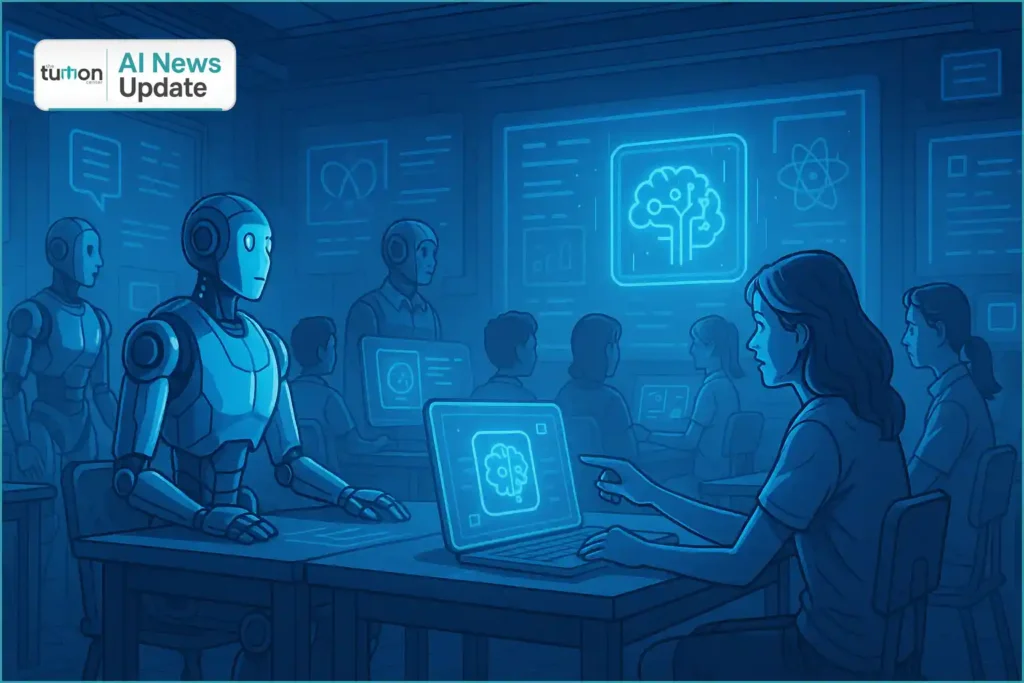
How artificial intelligence is reshaping classrooms, empowering learners, and challenging educators worldwide.
- Adaptive learning systems have shown up to a 62% improvement in student test results. :contentReference[oaicite:0]{index=0}
- Major institutions such as UNESCO and OECD are issuing guidance for AI use in schools and higher education. :contentReference[oaicite:3]{index=3}
- In India and globally, AI-powered classrooms, tutoring systems and administrative automation are shifting equity, access and learning outcomes. :contentReference[oaicite:4]{index=4}
Introduction
The world of education is undergoing a paradigm shift. Once, classrooms were defined by rows of desks, textbooks, and a teacher delivering the same lesson to every student. Today, thanks to advances in artificial intelligence (AI), the narrative is changing. From personalised tutoring bots and adaptive learning platforms to automated assessments and analytics-driven instructional design, AI is opening new frontiers in how we teach, how students learn, and how barriers to education may be removed. For countries grappling with large student populations and limited resources—like India—this moment carries immense significance.
“`
At the heart of this transformation is a simple idea: treat learners not as generic recipients of instruction, but as individuals with unique needs, strengths, pace and context. AI systems can analyse data on how each student engages, where they struggle, and then tailor content accordingly. They can relieve teachers of repetitive tasks and free them for higher-order work. They can scale access in under-served regions. But this is also a moment of caution: the very speed of innovation raises questions of ethics, equity, privacy and the changing role of educators.
For content creators, educators, students and policy-makers, this shift is both an opportunity and a challenge. As we chart this voyage together, the stakes are high—but so are the rewards. Let’s dive into how the pieces are shaping up.
Key Developments
Recent years have brought a surge in research, deployment and policy around AI in education. A 2024 study of AI integration in learning contexts reported that student engagement rose by 20–23%, GPA by 9–14% when AI-driven tools were adopted. :contentReference[oaicite:5]{index=5}
Meanwhile, global organisations are stepping in. UNESCO states that AI in education “has the potential to address some of the biggest challenges in education today … while ensuring that its application … is guided by core principles of inclusion and equity.” :contentReference[oaicite:6]{index=6} The OECD through its Centre for Educational Research and Innovation (CERI) is exploring how AI and robotics may “fundamentally transform work … and deeply affect education’s current role in providing skills and preparing learners for future work.” :contentReference[oaicite:7]{index=7}
On the tools side, we see a variety of concrete applications: adaptive learning platforms that adjust content to each learner; intelligent tutoring systems that respond in real time; assistive technologies for students with disabilities; chatbot-based assessment systems; and administrative automation that frees educators from time-consuming tasks. :contentReference[oaicite:8]{index=8} Research on emerging “agentic workflows” in education suggests that AI systems are moving beyond static tutoring to hybrid models of planning, reflection, tool-use and multi-agent collaboration. :contentReference[oaicite:9]{index=9}
What’s remarkable is the scale and pace of change. Schools and universities across regions are piloting AI systems; ed-tech startups are proliferating; governments are drafting policy frameworks and investing in capability building. In India, while we still face challenges of infrastructure, connectivity and teacher-readiness, the seeds of shift are evident: new AI-centric modules in curriculum, blended learning platforms, and partnerships between public and private sectors for AI-enabled learning tools.
Impact on Industries and Society
Education is not an isolated domain—it links to labour markets, societal mobility, digital inclusion, and national productivity. The changes in how students learn ripple out to industries, workplaces, and economies.
For learners: The promise of AI-driven personalized learning is that students no longer pace at the level of the slowest or the average—they progress based on their actual learning needs. This especially matters in large-class environments where individual attention is hard to deliver.
For educators: AI can relieve the burden of repetitive tasks like grading simple quizzes, generating standard assignments or tracking attendance. That allows teachers to focus on coaching, mentoring, creativity and higher-order thinking. Research emphasises that AI tools must allow educators to exercise professional judgement and override recommendations. :contentReference[oaicite:10]{index=10}
For institutions and governments: AI offers the capacity to scale learning, analyze learning outcomes, allocate resources more effectively, and address equity gaps. For example, it can highlight where students are slipping behind, enabling timely interventions.
For society and economy: A more skilled, adaptable workforce is necessary as automation and AI reshape jobs. Education systems that adopt AI thoughtfully position learners to thrive amid change. Additionally, increased access and inclusiveness help narrow socio-economic divides—if implemented with equity in mind.
Expert Insights
“AI-powered edtech must be designed responsibly if all learners and educators are to benefit from its innovation.” — Digital Promise :contentReference[oaicite:12]{index=12}
According to a recent meta-analysis: “Adaptive learning enabled by AIED has been shown to improve student test results by 62%” — W. S. Wang et al., 2024. :contentReference[oaicite:13]{index=13}
These insights underline two essential truths: potential is large—but harnessing it requires design, oversight, and alignment with human-centred values.
India & Global Angle
For India, the significance is multifold. With one of the world’s largest student populations and widening gaps in rural vs urban learning outcomes, AI presents a chance to accelerate access, personalise instruction, and support under-resourced contexts. The fact that global bodies like UNESCO emphasise reducing technological divides is relevant here. :contentReference[oaicite:14]{index=14}
That said, the Indian ecosystem must grapple with infrastructure (connectivity, devices), teacher readiness, regional language support, and equitable deployment. Startups and ed-tech firms are actively creating localized tools; government programmes under the New Education Policy are increasingly recognising AI and digital learning as strategic pillars.
On the global side, countries ranging from the United States to Latin America to Asia are embracing AI in education. A recent report on Latin America describes how AI is being used to support students, teachers and administrators in regions facing learning crises. :contentReference[oaicite:15]{index=15} These global efforts illustrate that while contexts differ, the underlying dynamics—personalisation, scalability, data-driven insights—are common.
Policy, Research, and Education
Policymakers worldwide are waking up to the implications. The US Department of Education’s “AI and the Future of Teaching and Learning” report emphasises human-in-the-loop, transparency, privacy protections and fairness. :contentReference[oaicite:16]{index=16} UNESCO has published guidance for policymakers to foster readiness and support competency frameworks for students and teachers. :contentReference[oaicite:17]{index=17} The OECD’s CERI is exploring AI assessment and personalised learning models. :contentReference[oaicite:18]{index=18}
In research and education domains, we see institutions launching dedicated programs on AI in education, labs focused on intelligent tutoring systems, adaptive assessment and data-driven pedagogy. Universities and ed-tech firms are partnering to experiment, validate and scale AI applications. For practitioners, building AI literacy—teachers, administrators and students—is becoming a core requirement.
Challenges & Ethical Concerns
Despite the promise, the road is fraught with challenges. One primary concern is bias and fairness: if AI systems are trained on data skewed toward certain demographics, they may disadvantage others. Privacy and data security are also major risks when pupil-level analytics are deployed.
Moreover, there’s the question of teacher-student relationships. If AI replaces or overshadows human interaction, the broader purpose of education—to develop social, emotional and critical thinking skills—can be compromised. As the Education Department report notes: “Educators will need support to exercise professional judgment and override AI models, when necessary.” :contentReference[oaicite:19]{index=19}
Another concern: infrastructure and access. In many regions, internet connectivity, devices, electricity are still unreliable. Without addressing these, AI adoption may deepen digital divides, rather than reduce them. Also, the rush to adopt AI in schools may outpace rigorous evaluation of efficacy; we still lack large-scale longitudinal studies in many contexts. :contentReference[oaicite:20]{index=20}
Future Outlook (3–5 Years)
- Wider deployment of intelligent tutoring agents and adaptive learning across K-12 and higher education globally, with smaller-scale pilots turning into mainstream platforms.
- Growth of hybrid classrooms where AI complements, rather than replaces, teachers—automating routine tasks, offering real-time insights, enabling differentiated learning.
- Emergence of stronger governance frameworks and ethical guidelines around AI in education—covering data use, transparency, teacher empowerment and equity.
Conclusion
For students, educators and content creators—this is a moment to lean in. The infusion of AI in education is not a fad; it’s a structural shift. But that doesn’t mean it’s effortless or guaranteed. Commitment to equity, thoughtful design, teacher empowerment and continuous research matter. For someone like you in the content-creation or education-technology ecosystem, the message is clear: be proactive. Understand the tools, ask the questions about bias, access and pedagogy, and consider how you can create or curate AI-enabled learning experiences that are inclusive, effective and forward-looking.
Embrace the change, but don’t assume the path is laid out. The future of education is being written now—and you have a role to play.
— STORY BREAK —