
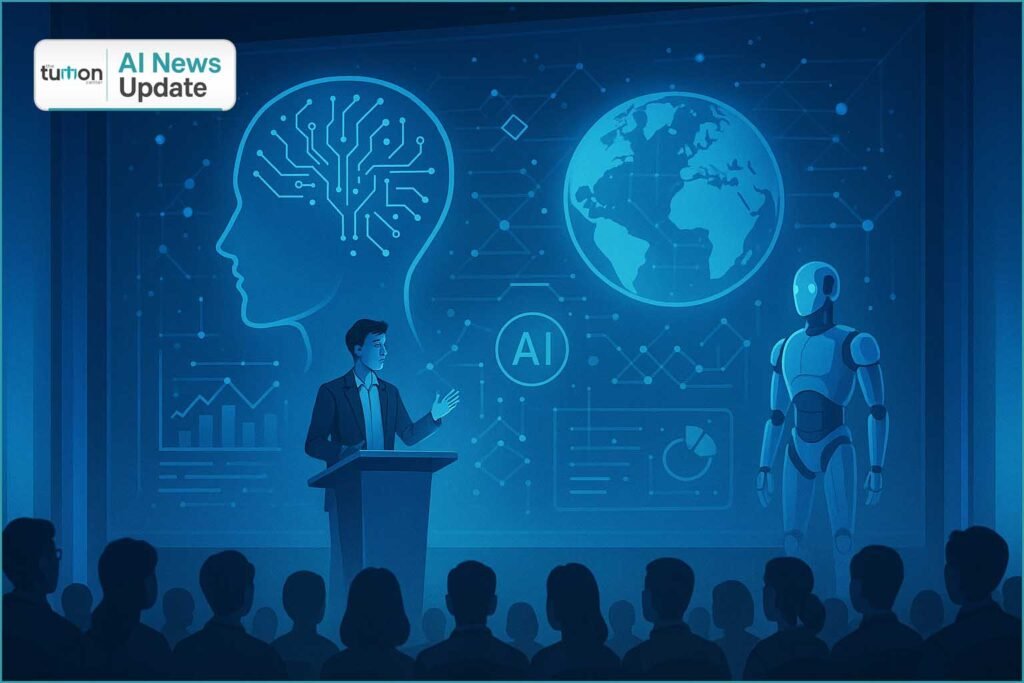
AI is no longer an add-on — it is becoming the backbone of global learning. From personalised tutors to VR classrooms, the education revolution has officially begun.
Key Takeaway: AI is redefining how 1.5 billion students learn, skill, and prepare for the future — creating the most profound education shift in modern history.
- AI adoption in global classrooms grew by 380% between 2022 and 2025.
- Over 500 million students now use AI tools daily for learning.
- Governments are building national AI curricula, VR labs, and intelligent learning ecosystems.
“`
Introduction
Education is experiencing the most dramatic transformation since the birth of the internet. What began as simple MCQ apps and video-based learning has evolved into intelligent learning ecosystems powered by AI tutors, multimodal agents, VR classrooms, hyper-personalised lesson paths, and skill-based assessments.
In 2025, students don’t just “study with AI” — they study *through* AI.
Classrooms are becoming hybrid. Teachers are becoming mentors. Students are becoming creators. And AI is becoming the bridge between curiosity and mastery.
From rural India to urban Seoul, from African innovation hubs to European universities, AI-driven education is not an experiment anymore — it is the new global standard.
Key Developments
Several major developments define the 2025 AI-in-education revolution:
1. Rise of AI Personal Tutors
AI tutors can now:
- explain concepts in multiple ways
- identify learning gaps using behavioural patterns
- generate personalised quizzes and practice papers
- simulate exam environments
- provide emotional encouragement through empathetic voice models
These tutors operate 24×7, never get tired, and adjust teaching style instantly.
2. Virtual & Holographic Classrooms
VR learning labs allow students to “enter” historical events, observe astronomy from space, or walk through 3D models of molecules.
Holographic learning pods — used in South Korea and Japan — bring immersive science and technology into everyday classrooms.
3. AI-Generated Textbooks
AI now creates customised textbooks for each student based on their understanding, weaknesses, and learning patterns.
Dynamic textbooks update in real-time as students progress.
4. Assessment Without Exams
Several countries are experimenting with AI-powered continuous assessment:
- skill-based evaluations
- project-based tracking
- AI-verified learning milestones
Exams are transforming from memory tests to problem-solving experiences.
5. Teachers Supported by AI Co-Pilots
Teachers now use AI for:
- lesson planning
- student progress reports
- class engagement analysis
- identifying struggling students
- creating assignments and presentations instantly
AI doesn’t replace teachers — it amplifies them.
Impact on Industries and Society
The ripple effects of AI-driven learning extend far beyond classrooms:
1. Workforce Transformation
Students entering the workforce in 2030 will have:
- AI fluency
- automation management skills
- multimodal communication expertise
- ability to collaborate with AI agents
Companies already value “AI-native talent” — young professionals who can work alongside intelligent systems.
2. Reduced Learning Inequality
AI tutors in local languages (such as Hindi, Tamil, Bengali, Swahili, Arabic, Spanish) are making high-quality learning accessible across remote and underserved regions.
3. Parenthood & Home Education
AI-powered home learning assistants support:
- homework help
- skill development
- habit-building routines
- early childhood education
4. Lifelong Learning
Professionals are upgrading skills through AI mentors that create personalised micro-learning courses.
5. EdTech Industry Evolution
The EdTech sector has shifted from “content providers” to “learning intelligence engines.”
Startups now build AI-driven ecosystems — not just videos or quizzes.
Expert Insights
“AI is the greatest equalizer in education history. A child in a remote village can now learn like a child in the best city school.”
— Dr. Maya Johnson, UNESCO Education Futures
“Teachers are not being replaced — they’re being empowered. AI handles the heavy lifting so teachers can focus on mentoring.”
— Prof. Satish Rao, IIT Bombay EdTech Lab
“By 2030, AI literacy will be as essential as reading or writing.”
— Elena Park, South Korea National AI Program
India & Global Angle
India is emerging as a global hub for AI-driven learning. Several factors contribute:
- the world’s largest school population
- a massive EdTech ecosystem
- NEP 2020 emphasis on skill-based learning
- AI in schools initiatives across states
- National Digital University acceleration
India’s multilingual learning models are becoming templates for global adoption.
Internationally:
- Finland leads research in AI pedagogy.
- UAE is building AI-first public schools.
- USA leads foundational model integration in classrooms.
- Japan integrates AI into robotics-based learning.
- South Africa uses AI for rural education empowerment.
Policy, Research, and Education
Governments are launching initiatives such as:
- AI knowledge banks for teachers
- AI model validation for student safety
- national digital curricula
- AI skill certification programs
- student data privacy and ethics frameworks
Universities are offering degrees in:
- AI in Learning Sciences
- Human-AI Interaction
- Education Technology Engineering
- AI-driven Curriculum Design
Research labs are exploring:
- emotion-aware AI tutors
- adaptive learning paths
- multilingual cognitive AI
- brain–computer learning interfaces
Challenges & Ethical Concerns
AI-driven education faces several crucial challenges:
- ensuring privacy of student data
- preventing algorithmic biases
- avoiding over-dependence on AI tutors
- maintaining teacher authority
- avoiding misinformation in AI-generated responses
- ensuring equitable access across socioeconomic groups
These challenges require a balanced approach — innovation with safety, advancement with oversight.
Future Outlook (3–5 Years)
- Students will collaborate with AI agents to build projects, research, and solve real-world problems.
- Digital learning passports will replace report cards.
- AI-powered skill trails will guide students from school to career.
Conclusion
The future of education is intelligent, personalised, and globally connected.
AI is not just transforming learning — it is redefining what it means to be educated.
For students, this is the most exciting era in history. For teachers, this is the most empowered. For nations, this is the most strategic opportunity for development.
Education is no longer a one-size-fits-all journey.
It is a personalised adventure — powered by AI.