
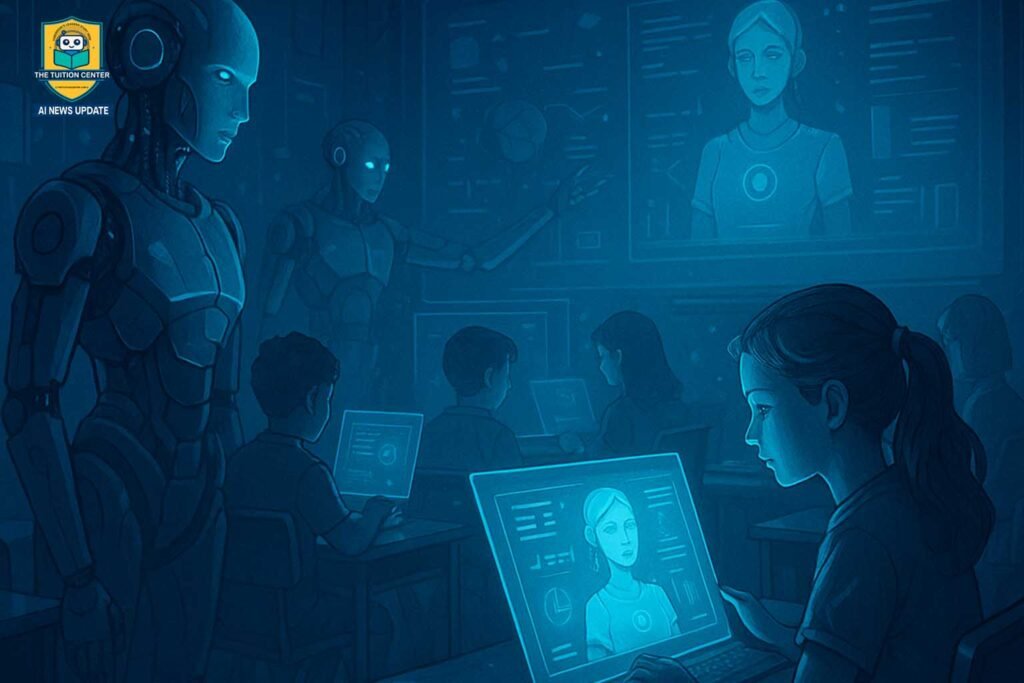
From AI tutors to hyper-personalised classrooms, education is undergoing its biggest transformation since the invention of formal schooling.
- AI-driven platforms now reach over 1.7 billion learners globally.
- Countries are integrating AI literacy and agent-based learning into national curricula.
- AI-powered assessment, personalised tutoring, and skill-matching are redefining student success.
Introduction
The world is undergoing a seismic shift in how learning happens. For decades, education systems struggled with scale, outdated curricula, limited teacher bandwidth, and inconsistent quality across regions. But the rise of Generative AI—especially post-2024—has transformed education from a static system into a dynamic, personalised, global learning ecosystem.
The AI education shift isn’t a future possibility; it’s already unfolding. Millions of students now learn through AI-powered tutors. Teachers rely on AI for planning, assessments, content creation, and remediation. Universities use AI to personalise degree pathways. Corporates use intelligent platforms to reskill workers in months instead of years.
This transformation is not just technological—it’s social, economic, and deeply human. The biggest winners will be the countries that reimagine education with AI at the center.
Key Developments
1. AI Tutors Enter Mainstream Education
AI tutors are now embedded inside classrooms in India, UAE, Japan, UK, Singapore, and South Korea. These tutors:
- adapt lessons instantly based on student behaviour
- offer voice-based guidance
- generate multisensory explanations
- diagnose conceptual gaps in real time
- create personalised revision plans
They function as digital teaching assistants that never get tired.
2. AI-Powered Assessments Replace Old Exam Systems
Traditional exams failed to measure true understanding. Now AI-based assessments:
- track learning behaviour over time
- evaluate critical thinking
- offer conversational testing
- measure practical application instead of memorisation
Several Indian states have already replaced mid-term exams with AI-driven adaptive tests.
3. Universities Shift to “AI-Integrated Degrees”
By 2025, more than 200 universities introduced AI-integrated degree programs:
- AI + Law
- AI + Healthcare
- AI + Business Analytics
- AI + Design
- AI + Public Policy
Degrees now include mandatory AI literacy modules.
4. Corporate Skilling Enters the Hyper-Acceleration Era
Companies use AI learning agents to:
- create training programs on the fly
- track employee competencies
- match workers to new roles
Skill transformation time has dropped from 18 months to 8–10 weeks.
Impact on Industries and Society
1. Bridging Urban–Rural Learning Gaps
AI-powered teaching is finally equalising education. A child in rural Bihar can now access the same quality of content as a student in Seoul or Dubai.
2. Reducing Teacher Workload
AI handles up to 60% of administrative tasks:
- grading
- lesson planning
- data analysis
- content preparation
This frees teachers for creativity, emotional support, and mentoring.
3. Learning Becomes Lifelong
People aged 18–50 are now returning to learning because AI makes content easier, faster, personalised, and affordable.
4. The Global Education Economy Expands
AI learning ecosystems have created new sectors:
- AI curriculum design
- AI coach training
- agent-based learning startups
- digital content markets
- AI-driven virtual universities
Expert Insights
“We are not teaching students for jobs—the jobs are being reinvented faster than curricula. AI enables learning to evolve with the world, not behind it.” — Prof. Anjali Prasad, Global Education Futures Lab
“AI education isn’t automation. It’s augmentation. It gives teachers superpowers—something the world needed for decades.” — Alex Romero, OECD Education Policy Lead
India & Global Angle
India is the epicenter of the global AI education revolution due to:
- the world’s largest school-age population
- fastest-growing EdTech markets
- National Digital Education Policy 2024
- AI-in-Schools 2.0 initiative
Globally, countries like UAE, Singapore, Japan, and Finland lead AI-integrated schooling.
Policy, Research, and Education
Governments are introducing:
- AI ethics in schools
- curriculum modernization councils
- AI literacy standards for teachers
- national AI research universities
UNESCO and the World Bank are supporting AI-enabled education in developing nations.
Challenges & Ethical Concerns
The rise of AI learning systems brings serious concerns:
- over-reliance on AI explanations
- bias in adaptive assessments
- child data privacy
- equitable device access
- teacher–AI conflict in authority
Future Outlook (3–5 Years)
- Every classroom will have an AI learning assistant.
- Students will have lifelong AI mentors following them across education and career.
- Global virtual universities will challenge traditional degrees.
Conclusion
The AI education shift from 2025 to 2030 will redefine humanity’s relationship with learning.
Education will no longer be a linear journey from age 5 to 22.
It will become an ever-evolving, AI-supported lifelong adventure.
Nations that embrace this shift will create a future-ready generation equipped with creativity, intelligence, emotional resilience, and technological fluency.