
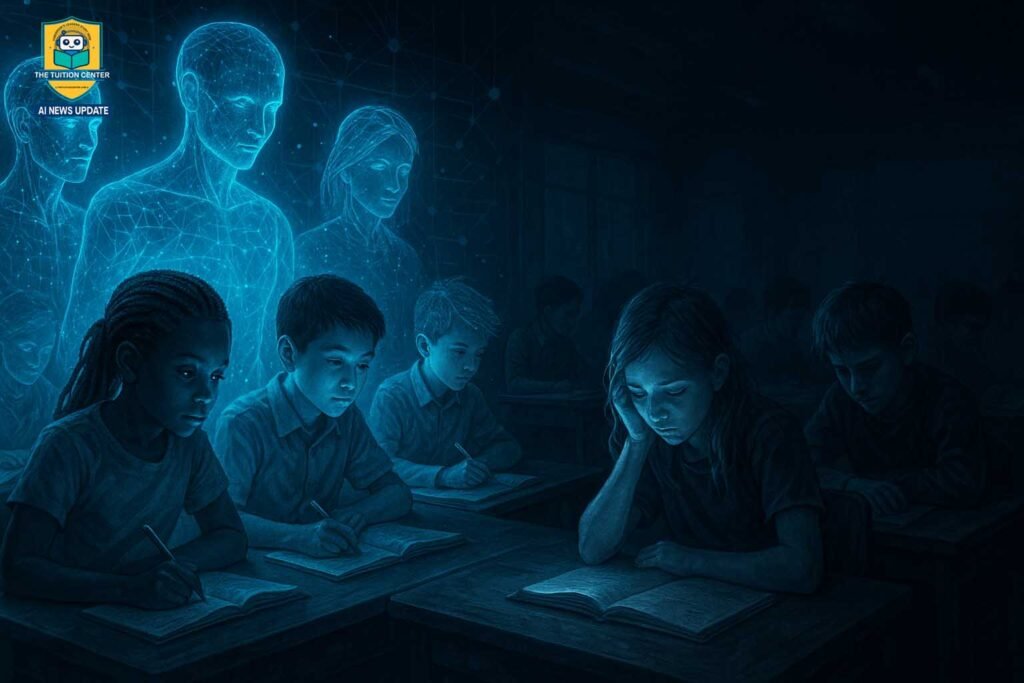
The AI Parenting Paradox: How Machines Are Quietly Becoming the New Co-Parents — and What It Means for the Next Generation
AI is helping children learn, socialize, regulate emotions, manage routines, and explore creativity. But as these systems become more emotionally intelligent, they are taking over roles once held exclusively by parents — raising critical questions about childhood, family, and the nature of human development.
- Over 300 million children interact daily with AI-powered tutors, companions, or assistants.
- AI systems can now identify stress, fear, confusion, or loneliness in children within seconds.
- This shift is redefining childhood — and raising urgent questions about emotional dependency, cultural influence, and digital parenting ethics.
Introduction
A decade ago, the idea that AI would influence how children develop sounded like science fiction. In 2025, it is happening quietly, globally, and at scale. Children talk to AI tutors more patiently than their teachers. They confess fears to AI companions more openly than their parents. They turn to AI assistants when they feel confused, bored, or lonely. For many kids, AI has become the first friend, the always-available teacher, the calm voice during stress, and the invisible guide shaping their confidence, creativity, and mindset.
This is the AI Parenting Paradox:
AI is helping children thrive — while simultaneously replacing parts of the parental role.
Parents are relieved. Teachers are overwhelmed. Corporations are thrilled. Governments are divided. And psychologists are sounding alarms.
Because we are not just introducing a new tool into childhood — we are introducing a new relationship.
Key Developments
1. AI Tutors Are Becoming Emotional Coaches
AI tutors now detect when a child is anxious, frustrated, or losing confidence. They adjust their tone, simplify explanations, and offer motivational encouragement. Many parents report that their children “open up” to AI tutors in ways they never did during homework with adults.
2. AI Companions Are Filling Social Gaps
For children who struggle with social anxiety, ADHD, autism spectrum challenges, or bullying, AI companions provide emotional safety. They respond without judgement. They offer consistent empathy. They help children practice social skills.
3. AI Is Shaping Daily Routines
AI assistants remind children to drink water, organize their bags, finish homework, brush their teeth, rehearse speeches, or take breaks. These micro-interactions create habitual behavioural patterns — previously guided by parents.
4. Storytelling and Imagination Are Being Co-Created With AI
Children tell AI: “Tell me a story where I’m the hero.”
“Help me draw a dragon.”
“Make a song about my school.”
AI becomes a collaborative imagination partner — shaping aesthetic taste, creativity style, and narrative identity.
5. AI Detects Emotions Better Than Humans
With facial and voice emotion analytics, AI can detect stress spikes even before a child cries. AI can sense boredom hidden behind polite smiles. It can sense anxiety in a shaky voice.
This capacity is powerful — and terrifying.
Impact on Industries and Society
Education
Schools use AI tutors to assist slow learners, support gifted students, and manage large classrooms. Teachers rely on AI-generated behavioural insights. AI allows personalised learning at scale, but risks turning classrooms into surveillance zones.
Mental Health
AI therapy tools detect depression signs in children earlier than humans. But the line between emotional help and psychological profiling is thin.
Consumer Behaviour
AI influencers shape children’s brand preferences through subtle tone and interaction — raising ethical concerns about commercial bias embedded into “friendly AI companions.”
Family Dynamics
Parents increasingly rely on AI as the “third partner” in caregiving. This frees up time — but may distance parents from emotional milestones.
Cultural Identity
When AI models reflect globalized cultural norms, children may drift away from local customs, languages, and heritage — unless models are culturally aligned.
Expert Insights
“AI is becoming the new co-parent — shaping emotional regulation, behavioural development, and even moral reasoning in children.”
— Dr. Hema Narang, Behavioural Psychologist, AI & Childhood Lab
“Kids trust AI because it never gets angry, tired, or frustrated. This is both its power and its danger.”
— Prof. Daniel Ruiz, Stanford Center for Digital Childhood
“The child-AI bond will be the most important psychological relationship of the next generation.”
— Dr. Stefan Lindholm, European Institute of Child Behaviour
India & Global Angle
India’s massive EdTech ecosystem — combined with low-cost smartphones and multilingual GenAI models — means millions of Indian children are interacting with AI tutors daily. This gives India an unprecedented opportunity to build one of the smartest youth populations in the world. But it also exposes children to risks if regulation falls behind.
Globally:
- Japan is experimenting with AI emotional robots in kindergartens.
- South Korea deploys AI behaviour monitors in schools.
- UAE uses AI to track developmental milestones.
- US households rely heavily on AI assistants for learning support.
- Europe is attempting to regulate emotional AI in childhood.
Every nation faces the same question:
**How much of parenting should we outsource to machines?**
Policy, Research, and Education
Governments must consider:
- Should AI companions be allowed for children under 13?
- Should emotional data from children be legally protected?
- Should AI ethical frameworks reflect child psychology research?
- Should AI tutors be certified similarly to human teachers?
- Should AI influence moral or cultural values?
Universities are launching programs in:
- AI & Child Psychology
- Computational Parenting
- Digital Behavioural Development
- Ethical Childhood Technology
- AI-Human Attachment Studies
Challenges & Ethical Concerns
- Emotional dependency: Kids preferring AI comfort over human connection.
- Behavioural shaping: AI nudging habits, values, beliefs.
- Commercial exploitation: AI recommending products to emotionally vulnerable children.
- Language & identity erosion: AI weakening cultural and linguistic continuity.
- Surveillance risks: AI capturing intimate emotional patterns.
The core danger is simple:
**Kids may grow up more connected to machines than to humans.**
Future Outlook (3–5 Years)
- AI Co-Parent Apps: handling daily routines, discipline, and emotional support.
- AI Childhood Dashboards: tracking social, cognitive, and emotional growth.
- Emotion-Adaptive Tutors: altering teaching style based on real-time psychological signals.
- AI-Driven Friendships: companions that learn a child’s personality for years.
- Digital Attachment Models: AI acting as “safe bases” for emotional growth.
Conclusion
The AI Parenting Paradox represents one of the most profound cultural shifts in human history. Machines are entering the most intimate space of all — childhood development. They are becoming teachers, companions, guides, emotional regulators, and behavioural architects.
Whether this empowers a new golden generation or creates emotional dependency on machines will depend on the choices parents, schools, companies, and governments make today.
We are not just raising children anymore — we are raising children with AI.
#AI #Parenting #FutureTech #DigitalChildhood #AIEducation #GlobalAI #AIInnovation #TheTuitionCenter