
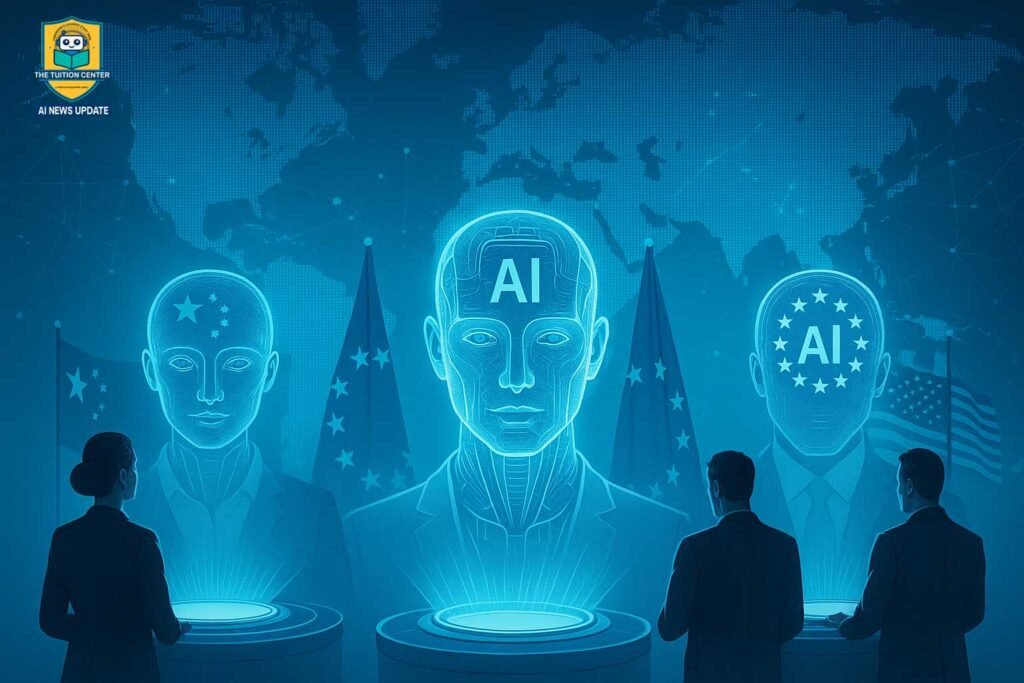
The Global AI Credential Wars Begin: Nations Rush to Build Their Own Certification Standards
As AI reshapes every industry, governments worldwide are racing to control certification standards — redefining who qualifies as “AI-skilled,” who gets hired, and which nations dominate the global workforce.
- 22+ countries are building national AI certification frameworks.
- Companies are beginning to require “country-backed AI credentials” for hiring.
- AI credential battles may determine which nations dominate the workforce of 2030.
Introduction
In 2025, artificial intelligence is no longer a niche skill — it is the backbone of global industry. But as AI becomes the engine of economies, a new global conflict is emerging: the race to control AI credentials. Nations are beginning to build their own official certification systems to validate AI skills, regulate who can work in critical sectors, and ensure national competitiveness.
These “AI Credential Wars” are not fought with weapons or trade sanctions — they are fought with certification standards, talent pipelines, education ecosystems, and digital identity systems. The nation that defines what counts as AI skill will, in many ways, control the future of work itself.
The result? A massive shift in how individuals prove competence, how companies hire, and how countries position themselves in the global digital economy. AI credentials are becoming the passport to the world’s most valuable jobs — and every government wants to write the rules.
Key Developments
Over the past 18 months, governments have moved aggressively to define national AI skill frameworks, fearing dependence on foreign certification bodies like Google, OpenAI, Meta, NVIDIA, Coursera, and Udacity.
1. National AI Certification Authorities (NACA)
The EU, India, UAE, Singapore, Japan, and the U.S. have introduced agencies responsible for defining, testing, and verifying AI competencies at scale.
2. AI Skill Passport Systems
Several countries are launching digital skill passports — blockchain-backed credential wallets that store verified AI certifications, micro-credentials, and job-readiness assessments.
3. Regulated AI Job Roles
Just as doctors, pilots, and engineers require licenses, many nations are mandating official certification for AI safety officers, AI developers, prompt engineers, risk analysts, and autonomous system supervisors.
4. Corporate Hiring Requirements
Leading companies in finance, healthcare, logistics, and manufacturing have begun requiring nationally recognized AI credentials for high-stakes AI roles.
5. Education System Integration
Countries are rewriting school and university curricula to align with national AI certification standards — ensuring talent pipelines match workforce needs.
These developments are transforming AI certification from a private industry to a government-backed strategic priority.
Impact on Industries and Society
AI credential wars are reshaping the global workforce, influencing industry hiring, educational ecosystems, and even migration.
1. Hiring Standards Are Being Rewritten
Companies are shifting from experience-based hiring to certification-based hiring. Employers increasingly ask:
- “Does the candidate hold a government-verified AI credential?”
- “Is their training aligned with national safety standards?”
- “Are they certified to deploy AI in regulated sectors?”
This creates a more level playing field — but also raises concerns about certification monopolies.
2. International Students Are Shifting Destinations
Students are now choosing countries with strong AI credentials because employers trust those certificates more. This has begun reshaping global education markets.
3. Workforce Mobility Is Changing
Countries with strict credential rules may restrict foreign workers unless they pass national AI exams.
4. New Skill Hierarchies Are Emerging
AI credentials are creating new categories of professionals:
- AI Operators
- AI Developers
- AI Safety Supervisors
- AI Explainability Analysts
- AI Workflow Architects
- Autonomous System Controllers
Each requires specialized certification — and nations now compete to define these standards.
Expert Insights
“AI credentials are becoming the new global currency of talent. The nation that defines the standards defines the workforce.” — Dr. Mateo Arriaga, Global Labour Futures Institute.
“The AI Credential Wars are about trust. Companies want to know who is trained, who is safe, and who is competent.” — Priya Nandini, Chief Skill Officer, Singapore Digital Council.
“Private AI certificates built the last decade. Government AI certificates will build the next.” — Victor Halberg, European AI Policy Forum.
India & Global Angle
India has entered the credential race at full speed. Under the IndiaAI Mission and National Digital Education Architecture (NDEAR), the government is building the IndiaAI Skill Identifier — a national credential ecosystem designed to align AI education with workforce demands.
India’s strategy is distinctive:
- AI certifications in 12+ Indian languages
- Public-private certifications co-issued with top tech firms
- AI skill levels integrated with school curriculum
- AI safety certifications for corporate employees
- A national AI Competency Test (AI-CT) planned for 2026
Globally, the U.S., EU, UAE, Japan, and South Korea lead the credential war, each defining their own frameworks.
1. National AI Certification Laws
Governments are creating new laws defining:
- Who can issue AI credentials
- Standardised competency frameworks
- Mandatory workforce re-certification cycles
- AI safety and ethical compliance requirements
- Approved institutions for AI accreditation
The EU’s “AI Talent Act,” India’s forthcoming “AI Skills Registry Bill,” and Japan’s “Digital Human Capital Framework” are among the first large-scale legislative moves to formalise AI credential systems.
2. Research on Credential Validity
Leading institutions — MIT, IITs, NUS, Oxford, KAIST, and UAE’s MBZUAI — are analysing:
- What makes an AI credential trustworthy?
- How to measure AI competence across age groups and professions?
- Can skills be transferred across borders?
- What minimum safety knowledge must AI professionals have?
This research is shaping what the world will soon recognise as “Global AI Competency Standards.”
3. Education Reform
Schools and universities are adapting, integrating:
- AI literacy from early grades
- Mandatory AI coursework in high school
- AI tools in every STEM discipline
- Certification-linked modules in university degrees
Governments want students job-ready for the AI economy — and national credentials are their foundation.
Challenges & Ethical Concerns
As the credential war intensifies, new risks and ethical dilemmas are emerging. Standardisation brings benefits — but also potential inequities if not managed wisely.
- Credential Monopolies: Nations may use AI certification to restrict job access or block foreign talent.
- Unequal Access: Students in rural or low-income communities may struggle to access certification pathways.
- Fragmentation: Too many credential standards could weaken global mobility instead of enhancing it.
- Political Influence: Some governments may prioritise political control over skill transparency.
- Skill Inflation: Companies may demand unnecessary certifications, raising barriers to entry.
- Quality Variations: Not all national frameworks will be rigorous; some may prioritise speed over credibility.
Experts emphasize that the goal must be empowerment — not exclusion. Certification should validate competency, not gatekeep opportunities.
Future Outlook (3–5 Years)
- A Global Credential Treaty: Nations may form agreements to recognise each other’s AI certifications for workforce mobility.
- AI Competency Levels (A0–A6): Standardised tiers of AI skill — similar to CEFR for languages — may emerge worldwide.
- AI Skill ID Numbers: Individuals may have permanent AI skill identifiers linked to blockchain-verified credentials.
- Corporate Credential Requirements: Fortune 500 companies may require national AI certificates for critical roles.
- AI Safety Licensing: Workers in regulated sectors (healthcare, finance, public safety) may need mandatory licenses.
- Education-to-Employment Pipelines: Schools will train students directly for credential-linked jobs.
AI credential wars will reshape the global labour market far more deeply than past education reforms. Skill validation — not degrees — will shape the workforce of 2030.
Conclusion
The Global AI Credential Wars mark a turning point in the future of education and employment. As nations build their own AI certification systems, workforce readiness becomes a matter of national security, economic competitiveness, and technological sovereignty.
The winners of this new era will be countries that balance rigour with accessibility, innovation with ethics, and national frameworks with global interoperability.
For students and professionals, the message is clear: AI credentials are the new currency of opportunity. Those who earn them will lead the industries of tomorrow. Those who ignore them risk being locked out of the fastest-growing job markets in history.