
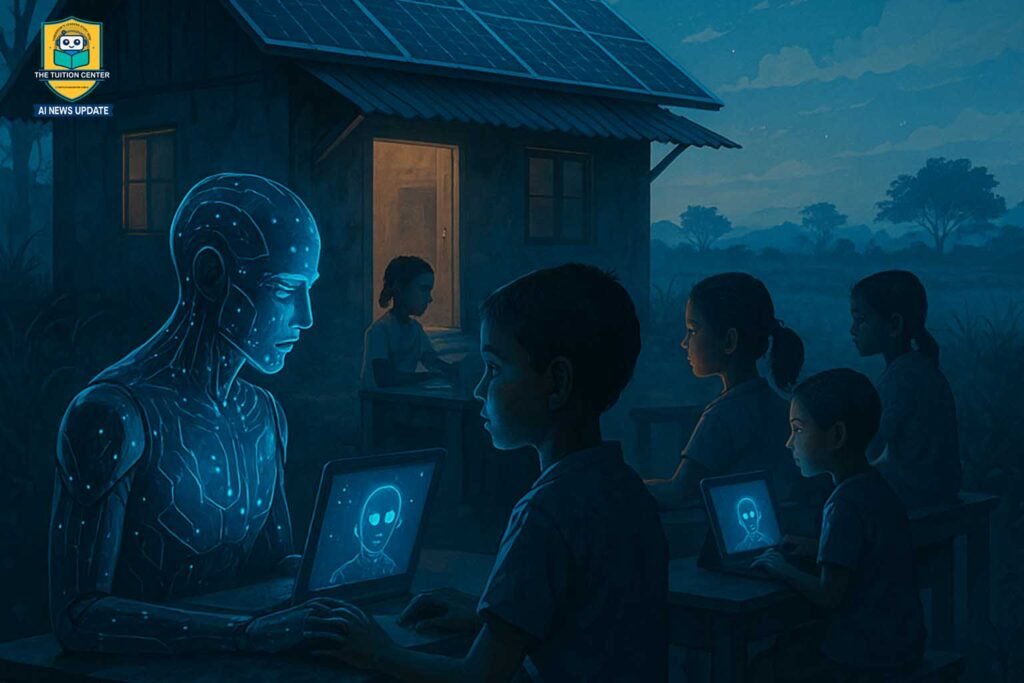
The AI Village School: How Solar-Powered Micro-Classrooms Are Lifting Millions Into the Future
Rural education is being transformed by a new model of solar-driven micro-schools supported by AI tutors, delivering personalised, high-quality learning where traditional schooling has struggled for decades.
- Over 40,000 villages globally now run AI micro-schools powered by solar energy.
- AI tutors adapt to local languages, learning levels, and personalized progress.
- Countries in Asia, Africa, and Latin America report 30–50% improvement in foundational literacy and numeracy within months.
Introduction
For decades, rural and low-income regions around the world have battled inadequate school infrastructure, lack of teachers, outdated textbooks, and limited access to digital learning. Nearly 260 million children globally live in communities where quality education is inconsistent or unavailable. Many villages have single-teacher schools, irregular attendance, and insufficient resources to support modern learning needs.
In 2025, a radical new model is rewriting this reality: AI-powered, solar-driven micro-schools. Built on low-cost infrastructure, rooftop solar panels, battery storage, and compact digital classrooms, these micro-schools are enabling world-class education to flourish in places long overlooked by traditional systems. The heart of these classrooms is an AI tutor — multilingual, adaptive, patient, tireless — capable of teaching children at their exact level, anytime, anywhere.
This movement is not a pilot — it is a revolution. From rural India to Kenya, from remote Indonesian islands to Andean mountain villages in Peru, AI micro-schools are giving children an unprecedented opportunity: personalised, high-quality learning in their own local language, powered entirely by renewable energy. The AI Village School model is proving that the future of education does not require massive concrete buildings — it requires intelligence, consistency, creativity, and energy independence.
Key Developments
Several breakthroughs in energy, AI, and low-cost hardware have converged to make rural micro-Schools a transformative force:
1. Solar Energy Independence
Solar rooftops with battery storage allow micro-schools to operate without dependency on unreliable grid power. In many remote areas, this makes AI education possible for the first time.
2. Offline-First AI Tutors
AI models optimised for low bandwidth — or complete offline operation — provide adaptive learning without requiring 24/7 internet. This addresses one of the largest barriers in rural education.
3. Local-Language AI Models
Children can now learn in their primary language: Hindi, Bengali, Tamil, Swahili, Arabic, Hausa, Amharic, Quechua, Bahasa Indonesia, and dozens more.
This multiplies learning speed and confidence.
4. Ultra Low-Cost Classrooms
With rugged tablets, micro-projectors, and modular furniture, a complete AI micro-School can be built for less than the cost of a single urban classroom.
5. Community Learning Guides
Instead of full-time teachers, villages employ trained “learning facilitators” — local youth who help supervise, motivate, and support children as the AI handles instruction and evaluation.
These developments combine to form a system that is resilient, scalable, affordable, and deeply personalised.
Impact on Industries and Society
The rise of AI micro-schools is reshaping more than education — it is triggering socioeconomic transformation in regions historically left behind.
1. Literacy and Numeracy Surge
Villages using AI tutors report dramatic improvements:
- Foundational math accuracy up 40–60% in 4–6 months
- Reading fluency doubling within a year
- Higher engagement due to interactive learning formats
2. Reduced Teacher Dependency
Rural schools often face teacher shortages and high absenteeism. AI tutors fill this gap, ensuring consistent instruction regardless of staff availability.
3. Women’s Empowerment
Micro-schools free mothers from excessive tutoring burdens and create income opportunities for women as community learning guides.
4. Youth Employment
Rural youth without formal teaching degrees can become certified facilitators — giving them dignified, stable employment within their villages.
5. Local Economic Uplift
Better-educated children → higher employability → stronger local economies → reduced migration pressure.
6. Global Workforce Pipeline
AI micro-schools are training future coders, digital workers, technicians, and AI-native learners who can integrate into global digital economies.
Expert Insights
“AI micro-schools are the first model that truly scales quality education to the last mile.” — Dr. Naomi Hughes, UNESCO Learning Innovation Council.
“This is not future-forward — this is present reality in thousands of villages. AI tutors are outperforming traditional homework and remediation everywhere we deploy them.” — Kelechi Amadi, African Education Innovation Network.
“Solar-powered learning hubs are the most important rural development infrastructure since mobile phones.” — Prof. Rajan Varma, IIT Gandhinagar.
India & Global Angle
India is rapidly becoming the global epicenter of AI micro-school adoption. Under NEP 2020, DIKSHA 2.0, Samagra Shiksha, and IndiaAI Mission, states are rolling out village learning hubs that combine solar energy, device-sharing models, and AI tutors.
Over 12,000 micro-learning centers across Rajasthan, Uttar Pradesh, Assam, Jharkhand, Karnataka, and Maharashtra are piloting AI-based literacy programs with promising early results.
Globally, Kenya, Nigeria, Indonesia, Peru, and the Philippines are deploying similar models, supported by UNICEF, UNDP, Google.org, and non-profit foundations.
Policy, Research, and Education
As solar-powered AI micro-schools expand across developing and emerging economies, policymakers are building new frameworks to regulate, standardise, and accelerate this model of community-based digital learning. Governments and global agencies recognise that these micro-classrooms are not temporary alternatives — they are the new foundation of rural education.
1. AI Education Policy Integration
Countries are drafting policies that:
- Define standards for AI tutors’ safety and reliability
- Ensure multilingual access for all regional communities
- Map AI learning outcomes to national curricula
- Set guidelines for permissible AI interaction with minors
- Mandate community oversight committees for micro-schools
India’s “AI Village Education Blueprint 2026” and Kenya’s “Solar Learning Act” are early examples of national policies that incorporate AI schooling models into mainstream education policy.
2. Evidence-Based Research
Universities and global institutions are studying the impact of village AI micro-schools using real-world data:
- Retention and comprehension improvements
- Dropout reduction in rural regions
- Behavioural improvements resulting from personalised learning
- Student confidence boosted by consistent AI engagement
- Teacher workload optimisation
Research from IIT Madras, University of Cape Town, University of Toronto, and the London School of Economics confirms that adaptive AI instruction significantly outperforms traditional lecture-based methods in rural contexts.
3. Teacher Roles Are Evolving
The micro-school model does not eliminate teachers — it transforms their roles.
- Teachers become mentors, guides, and motivators.
- AI handles teaching, correction, personalisation, and evaluation.
- Local youth facilitators help maintain attendance and support learners.
This hybrid system combines the emotional intelligence of humans with the precision and consistency of AI.
Challenges & Ethical Concerns
Despite extraordinary success, the rise of AI village schools brings significant challenges that must be addressed responsibly.
- Digital Divide: Many communities still struggle with device availability.
- Connectivity Gaps: Although offline AI helps, periodic updates require telecom support.
- Data Privacy: Children’s learning behaviour data must be strictly protected.
- Over-Reliance on AI: Educators fear children may depend too heavily on digital guidance.
- AI Bias: Language models may misinterpret dialects or accents if not properly trained.
- Local Resistance: Some communities initially mistrust AI involvement in schooling.
- Funding Sustainability: Building and maintaining micro-hubs require continuous investment.
Experts emphasise that the micro-school model must be community-led — not imposed — to ensure long-term success and cultural acceptance.
Future Outlook (3–5 Years)
- 1 Million AI Micro-Schools Worldwide: The model will scale rapidly across Asia and Africa.
- Universal Multilingual AI Tutors: AI will support 200+ languages and dialects.
- Solar + Battery Innovations: Lower costs will make micro-schools even more affordable.
- AI Career Pathways: Children in rural communities will directly access global digital opportunities.
- Village Learning Data Lakes: Anonymous insights will help governments optimise national education strategies.
- Community-Run Digital Campuses: Youth facilitators will evolve into “AI Educators” with formal certification.
- Reduced Migration: Better education and local jobs will lower urban migration pressure.
The next decade will see micro-schools become permanent, trusted pillars of rural development — delivering not just education, but empowerment.
Conclusion
The AI Village School model proves a powerful truth: world-class education no longer requires massive infrastructure, expensive staffing, or constant electricity. It requires innovation, accessibility, and a belief that every child — regardless of geography — deserves to learn with dignity and opportunity.
Solar-powered micro-classrooms supported by AI tutors are achieving what traditional systems have struggled to deliver for generations: personalised learning, consistent instruction, and measurable progress. These hubs represent the future of equal education — not as charity, but as a sustainable, scalable system.
The future belongs to communities that embrace this transformation. And for millions of children in rural regions, the AI Village School is not just a classroom — it is the doorway to a new life.