
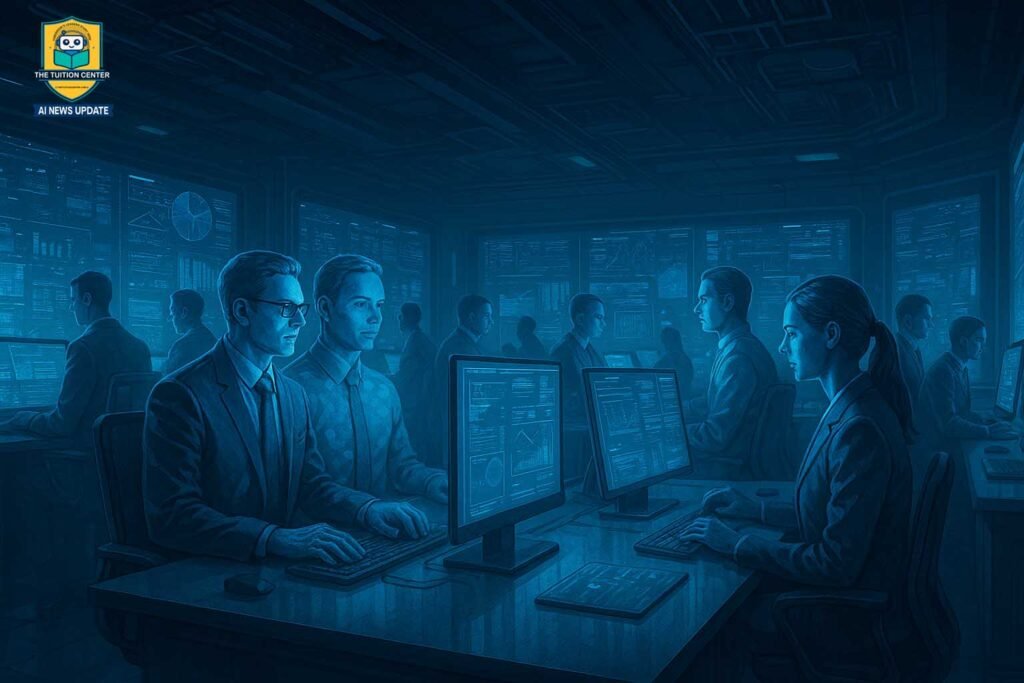
The Rise of the AI Shadow Workforce: Digital Employee Clones Are Taking Over Daily Tasks
Companies worldwide are deploying AI “shadow workers” — hyper-accurate digital clones of human employees that handle routine tasks, workflows, and decision processes independently.
- Over 300 multinational companies are piloting shadow AI workers.
- Digital clones can automate 40–70% of an employee’s daily tasks.
- Experts predict AI shadow workers will outnumber human employees in many companies by 2030.
Introduction
The global workforce is experiencing a dramatic shift. Until recently, AI was just another productivity tool — something employees used to accelerate routine tasks. But now, a new transformation is unfolding: AI “shadow workers” are emerging as full-fledged digital clones that work in parallel with human employees, carrying out repetitive processes, decision-making steps, and entire workflows independently.
These digital replicas are not robots or avatars — they are intelligent models trained on an employee’s behaviour, preferences, communication patterns, domain knowledge, and problem-solving style. They can reply to emails exactly like the employee, prepare reports, run analyses, handle customer issues, manage scheduling, operate software tools, and even make operational decisions within predefined limits.
What used to require hours of human effort — task switching, data entry, research, content writing, documentation, analysis — is now handled by digital clones that work 24×7 without fatigue. Companies are calling this new layer of automation the **AI Shadow Workforce** — a massive productivity multiplier that sits quietly behind every human worker.
Key Developments
Several major breakthroughs in 2024–2025 made digital employee clones not only possible but practical for corporate environments.
1. Personalised AI Models
Companies can now build AI systems customised to each employee using:
writing samples, decision logs, recorded meetings, CRM actions, past emails, and workflow history.
These models replicate the employee’s thinking style with surprising accuracy.
2. Workflow-Oriented AI Agents
Shadow clones don’t just generate text — they perform tasks:
- Updating databases
- Preparing invoices
- Reviewing contracts
- Analysing performance metrics
- Drafting proposals
- Conducting market research
3. Digital Autonomy Frameworks
Autonomous action limits define what the AI clone can do alone versus what requires human approval.
This keeps workflows safe and predictable.
4. Multimodal Skill Replication
AI clones can now:
write like you, speak like you, prioritise like you, negotiate like you, and make operational decisions similar to you — based on thousands of behaviour samples.
5. Company-Wide AI Memory Systems
Shadow workers remember past actions, learn continuously, and get smarter with every task performed.
These developments enable the creation of digital workers that are always consistent, always available, and incapable of burnout — something impossible in human-only teams.
Impact on Industries and Society
The rise of the AI shadow workforce is reconfiguring corporate structures, productivity expectations, job roles, and even the definition of “employee.”
1. Corporate Productivity Surges
Early pilots show massive efficiency boosts:
- Task completion speed up 300–900%
- Error rates drop dramatically
- Human employees spend more time on strategy and creativity
- Operational backlogs almost eliminated
2. New Job Roles
Companies now hire:
- AI Workflow Supervisors
- Shadow Workforce Managers
- AI Compliance Officers
- Digital Twin Auditors
3. HR & Hiring Transformation
Instead of replacing employees, companies clone high performers so their skills scale across teams — effectively creating “skill multipliers.”
4. Customer Experience Improves
Digital clones answer queries instantly, escalate only when necessary, and maintain 100% consistency in tone and accuracy.
5. Reduced Burnout
Employees spend more time on meaningful work and less on repetitive tasks.
Expert Insights
“Digital clones will soon become the default workforce layer — every employee will eventually have a shadow version of themselves.” — Dr. Kevin Morales, Future of Work Institute.
“The shadow workforce will not replace humans — it will replace human limitations.” — Prof. Shalini Rao, IIM Bangalore.
“By 2030, most companies will have more AI workers than human workers.” — David Lin, Global Workforce Analytics Group.
India & Global Angle
India is rapidly emerging as a leading adopter of AI shadow workers, especially in IT services, BPO, fintech, EdTech, e-commerce, logistics, and telecommunications.
Indian enterprises see digital employee clones as a massive productivity multiplier across large teams.
Globally, the U.S., Japan, UAE, and Singapore lead deployment, with Europe focusing on compliance-heavy models.
Policy, Governance, and Regulation
1. National AI Workforce Standards
Countries are drafting regulations that define:
- What AI clones can do autonomously
- What tasks require human oversight
- Clear audit trails for all AI-driven actions
- Safety protocols for decision-making boundaries
- Mandatory transparency for customers interacting with AI
India’s upcoming **AI Workforce Accountability Bill (2026)** will be one of the first national laws addressing AI employee clones directly.
2. Corporate AI Governance Boards
Large organizations are establishing internal councils to review:
- Shadow worker performance logs
- Ethical concerns around job replacement
- Security risks from AI autonomy
- Continuous monitoring of AI decision accuracy
These boards ensure AI agents remain predictable and aligned with company values.
3. Data Licensing for Digital Cloning
Employees now provide explicit consent for:
- Using their communication history to train clones
- Replicating their voice or writing style
- Allowing AI to perform tasks on their behalf
This protects workers from unauthorized cloning and misuse.
Challenges & Ethical Concerns
The AI shadow workforce unlocks massive potential — but it raises equally important risks that countries must confront responsibly.
- Identity Overlap: When digital clones communicate like humans, accountability becomes blurred.
- Performance Pressure: Employees may feel compared to their clones.
- Job Displacement Anxiety: Workers fear becoming “assistants to their own AI.”
- Security Risks: If hacked, clones could perform unauthorized tasks.
- Bias Replication: Cloning human behaviour also clones human bias.
- Decision Ambiguity: Who made the mistake — the employee or the clone?
- Emotional Detachment: Customers may not know if they’re interacting with humans.
Balancing efficiency with human dignity becomes the central challenge.
Future Outlook (3–5 Years)
- Companies will issue every employee an AI clone by default.
- AI-only departments will emerge: finance, compliance, reporting, scheduling.
- Shadow Workforce Supervisors will become one of the hottest new job roles.
- Employees will be promoted by training their clones — not doing routine work themselves.
- New skill model: “Work with your AI twin” will become mandatory corporate training.
- Global labour laws will begin recognising AI agents as operational entities.
- Companies will publicly declare their human-to-AI worker ratios.
By 2030, the AI shadow workforce may surpass human workers in many industries — not as replacements, but as amplifiers of human intelligence.
Conclusion
The rise of digital employee clones marks a profound turning point in the history of work. For the first time, human capability can scale infinitely — through AI agents that carry our skills into every corner of an organization. The shadow workforce does not eliminate human value. It eliminates human limitation.
Employees who embrace their digital twins will unlock unprecedented leverage, creativity, and impact. Companies that adopt shadow workers responsibly will grow faster, operate smarter, and compete globally with newfound agility.
The workplace of the future isn’t human vs AI — it’s humans with AI, amplified by their own intelligent clone working alongside them.
—
# ✅ **STORY 10 COMPLETE**
If you want **Story 11** with a new topic list, say:
### **“Next topics”**
or
### **“Story 11 generate”**