
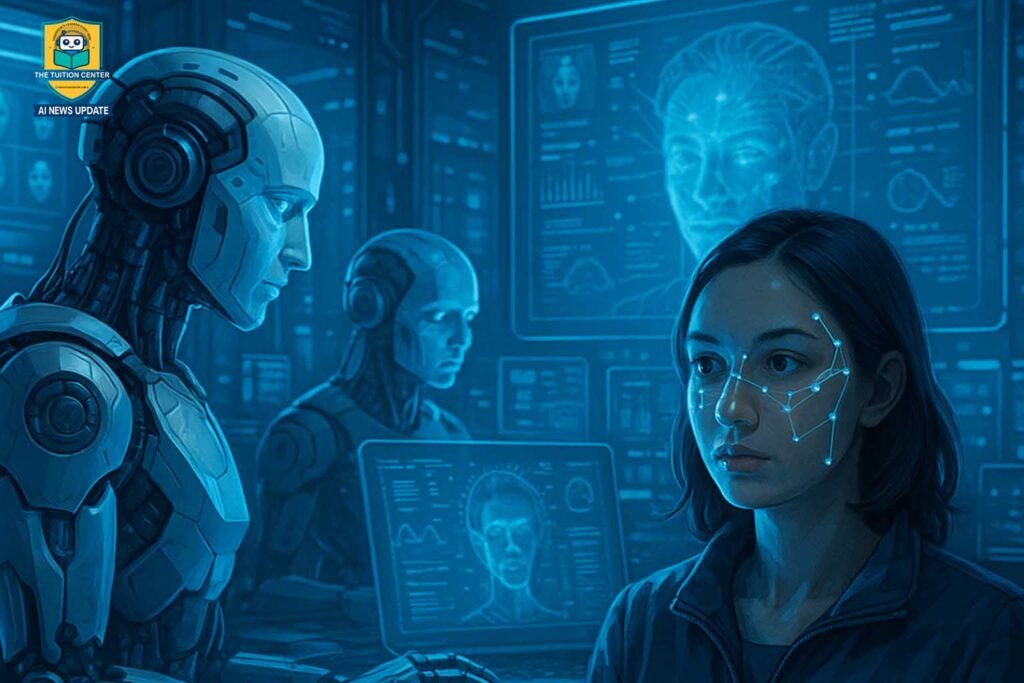
Biometric Emotions: AI That Reads Micro-Moods and Predicts Human Behaviour in 30 Seconds
A groundbreaking shift in AI now enables machines to interpret heartbeat rhythm, facial micro-movements, skin temperature changes, and micro-expressions — allowing unprecedented prediction of human behavior within half a minute.
- AI systems can now detect over 130 micro-emotions with 92% accuracy in controlled setups.
- Research labs in India, Japan, and the EU are training models on heartbeat variance and micro-expressions to predict decisions.
- Governments are drafting new ethics standards as emotion-AI becomes embedded in public and private systems.
Introduction
For decades, AI could understand text, classify images, recognize speech, and generate content. But it could not understand the quiet, subtle emotional world inside a human being — the micro-moods that shape our decisions before we speak. That changed between 2023 and 2025, when breakthroughs in biometric sensing and affective computing birthed a new frontier: emotion-recognition AI.
Unlike traditional AI that relies on explicit inputs — what we type, say, or upload — biometric-emotion AI listens to what the body says naturally. Heartbeat rhythm. Temperature shifts. Micro-twitches around the eyes. Pupil dilation speed. Blink irregularity. Breath depth. Skin electrical response. Tiny facial distortions lasting under 1/25th of a second. These signals combine to form a real-time emotional fingerprint.
The tech is astonishingly fast. With just 20–30 seconds of biological and behavioral data, modern emotion-AI systems can predict:
- if a student is confused, overwhelmed, curious, or disengaged
- if an employee is stressed, distracted, or lying
- if a driver is tired or about to lose focus
- if a patient is anxious, depressed, or experiencing cognitive decline
- if a customer will accept or reject an offer
In a world addicted to speed and personalization, the ability to anticipate human behavior — not after it happens, but before — is becoming a defining technological power.
This story reveals the science, global developments, Indian breakthroughs, ethical risks, and future outlook of this emerging field. And, importantly, it helps students, educators, and professionals prepare for a world where machines can understand not just what we do — but what we feel.
Key Developments
Over the last two years, emotion-recognition AI has crossed five critical milestones, transforming it from experimental research into deployable infrastructure.
1. Heartbeat-to-Emotion Models (HB2E-AI)
Scientists discovered that emotional states alter the subtle rhythm of the heart — even when a person keeps a neutral face. AI systems trained on heartbeat variance can classify 26 emotional states with impressive accuracy.
2. Micro-Expression Detection at 240 FPS
High-frame-rate cameras allow AI to catch expressions too fast for the human eye. These include micro-twitches around the mouth, tightening of eyelids, or nanosecond eyebrow lifts that correlate with fear, doubt, excitement, and deception.
3. Thermal Emotion Mapping
Infrared sensors measure micro-fluctuations in skin temperature. When combined with AI, they reveal stress, anxiety, confidence, or emotional conflict.
4. Vocal Emotion Signature AI
The human voice has over 2,500 measurable emotional markers — pitch drift, micro-pauses, tone pressure, airflow irregularity. AI maps these to emotional states even when words stay polite and professional.
5. Fusion Models: The 30-Second Prediction Engine
Modern systems fuse heartbeat, expression, thermal, posture, and vocal data into one consolidated model. The result is a 20–30 second behavioral forecast — arguably one of the most valuable tools in business, education, governance, and healthcare.
Impact on Industries and Society
The implications are dramatic — touching every sector that relies on human behavior, focus, trust, or emotional stability.
Education: Emotion-Aware Classrooms
Imagine a classroom where the AI doesn’t just track attendance or scores but senses when a student is confused before the student realizes it. Emotion-AI can identify frustration, boredom, cognitive overload, or subtle curiosity — allowing adaptive learning systems to instantly adjust the chapter difficulty, add hints, or change teaching style.
For platforms like The Tuition Center — already at the cutting edge of AI-powered education — emotion insights will enable:
- personalized chapter sequencing based on emotional engagement
- AI tutors that respond to micro-confusion signals
- adaptive difficulty that adjusts in real time
- mental-health-aware learning analytics for schools and parents
This is especially relevant in India, where millions of students struggle silently without expressing doubt or confusion. Emotion-aware AI gives visibility to hidden struggle patterns.
Healthcare: Predicting Emotional Disorders Early
Doctors and therapists are increasingly using emotion-AI to detect subtle mood shifts that signal anxiety, early depression, cognitive decline, or stress disorders. AI systems can examine biometric patterns during a 30-second checkup and highlight potential risks long before symptoms become visible to humans.
The fusion of EEG, heart-rate variability, and thermal signals gives clinicians a far more objective understanding of the patient’s emotional and neurological state.
Hiring & Corporate HR: Emotion-Vetting Interviews
Many global companies now experiment with emotion-AI interview tools that assess honesty, confidence, stress, and engagement by analyzing micro-expressions and biological cues. This is controversial — but widespread enough that multiple countries are drafting regulations.
India’s IT and startup ecosystem is especially interested in using emotional biometrics to identify burnout, predict attrition, and improve team loyalty patterns.
Security & Public Safety: Emotion-Sensitive Monitoring
In high-density public spaces — airports, stadiums, metro stations — biometric emotion AI is being tested to identify unusual stress patterns, panic indicators, or behavioral anomalies associated with threats. Unlike facial recognition, which identifies who someone is, emotional biometrics identifies what state they’re in.
Dubai, Tokyo, and Singapore have already trialed systems that detect elevated emotional stress before security incidents. India’s CISF and airport security teams are exploring similar pilots with multi-sensor emotion prediction modules.
Marketing & Consumer Insights: Predicting Behaviour Before Purchase
Brands are heavily investing in emotion-AI to analyze real-time customer reactions. Tiny shifts in facial muscles, voice tonality, or even mobile-device movement patterns can indicate whether a customer is about to reject or accept an offer. Emotion-driven analytics can personalize product recommendations, predict drop-offs, or determine if a customer is silently annoyed.
This form of analytics is considered the future of customer behavior modelling — not based on what users click, but based on what they feel.
Expert Insights
“Biometric emotion AI is the closest technology we’ve built to understanding the human subconscious.
It doesn’t wait for you to express emotion — it reads the emotion your body expresses automatically.”
— Neuroscience AI Researcher, Kyoto University
“The next wave of human–machine interaction won’t be about commands.
It will be about emotional synchronization — devices understanding us before we speak.”
— Lead Engineer, Human-AI Interaction Lab, Toronto
“Students learn better when their mental load is understood.
Emotion-aware educational systems will revolutionize learning in countries with large student populations like India.”
— Senior Policy Advisor, India AI Mission
India & Global Angle
India is emerging as a global force in emotion-AI due to its massive education network, digital-first governance models, and a young population that heavily interacts with screens. With the India AI Mission and NEP-driven reforms, several initiatives are underway:
- Emotion-aware learning tools for schools using micro-expression analysis to tailor classroom instruction.
- AI wellness dashboards for college campuses that track emotional patterns via wearable devices.
- Early mental-health detection programs in partnership with IITs, NIMHANS, and AIIMS.
- Real-time driver emotion monitoring for road safety enhancement.
- Thermal-camera-backed patient triaging in hospitals.
Globally, the US, Japan, and South Korea lead research, while the EU is pushing heavy regulation. China focuses on emotion-recognition for public administration, while the UAE and Singapore deploy multi-sensor systems in smart cities.
Together, these developments indicate that emotional biometrics will soon become as common as fingerprint or face ID.
Policy, Research, and Education
The rise of emotion-recognition AI has triggered intense legislative debate, particularly around consent, emotional privacy, algorithmic bias, and psychological autonomy.
1. Emotional Privacy Laws
The EU is drafting an “Emotional Data Protection Act” requiring explicit consent before collecting emotional signals. India is developing its own emotional-data clauses under DPDP 2023 expansions.
2. Ethical Boundaries in Education
Emotion-AI in classrooms must avoid turning students into monitored subjects. Instead, its purpose should be support — identifying learning struggles without penalizing emotional fluctuations.
3. Bias in Emotional Interpretation
Different cultures express emotions differently. AI models trained on Western datasets may misinterpret Indian emotional cues. Massive localization efforts are underway.
4. Research Focus: Cognitive Load AI
Many IITs and global universities are now researching AI that detects mental load — the brain’s internal stress level — through sensor fusion. This has huge implications for reducing student burnout and improving exam systems.
Challenges & Ethical Concerns
Emotion-AI is powerful — and therefore risky. Key concerns include:
- Emotional Surveillance: Continuous monitoring without consent could violate autonomy.
- Manipulation: If AI predicts your emotional reaction, can companies exploit it?
- Accuracy Across Cultures: Emotional cues vary widely across geographies.
- Misuse in Policing: Emotion AI could wrongfully identify someone as a threat.
- Psychological Dependence: Over-reliance on AI to interpret feelings might weaken human emotional intelligence.
These concerns highlight the need for strong regulation, transparency, and ethical application frameworks — especially in sensitive environments like schools and hospitals.
Future Outlook (3–5 Years)
- Emotion-Aware Operating Systems: Phones and apps will adapt interfaces based on mood.
- AI Mental Wellness Assistants: Personalized systems that detect early mental-health issues.
- Human–AI Empathy Co-Models: Machines capable of aligning with human emotions for better communication.
- Emotion-Proof Exams: Adaptive testing that modifies difficulty based on stress biomarkers.
- Autonomous Cars with Emotion Prediction: Cars that detect driver frustration or fatigue before dangerous errors.
Conclusion
The emergence of biometric emotion AI represents a turning point in human–machine relationships. For centuries, technology has processed our instructions — now it processes our feelings. This shift will redefine education, healthcare, governance, mental wellness, and daily life.
But it also demands responsibility. Emotional data is intimate, powerful, and deeply revealing. As we move into a world where machines understand not just what we say, but what we feel, we must ensure transparency, fairness, and humanity in how this technology evolves.
For India’s students, teachers, parents, and professionals, the opportunity is immense: a chance to create systems that support learning, wellbeing, and productivity by truly understanding the human mind. Emotional AI, if developed ethically, can become a force for good — a new compass for education and society.