
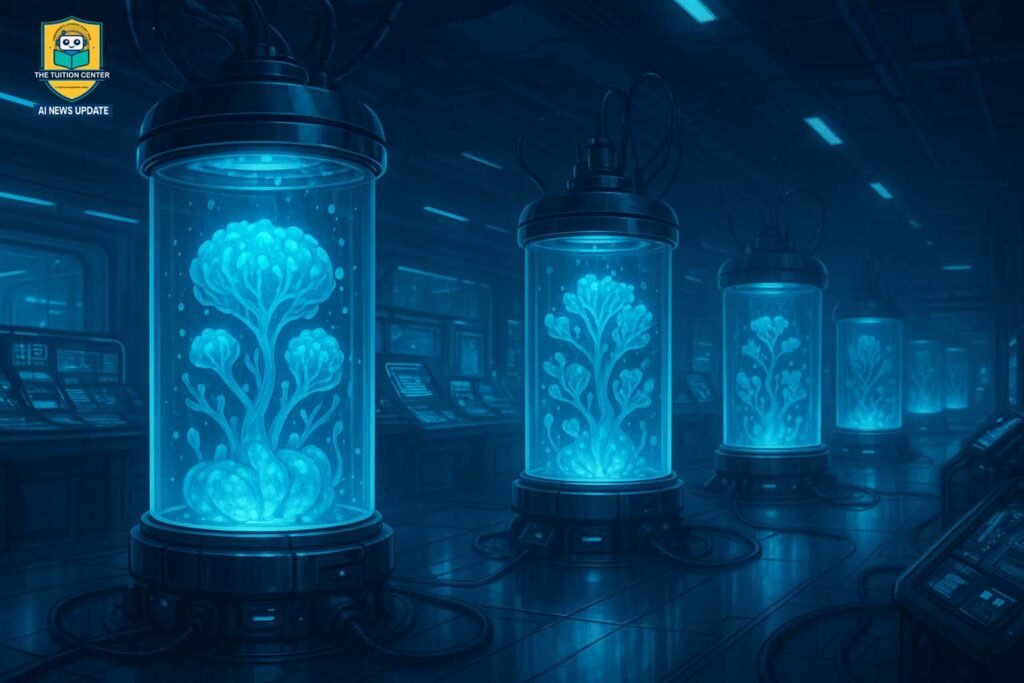
Synthetic Food Ecosystems: AI-Designed Edible Life for Zero-Resource Environments
Food scarcity is rising. Land is shrinking. Water tables are collapsing. AI is now designing edible lifeforms grown without soil, sunlight, or traditional farming — the next revolution in global food security.
- AI models now design nutrient-dense edible organisms from scratch.
- Zero-resource food ecosystems reduce water use by 98%.
- India and UAE are piloting AI-powered food bioreactors for climate-stressed regions.
Introduction
The world’s population crosses 8.3 billion. Traditional agriculture is collapsing under heat, drought, soil loss, groundwater depletion, and climate volatility. Nations face the harsh truth: food systems built on land, rain, livestock, and predictable seasons will not survive the next century.
This is pushing humanity toward a radical new frontier — food that does not come from farms, animals, or soil. Food that is not “grown” but *designed*. Food that is not dependent on rainfall or weather cycles but emerges inside controlled bioreactors powered by AI and synthetic biology.
Welcome to synthetic food ecosystems — autonomous, AI-designed edible lifeforms created from cellular structures, nutrient matrices, and computational evolution. These edible organisms grow with almost no external inputs. They feed themselves through closed nutrient cycles. They regenerate. They scale vertically. They can be shipped anywhere.
This isn’t science fiction. This is the deepest food revolution since the invention of agriculture itself.
Key Developments
1. AI-Generated Edible Organisms
AI now designs novel edible structures — protein-rich, vitamin-optimized, allergen-free foods built from cellular templates. Some resemble tofu; some resemble fish; some resemble fruit; others are entirely new textures.
2. Zero-Resource Bioreactors
These sealed food-production chambers recycle water, nutrients, and carbon internally — creating perpetual food loops without soil or sunlight.
3. Self-Regenerating Food Blocks
Certain AI-designed biomass clusters regenerate overnight, providing continuous harvest cycles.
4. Space-Grade Nutrition Engineering
NASA, ISRO, and ESA are testing AI-designed edible organisms for Mars colonies and long-duration missions.
5. India’s Synthetic Food Missions
Startups in Bengaluru, Hyderabad, and Pune are building bioreactors capable of feeding entire urban districts with minimal resources.
Impact on Industries & Society
1. Ending Urban Food Insecurity
Global cities face shrinking farmland and expensive supply chains. Synthetic food ecosystems solve this problem by producing massive quantities of food in micro-factories located inside cities themselves.
Advantages:
- No farms required
- No livestock emissions
- No pesticides
- Minimal water usage
- Local, fast production
2. Feeding Desert Nations
Countries like UAE, Qatar, Oman, Sudan, and Saudi Arabia are using AI-powered food reactors to produce protein in areas where agriculture is impossible.
3. Disaster Relief & War Zones
Synthetic food blocks can be transported into war zones, refugee camps, and disaster-hit regions where traditional supply chains collapse.
4. Space Settlements & Interplanetary Colonies
Synthetic food ecosystems are the backbone of future Mars, Moon, and asteroid colonies. They require:
- no soil
- no sunlight
- minimal maintenance
- recyclable nutrients
AI manages food growth cycles, flavor design, nutritional balance, and regenerative harvesting.
5. Ending Livestock Emissions
Livestock creates more greenhouse gases than all global transportation combined.
Synthetic edible organisms remove the need for cattle, poultry, and fisheries — cutting methane emissions dramatically.
Expert Insights
“AI-designed food is the only scalable answer to feeding 10 billion people sustainably.”
— Director, Global Future Food Institute
“Zero-resource food ecosystems will be the greatest climate solution no one saw coming.”
— MIT Computational Biology Lab
“India can lead the world in synthetic food if it acts now — our population, climate pressure, and tech talent give us a strategic advantage.”
— Chief Scientist, India FoodTech Mission
India & Global Angle
India’s rapid urbanization puts enormous strain on farmland. Synthetic food ecosystems give the country a chance to stabilize nutrition availability without relying on unpredictable monsoons.
India’s Momentum
- Bengaluru labs designing AI-optimized protein biomass
- IIT Kharagpur working on edible microbial lattices
- Hyderabad clusters developing bioreactor food factories
- ISRO testing synthetic food for manned space missions
Global Developments
- Singapore: World’s first zero-resource protein facility
- Japan: AI-engineered seafood replacements
- Netherlands: Synthetic dairy ecosystems
- UAE: AI-powered desert food factories
Policy, Research & Education
1. Food Safety Standards for Synthetic Biology
Governments must regulate genome-edited edible organisms with strict quality testing.
2. National Food Independence Missions
Countries with limited farmland will adopt synthetic food ecosystems to achieve food sovereignty.
3. Educational Transformation
New fields emerging:
- AI Food Design
- Computational Gastronomy
- Synthetic Nutrition Engineering
- Bio-Food Architecture
4. Ethical Oversight
Clear global policies must govern genetic modification, intellectual property of food organisms, and economic access.
Challenges & Ethical Concerns
- Public Acceptance: Will people eat AI-designed organisms?
- Genetic Safety: Synthetic food must not mutate unpredictably.
- Economic Disruption: Farmers and traditional industries will be affected.
- Corporate Monopoly: Food must not be controlled by a handful of tech giants.
- Ecological Containment: Synthetic organisms must not escape into natural ecosystems.
Future Outlook (3–5 Years)
- AI-designed national food grids
- Fully autonomous food bioreactor cities
- Edible organisms customizable for each person
- Zero-water global protein markets
- Food independence for climate-stressed nations
Conclusion
Synthetic food ecosystems represent humanity’s most radical food revolution since farming began 12,000 years ago. Powered by AI, these edible lifeforms can feed billions without relying on land, water, livestock, or weather.
India stands at a defining moment. With climate extremes rising and agriculture under pressure, embracing AI-designed food ecosystems is not a luxury — it is survival, sovereignty, and opportunity.
The next chapter in global food security will not be grown in soil.
It will be designed in intelligence.