
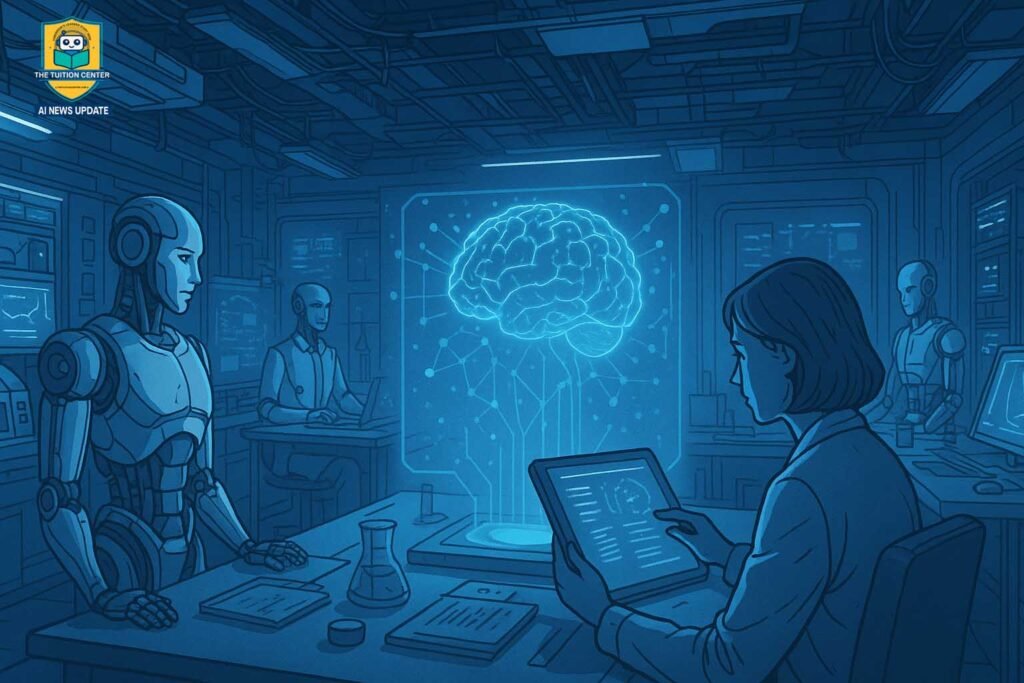
Multimodal Intelligence 2025: AI That Sees, Hears, Reads, Speaks — and Learns Everything at Once
AI is evolving beyond text. It now understands images, video, speech, emotions, environments, documents, and complex real-world patterns — all at the same time.
- AI models in 2025 understand text, audio, images, video, documents, and sensor data simultaneously.
- Multimodal systems now power education, healthcare, robotics, design, governance, and content creation.
- India is among the fastest adopters of multimodal AI in classrooms and enterprises.
Introduction
A year ago, AI mostly meant chatbots. Tools that could generate text or answer questions. The world had barely scratched the surface of
what was possible. But 2025 marks a turning point: the era of Multimodal Intelligence. These next-generation AI
systems can do what humans do naturally — interpret different types of information at once. They see, hear, read, speak, analyse,
observe, and understand complex contexts across multiple streams.
Imagine an AI that can watch a lecture, extract text from a whiteboard, identify confusion on students’ faces, summarise the lesson,
create a quiz, produce a video explanation, and auto-translate everything into 45 languages. That is multimodal intelligence.
It’s no longer science fiction. It’s the backbone of AI innovation in 2025.
What Exactly Is Multimodal AI?
Multimodal AI uses multiple forms of data:
- Vision — images, diagrams, objects, videos
- Speech — accents, tone, emotion, real-time interpretation
- Text — documents, notes, handwriting
- Audio — environmental cues, sound classification
- Motion — movement patterns, gestures
- Sensory Signals — IoT devices, sensors, biometrics
The magic lies in the synergy — the ability to blend all these inputs into a coherent understanding of the world. This is what makes
multimodal models so powerful: they perceive reality the way humans do.
Key Developments in 2025
The explosion of multimodal intelligence this year was the result of several breakthroughs.
1. Unified Multimodal Models
Models like GPT-5, Gemini Ultra, and OpenV2 integrate all modalities under one architecture, eliminating the need for separate image
or speech engines.
2. Massive Vision-Language Datasets
Global universities and research labs collaborated on datasets blending:
- Video + audio transcripts
- Images + descriptions
- Charts + numerical data
- Textbooks + diagrams
These became the training ground for truly intelligent agents.
3. Real-Time Multimodal Reasoning
AI doesn’t just “recognise” anymore — it reasons. For example:
“A teacher is pointing at the solar system diagram and explaining planetary rotation.”
The model not only sees the planets but understands the concept being taught.
4. Video + Voice AI Generation
Video generation models now create:
- Realistic avatars
- Educational lectures
- Training simulations
- Explainer videos
This is transforming industries from film to education.
Impact on Industries and Society
1. Education & Learning
Multimodal AI is redefining learning with:
- AI tutors that understand handwritten notes
- Homework evaluation using image + text reasoning
- Voice-based language learning
- Adaptive video lessons
- Interactive virtual labs
Students from India to Europe are experiencing personalised, multimodal learning experiences that were impossible before.
2. Healthcare
Multimodal AI analyses:
- Scans (X-ray, MRI)
- Doctor’s notes
- Patient voice symptoms
- Medical history
This reduces misdiagnosis, improves treatment plans, and speeds up emergency care.
3. Business & Enterprises
AI now reviews:
- Invoices
- Documents
- Emails
- Charts
- Sales calls
- Meeting videos
It creates a unified understanding of operations — something humans would take weeks to compile.
4. Robotics
Robots powered by multimodal AI can:
- Understand human gestures
- Recognise surroundings
- Navigate safely
- Respond to voice commands
This opens the door to smart factories, AI-driven logistics, and domestic robot assistants.
Expert Insights
“Multimodality is the closest AI has come to human cognition. The next generation won’t need instructions — it will infer meaning from context.”
— Research Chair, Stanford HAI.
“India’s classrooms will be powered by multimodal AI within five years. Students learning via text, voice, and video simultaneously will outperform traditional learners by a huge margin.”
— Director, National AI Education Mission, India.
India & Global Angle
India is at the centre of multimodal adoption. With its enormous education sector, tech workforce, and multilingual population,
India is naturally aligned with multimodal systems.
The global scene is equally competitive:
- UAE using multimodal AI for smart governance
- USA deploying multimodal agents in healthcare
- Japan integrating multimodal robotics in ageing care
- Europe regulating multimodal AI transparency
Policy, Research, and Education
Governments and universities are rapidly building multimodal training hubs. Key initiatives include:
- Dedicated multimodal AI labs in IITs and NITs
- Degree programs in AI perception, cognition, and real-time analysis
- Global partnerships for dataset creation
- Ethical frameworks for multimodal surveillance & privacy
Challenges & Ethical Concerns
1. Deepfake Explosion
Video + voice generation leads to realistic impersonations. Regulation is catching up, but slowly.
2. Data Privacy
Audio + video + text means AI sees everything. Guardrails are essential.
3. Bias in Vision Models
Vision-based decisions can be skewed without proper dataset diversity.
4. Surveillance Risks
Governments and corporations can misuse multimodal systems if left unchecked.
Future Outlook (3–5 Years)
- Real-time AI classroom instructors
- Full educational courses generated from a single topic prompt
- Multimodal health assistants for every household
- Unified AI workplace dashboards analysing meetings, notes, documents, and performance
- AI-powered AR glasses for real-world multimodal navigation
Conclusion
Multimodal Intelligence is the next major leap in AI. It brings machines closer to human-level understanding, unlocks new learning
possibilities, accelerates global research, and redefines industries forever. The future will belong to students, professionals,
and nations that adopt and innovate on top of multimodal systems.
#AI #AIInnovation #FutureTech #DigitalTransformation #AIForGood #GlobalImpact #Education #LearningWithAI #TheTuitionCenter