
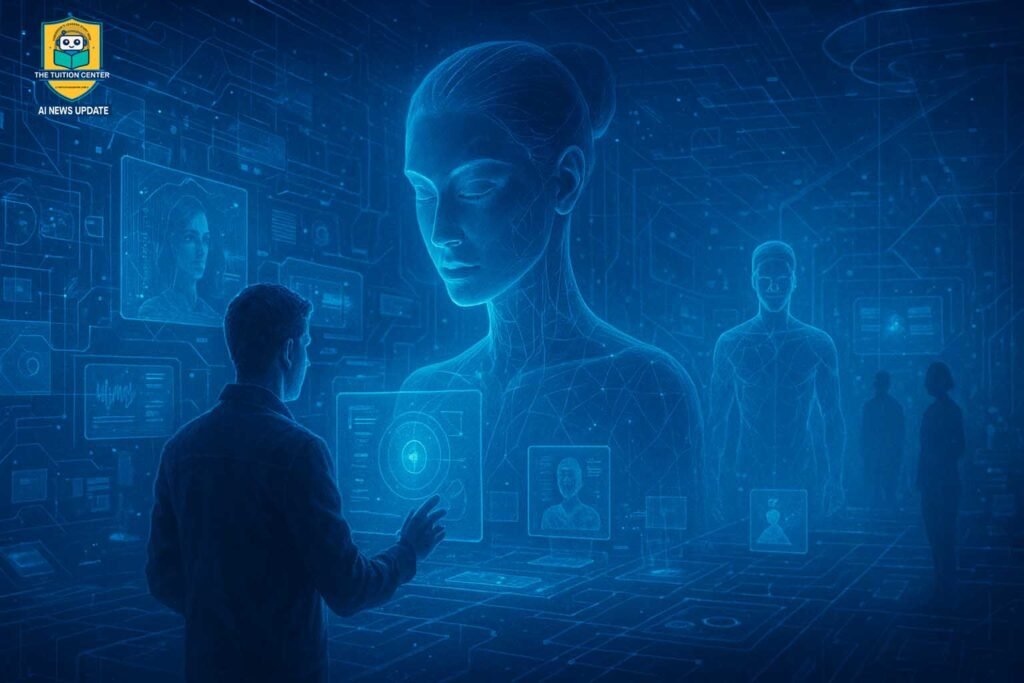
The New Workforce: How AI Co-Workers Are Transforming Skills, Productivity, and the 9-to-5 Job Forever
AI isn’t replacing workers—it’s joining them. A new era of human–AI collaboration is redefining jobs, skills, salaries, and how work gets done across the world.
- AI co-workers handle 40–60% of repetitive digital tasks in major industries.
- Companies are redesigning job roles around “human creativity + AI execution.”
- India leads global demand for AI upskilling, micro-certifications & digital workforce training.
Introduction
The world expected robots to take over factories.
Instead, artificial intelligence quietly took over our laptops.
Not by replacing workers—but by becoming their co-workers.
From virtual assistants that draft reports to autonomous agents that run entire workflows, AI has entered the workplace as a
collaborator, not a competitor. The shift is dramatic: instead of humans supporting machines, machines now support humans.
Companies around the world are restructuring roles, redesigning offices, and rethinking productivity because AI shares the desk.
The traditional 9-to-5 job isn’t dying.
It’s evolving — into something faster, smarter, more flexible, and more human than ever before.
The Birth of AI Co-Workers
AI co-workers are systems that:
- Complete tasks end-to-end
- Take decisions within boundaries
- Collaborate with humans in real time
- Learn from feedback
- Automate complex processes
They don’t just respond; they act.
They don’t just chat; they execute.
Three Types of AI Co-Workers
- 1. Assistant AI — Supports human tasks (drafting, summarising, scheduling)
- 2. Autonomous Agents — Manage workflows independently
- 3. AI Teams — Multi-agent systems working together like human teams
Every major industry now uses at least one of these.
Key Developments Shaping the New Workforce
1. Autonomous AI in Corporate Offices
AI agents handle:
- Email triage
- Meeting summaries
- Document drafting
- Research reports
- Data cleanup
- CRM updates
- Compliance filing
Employees report saving 3–5 hours per day.
2. AI in Customer Service
AI voice agents resolve 70% of customer queries independently.
Human agents now handle only complex emotional or strategic cases.
3. AI in Education
Teachers worldwide now rely on AI for:
- Lesson planning
- Paper evaluation
- Student analytics
- AI-generated worksheets
- Real-time classroom insights
Students have personal AI tutors available 24/7.
4. AI in Healthcare
AI assists with:
- Radiology scans
- Symptom analysis
- Risk forecasting
- Insurance documentation
- Treatment recommendations
Doctors maintain control — AI accelerates precision.
The Skills Revolution
AI didn’t eliminate skills. It changed which skills matter.
Top 10 Skills of 2025
- AI collaboration
- Prompt engineering
- Analytical reasoning
- Emotional intelligence
- Critical thinking
- AI-assisted creativity
- Data literacy
- Digital adaptability
- Multimodal communication
- Human leadership
Notice the pattern: humans are shifting from technical execution to strategic thinking and creativity — while AI executes tasks.
The New Rule:
“AI does the work, humans do the judgment.”
That’s the foundation of the AI-powered workforce.
Productivity Explosion
Businesses adopting AI co-workers are reporting:
- 35–60% drop in workload
- 2–3× faster project cycles
- 80% fewer repetitive tasks
- Significant reduction in errors
- Better work-life balance for employees
Some companies even shifted to 4-day work weeks while increasing output.
Expert Insights
“AI won’t replace humans. But humans using AI will replace humans not using AI.”
— Chief Digital Officer, Fortune 100 Company.
“In five years, every white-collar worker will have an AI co-worker. It’s inevitable — and it’s empowering.”
— Harvard Future Work Lab Researcher.
India & Global Perspective
India is one of the fastest adopters of AI-driven workplaces due to:
- Massive digital workforce
- Outsourcing industry transformation
- Government-led AI skill missions
- Low-cost access to AI training
- Startups building AI-first tools
Internationally:
- USA is building AI-first corporate infrastructure
- UAE is creating AI-governed service sectors
- Japan uses AI for workforce shortages
- Europe focuses on AI ethics & workplace transparency
Policy, Research, and Education
Countries are implementing policies like:
- AI-assisted job transition programs
- Human–AI governance frameworks
- Upskilling credit systems
- AI competency certifications
- AI workforce safety standards
Universities are creating AI-integrated curriculum across:
- Business
- Engineering
- Arts
- Healthcare
- Law & governance
Challenges & Ethical Concerns
1. Job Anxiety
Workers fear replacement.
Companies must communicate clearly and invest in reskilling.
2. Skill Gap
Those who don’t adapt will be left behind.
Digital literacy is now as important as reading.
3. Accountability
Who answers when an AI co-worker makes a wrong decision?
New policies are needed.
4. Ethical Use
AI must enhance work—not exploit workers or invade privacy.
Future Outlook (3–5 Years)
- Every worker will have a personalised AI assistant agent
- 90% of digital workflows will be AI-driven
- AI performance reviews integrated into HR systems
- AI-driven micro-degrees for workforce upskilling
- 4-day work weeks will become global standard
Conclusion
AI co-workers are not a threat—they are an upgrade.
They amplify human strengths, eliminate boring tasks, accelerate careers, and create space for creativity, leadership, and meaningful work.
The future of work is not human vs AI.
It’s human + AI.
And those who learn to collaborate with their AI co-workers will define the next generation of success.