
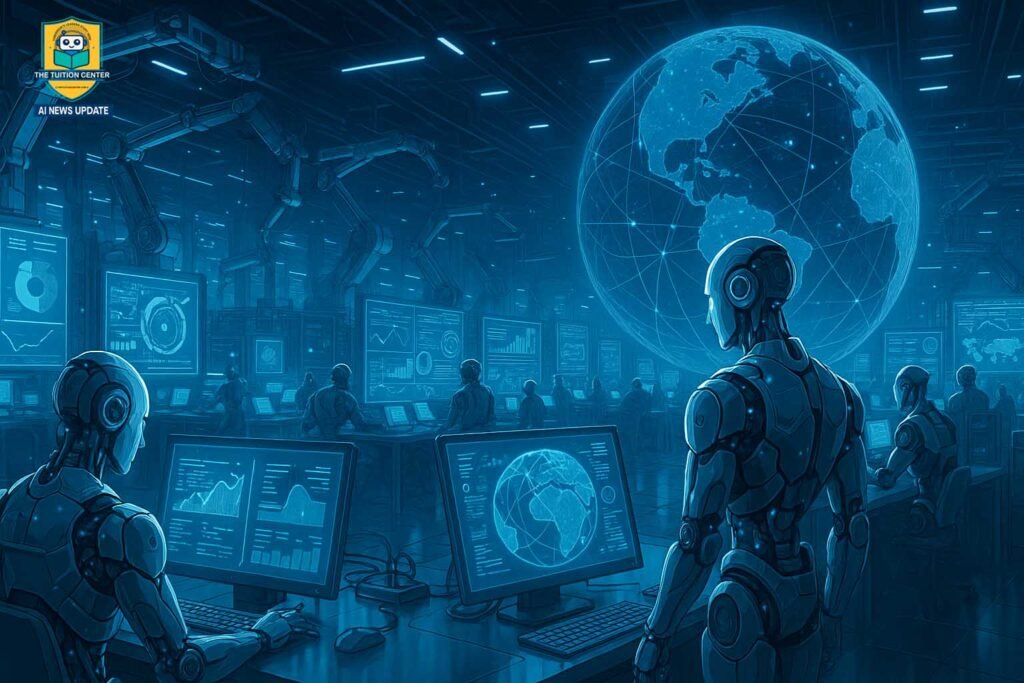
The Automation Singularity: How AI Workflows, Agents, and No-Code Tools Are Rebuilding the Global Workforce
Automation has broken free from factories and entered everyday life. AI agents, no-code systems, and autonomous workflows are now reshaping industries, jobs, and the very definition of work.
- AI agents now work as digital employees, managing tasks end-to-end.
- No-code tools allow anyone to build automation systems without programming.
- Businesses are reorganizing roles around hybrid human-AI teams.
Introduction
In 2010, automation meant robots in factories.
In 2020, automation meant software like Zapier and Google Scripts.
In 2025, automation means something far more powerful:
AI agents that think, decide, coordinate, and execute workflows independently.
We have reached what experts call the Automation Singularity — the moment when AI no longer just assists with tasks but manages entire processes, becoming a true partner in production, operations, learning, healthcare, finance, and business.
This shift is not the future — it is happening right now in companies, governments, startups, and homes around the world.
The Rise of AI Agents
AI agents are autonomous digital workers capable of:
- decision-making
- planning
- task execution
- workflow management
- problem-solving
- coordination with other AIs
These agents operate across industries:
1. Customer Support Agents
AI handles:
- email replies
- chat conversations
- ticket resolution
- product recommendations
Companies report 60–80% reduction in response time.
2. Finance & Accounting Agents
AI now performs:
- invoice processing
- financial forecasting
- expense auditing
- fraud detection
3. HR & Talent Agents
AI screens resumes, schedules interviews, and evaluates candidate fit.
4. Marketing Automation Agents
AI creates campaigns, designs content, analyzes performance, and reallocates budgets.
5. Education Agents
AI tutors personalize lessons, track learning, assign homework, and evaluate answers.
6. Operations & Supply Chain Agents
AI optimizes routing, procurement, vendor management, and inventory forecasts.
No-Code Tools: Automation for Everyone
No-code platforms like n8n, Make.com, Zapier, and Airtable allow anyone — even without programming knowledge — to build workflows that used to require a team of developers.
No-code automation has three superpowers:
- Speed — build in hours, not months
- Affordability — almost zero cost compared to engineering teams
- Accessibility — anyone can automate, not just tech experts
In 2025, no-code is no longer for “simple tasks.”
It can integrate:
- AI APIs
- payment systems
- CRMs
- databases
- cloud functions
- voice & video automation
AI Workflows: The New Digital Assembly Line
In traditional workflows, humans triggered every step.
In AI workflows, AIs trigger AIs — forming a chain of autonomous decisions.
Example:
A real estate business uses automation to:
- scan leads from WhatsApp
- auto-qualify them using AI
- check budgets via an agent
- send personalized property videos
- schedule site visits automatically
- log conversations in CRM
- trigger follow-ups
No human involvement until the client is ready to talk.
Impact on the Global Workforce
1. Jobs Are Changing, Not Disappearing
Automation replaces repetitive tasks, not human creativity.
Instead of losing jobs, workers evolve into:
- AI supervisors
- workflow designers
- data curators
- AI ethicists
- prompt engineers
2. Productivity Has Exploded
Companies adopting AI automation report:
- 40–400% productivity gains
- 3× faster delivery times
- 70% lower operational costs
3. New Industries Are Emerging
Autonomous workflows are creating:
- AI automation consultancies
- AI-powered SMB tools
- industry-specific AI stacks
- AI-native startups
India’s Role in the Automation Singularity
India is at the center of the automation explosion because:
- SMBs are adopting AI faster than global averages
- startups are building AI-first products
- India has the world’s largest pool of no-code builders
- government services are digitizing at massive scale
- young talent is upskilling in GenAI automation
India is on track to become the world’s largest automation economy by 2030.
Challenges Ahead
1. Skill Gaps
Most workers still lack AI literacy.
2. Workforce Resistance
Some fear replacement instead of embracing collaboration.
3. Trust & Transparency
Automation must remain auditable to avoid errors or bias.
4. AI Over-Automation
Businesses must avoid building systems that operate with no human oversight.
Future Outlook (3–5 Years)
- Every worker will have at least one AI agent working beside them
- Companies will automate 60–80% of operations
- AI-native startups will dominate global markets
- Governments will enforce automation transparency laws
- Education will shift to “AI-first skill development”
Conclusion
The Automation Singularity is not the end of human work — it is a new beginning.
AI workflows and agents are removing the repetitive, mechanical parts of jobs and leaving humans with what they do best: innovation,
creativity, leadership, and empathy.
In the future, every professional will have a digital team working with them — and those who learn to collaborate with automation will
lead the next era of the global workforce.