
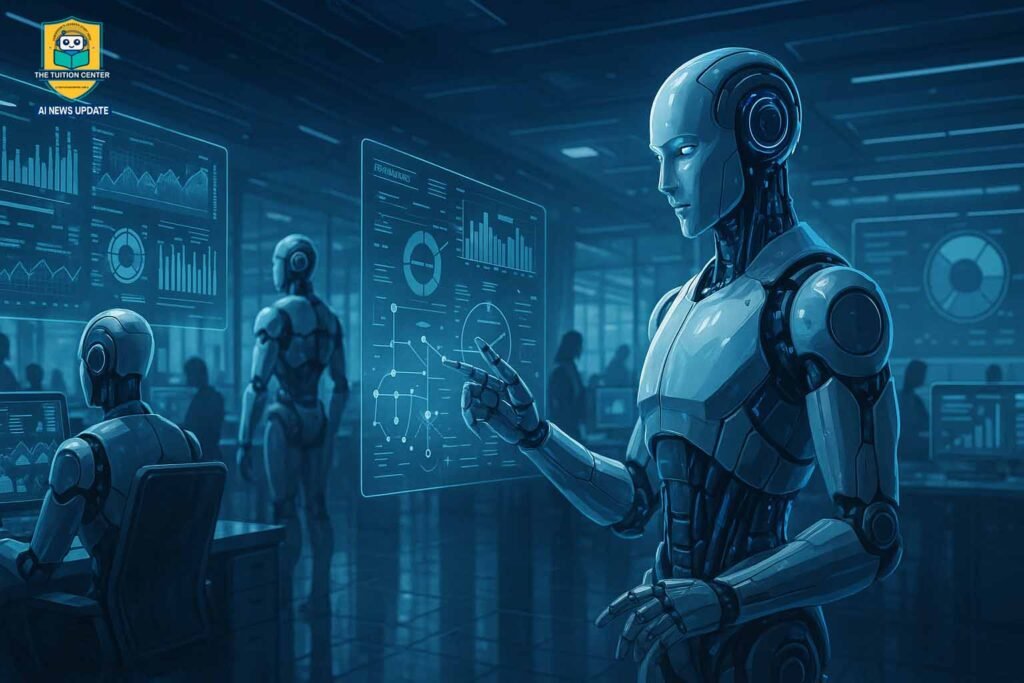
AI-Powered Global Learning Networks Are Redefining Education for 1.8 Billion Students
A new wave of AI-driven learning ecosystems is quietly restructuring global education — making personalized, multilingual, accessible learning possible for every child.
- UNESCO reports over 1.8 billion students now rely on some form of AI-assisted learning.
- India’s Digital Education Mission 2030 accelerates AI integration in 14+ states.
- AI-driven multilingual tools break barriers for rural learners worldwide.
Introduction
Across continents — from Kenya to Kolkata, Finland to Fiji — a silent revolution is unfolding. AI-powered learning networks are stitching together a new educational world: borderless, intelligent, adaptive, and deeply personal. These systems are not just digitizing classrooms; they’re restructuring how students learn, how teachers teach, and how knowledge flows globally.
With the surge of large language models, advanced translation engines, adaptive learning dashboards, and AI tutors that operate 24×7, education is shifting from a one-size-fits-all system to a personalized experience for every learner. This disruption is reshaping the future of global literacy, employment, and innovation.
Key Developments
2025 has been the breakout year for AI in education. Global institutions report record adoption of smart learning systems powered by GenAI and real-time analytics.
1. AI Personalized Learning Becomes Standard
From CBSE schools in India to public education systems in South Korea, AI algorithms now analyze student performance in real time, offering targeted quizzes, customized reading materials, and precise skill-building exercises. Students who once struggled to keep up now receive tailored pathways designed for their pace.
2. Multilingual AI Tutors Reach Remote Areas
Tools like Bhashini, Google Learn, and NGO-led AI tutors are now delivering lessons in 45+ languages. For the first time, children in remote tribal belts of Odisha and Jharkhand experience the same quality of instruction as students in urban schools.
3. Real-Time Global Teacher Collaboration
AI-enabled dashboards allow teachers from different countries to share content, co-create lesson plans, and benchmark progress. The shift is from isolated classrooms to global teaching communities.
4. AI Education Analytics for Governments
Countries like Singapore, UAE, India, and Canada now use AI dashboards to study attendance, learning gaps, dropout patterns, skill shortages, and teacher performance, enabling faster policy decisions.
Impact on Industries and Society
The rise of global AI learning networks is creating ripple effects far beyond classrooms.
Workforce Development: Organizations like Infosys, IBM, Meta, and Siemens now rely on AI-based upskilling engines to train millions of employees in emerging technologies. This ensures industries remain globally competitive.
Healthcare: AI-trained nurses and paramedic students use simulations to practice emergency responses in safe virtual environments, reducing risk while improving outcomes.
Rural Empowerment: AI translating textbooks into local languages has become a game-changer for communities that historically lacked access to quality education.
Economy: A World Bank report reveals that AI education tech could add $2.4 trillion annually to global GDP by 2030 through improved workforce readiness.
Expert Insights
“The world’s classrooms are no longer divided by borders. AI has made it possible for a child in a Himalayan village to access the same content as a student in New York,” says Dr. Catherine Li, Global Policy Lead at the International EdTech Alliance.
“AI isn’t replacing teachers — it’s extending their reach and amplifying their impact,” notes Professor Anil Sharma, Director of EdAI Research at IIT Delhi.
India & Global Angle
India is emerging as a global powerhouse in AI-enabled education. With projects like PM eVIDYA, DIKSHA, and Bhashini, and over 200 EdTech startups scaling globally, the country is influencing education trends worldwide. Meanwhile, Finland, Japan, UAE, Singapore, and Rwanda continue leading large-scale AI adoption in schools.
The global trend indicates a shift toward AI-first curriculums where coding, digital ethics, robotics, and computational thinking become foundational skills.
Policy, Research, and Education
Governments are rapidly adapting. India’s NEP 2020 and the Digital India Future Skills Mission are pushing AI literacy from Class 6 onward. Universities worldwide now offer compulsory modules in AI ethics, digital privacy, and responsible technology development.
Research institutions like MIT, Oxford, IISc, and NUS are collaborating through AI-learning clusters, testing new models for personalized learning and cognitive pattern detection.
Challenges & Ethical Concerns
Despite the transformative potential, AI-first education raises serious concerns.
Data Privacy: Children’s personal data needs strict governance, and global guidelines remain fragmented.
Equity: AI tools may widen gaps if rural regions lack devices or connectivity.
Algorithmic Bias: AI tutors must be audited to prevent misinformation or cultural bias.
Teacher Resistance: Many educators feel overwhelmed and require continuous digital training.
Future Outlook (3–5 Years)
- Global AI learning networks connecting 3 billion learners in real time.
- 99% of schools using AI tutors as co-teachers.
- Real-time skill certification and AI-generated digital portfolios replacing traditional exams.
Conclusion
The future of learning is not powered by apps, boards, or screens — but by intelligence. AI is rewriting the rules of education, not by controlling the system but by empowering learners. In the coming decade, the greatest advantage will belong to students and countries that embrace AI-driven learning early. The world is preparing — the question is, will we lead or follow?