
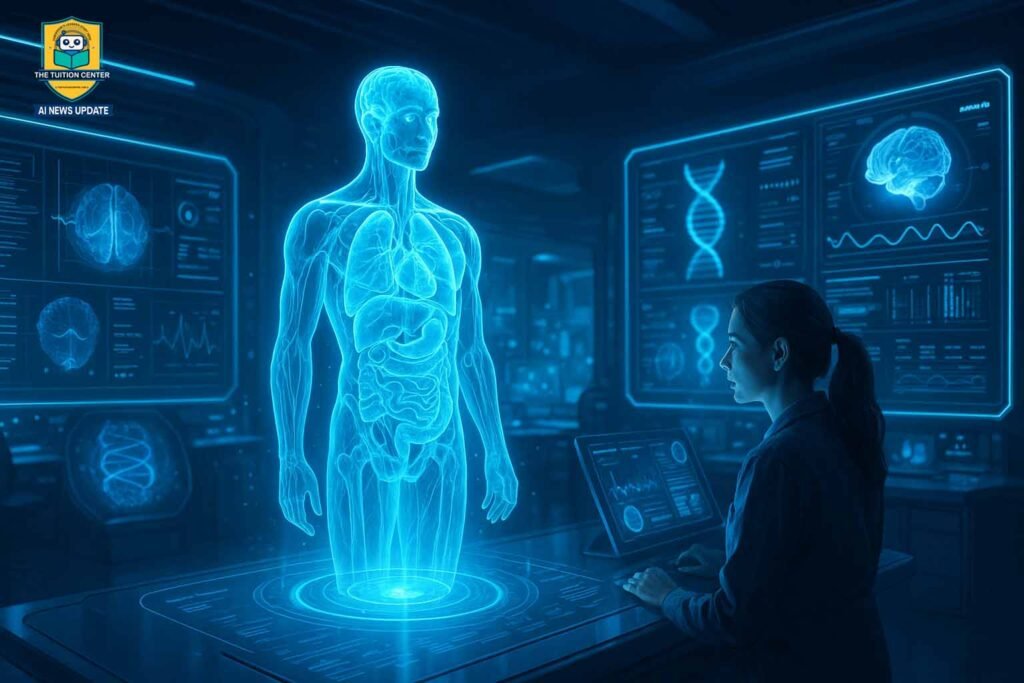
AI Personal Health Twins: The Digital You That Predicts Illness Before It Happens
AI-powered “digital health twins” are transforming preventive care by simulating your body, predicting disease risks, and recommending personalized health pathways.
- Digital twins reduce misdiagnosis rates by up to 60% in early trials.
- India launches national program for AI-based preventive health screening.
- 2025 marks the first year where hospitals rely on digital twins for treatment planning.
Introduction
The human body is incredibly complex. Until recently, understanding its internal behaviour required invasive tests, guesswork, or years of medical experience. But in 2025, a revolutionary technology has changed the landscape forever — AI Personal Health Twins.
An AI personal health twin is a complete digital replica of your body, built using your genetics, blood markers, wearable data, diet profile, medical history, sleep patterns, and stress levels. This digital twin continuously learns and simulates how diseases may emerge, how medications affect you, and how lifestyle changes transform your long-term health.
For the first time, healthcare is shifting from “diagnosing illness” to “predicting and preventing it.”
Key Developments
1. Organ-Level Simulations
AI can simulate your liver, heart, lungs, pancreas, kidneys, and gut microbiome — predicting future issues like metabolic dysfunction or inflammation.
2. Genetic Risk Prediction
Digital twins analyse DNA patterns to determine risks for cancers, cardiovascular diseases, diabetes, neurodegenerative disorders, and autoimmune conditions.
3. Metabolic Age Tracking
Instead of your chronological age, twins calculate your “true biological age,” helping detect accelerated aging caused by stress, pollution, poor diet, or sleep issues.
4. Medication Simulation
Doctors simulate how different drugs will interact with your body — before prescribing them. Side-effect risks drop dramatically.
5. AI Early Warning Systems
Wearables feed real-time data to your twin. If abnormalities appear — heart rate variability, oxygen changes, glucose patterns — the twin alerts your doctor.
6. Precision Nutrition & Lifestyle Plans
The twin evaluates how food, supplements, exercise, and sleep impact your organs and metabolism — then provides a personalized plan.
Impact on Industries and Society
Hospitals: Doctors rely on digital twins to predict surgical outcomes, drug behavior, and disease progression.
Insurance: Smart policies use preventive data to reduce premiums for healthier customers.
Pharma: Drug companies simulate patient reactions using thousands of AI twins, reducing trial times significantly.
Fitness & Wellness: Gyms and health platforms use twins to create ultra-personalized coaching programs.
Public Health: Governments use anonymized twin data to prevent outbreaks and design targeted wellness campaigns.
Expert Insights
“This is the biggest leap in preventive medicine. AI twins can save millions of lives before diseases even begin,” says Dr. Naomi Feldman, Harvard Medical AI Center.
“Digital twins turn your body into a readable, predictable system. This is the future of healthcare,” notes Dr. Devansh Rao from AIIMS Delhi.
“In the next decade, every human will have a digital health twin — it will become as normal as having a smartphone,” predicts futurist Karen Duval.
India & Global Angle
India is at the forefront of personal health twin adoption. The National Digital Health Mission (NDHM) has partnered with AI startups to pilot digital twins for lifestyle diseases. Mumbai, Bengaluru, Hyderabad, and Delhi are leading deployments.
Globally, Germany, Japan, UAE, Singapore, and South Korea have integrated digital twins into national health programs. US hospitals like Mayo Clinic and Cleveland Clinic use twins to predict heart disease and cancer progressions.
Policy, Research, and Education
Governments worldwide are drafting frameworks for responsible medical AI usage.
- India: DPDP-compliant health twin protocols.
- EU: BioDigital Ethics Charter.
- Japan: Genomic Twin Safety Standards.
- US: FDA’s Digital Physiology Approval Process.
New university programs include:
- Computational Medicine
- Digital Physiology
- Bio-AI Engineering
- AI-Driven Public Health
Challenges & Ethical Concerns
1. Privacy & Data Ownership: Health data is highly sensitive.
2. Insurance Bias: Misuse of twin data could disadvantage some groups.
3. Over-Reliance on AI: Human judgment remains essential.
4. Inequality: Access gaps between urban and rural healthcare systems.
5. Genetic Misinterpretation: AI predictions require expert cross-checking.
Future Outlook (3–5 Years)
- Every newborn receives a digital twin at birth.
- AI predicts diseases 5–10 years before onset.
- Virtual hospitals manage chronic patients through digital twins.
Conclusion
AI personal health twins are shifting humanity from reactive medicine to proactive health mastery. They offer a world where diseases can be prevented, aging slowed, treatments optimized, and wellbeing personalized. The future of healthcare will be written not in hospital rooms — but in the digital replicas that protect our bodies long before symptoms appear.