
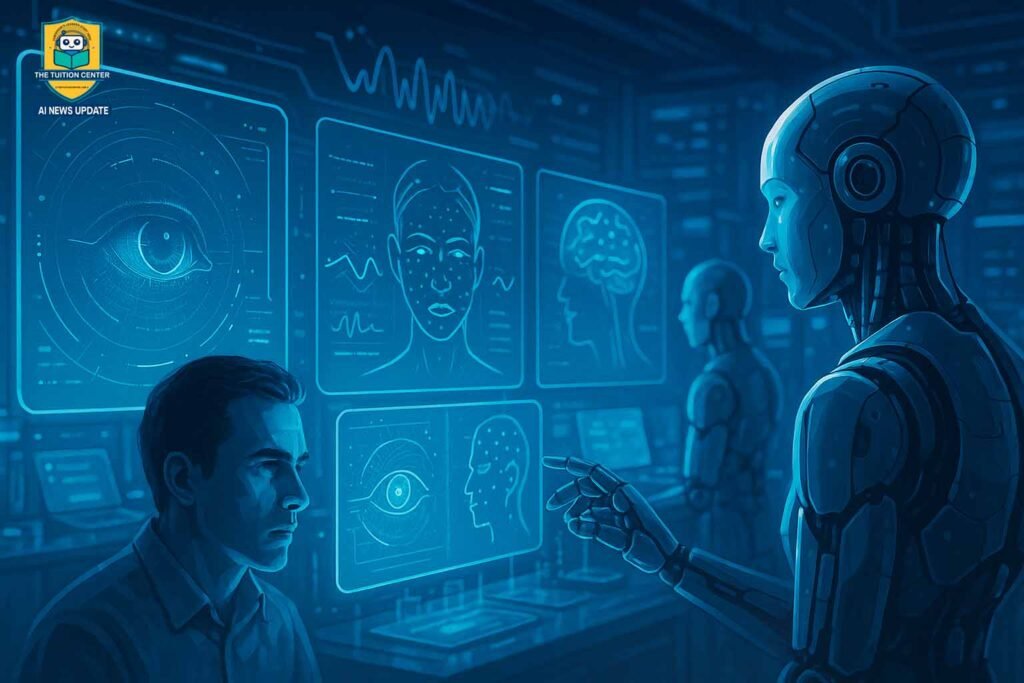
Emotion-Aware AI: The Technology That Understands Human Feelings Through Eye Movements
AI systems can now decode micro-emotions using nothing more than eye behaviour — unlocking new possibilities in healthcare, security, education, and human-computer interaction.
- New AI models detect 67 emotional states from eye movements alone.
- India and Japan lead in neuro-behavioural AI deployments for therapy and learning.
- Privacy concerns rise as emotion recognition becomes more precise.
Introduction
The eyes have always been seen as windows to the soul. In 2025, they have become windows to data. Emotion-aware AI systems can now interpret subtle eye movements — the speed of saccades, blink intervals, pupil dilation, fixation patterns, and peripheral shifts — to detect emotional states in real time.
This new frontier of affective computing is transforming industries that depend on trust, attention, emotional wellbeing, and human understanding. From classrooms to therapy rooms, from airports to automobiles, eye-based AI emotion mapping is changing how machines interpret and respond to human behaviour.
Emotion-aware AI doesn’t just monitor how you feel — it anticipates your reactions, predicts cognitive load, and adapts interactions accordingly.
Key Developments
1. Eye-Gaze Emotion Models Reach Human-Level Accuracy
Researchers have built AI models capable of mapping 67 distinct emotional states purely from eye behaviour — including nuanced emotions such as cognitive dissonance, suppressed frustration, hidden excitement, social discomfort, and evaluative thinking.
2. Neuro-Optical Sensors Become Mainstream
Lightweight sensors are now embedded in laptops, vehicle dashboards, VR headsets, and even smart glasses. They measure micro-gaze variations with high precision.
3. Mental Health Diagnostics
Psychologists use eye-based AI to detect early signs of anxiety, ADHD, depression, PTSD, and burnout. The models identify patterns invisible to human therapists.
4. Emotion-Aware Cars
Automobiles now detect driver fatigue, road stress, and distraction using real-time eye tracking. The car can issue alerts, adjust cabin temperature, dim lights, or even take control during emergencies.
5. AI Learning Assistants
Education platforms analyze students’ eye movements to detect confusion, boredom, or focus lapses. Lessons are auto-adjusted to improve comprehension.
6. Security & Verification
Eye-based AI is being tested at airports for behavioural risk detection. It analyses micro-reactions to questions — essentially emotion-informed lie detection.
Impact on Industries and Society
Healthcare: Emotion-aware AI helps therapists monitor patient progress between sessions, increasing treatment effectiveness.
Education: Personalized learning becomes smoother as AI adjusts content based on real-time emotional feedback.
Workplace: Companies use emotion AI to detect burnout risk and monitor meeting engagement.
Retail: Brands use eye-tracking to predict customer preferences and optimize product placement.
Law Enforcement: Eye-based AI helps detect stress and fear patterns in high-security environments.
Entertainment: Filmmakers use eye-analysis data to fine-tune scenes based on emotional impact.
Expert Insights
“Eye movements reveal what people feel before they express it. AI now reads those hidden signals,” says Prof. Yuki Nakamura, Tokyo Cognitive Systems Lab.
“This technology will transform mental health — but it must be handled with responsibility,” notes Dr. Priya Ahuja, NIMHANS Bengaluru.
“Emotion-aware AI will become essential to human-computer interaction. Machines will finally understand us,” adds Stanford HCI expert Dr. Michael Lane.
India & Global Angle
India is emerging as a global centre for neuro-behavioural AI. Teams in Bengaluru, Hyderabad, and IIT Bombay have built models that detect cognitive load in school students and early dementia markers in the elderly. Indian automotive giants are integrating eye-emotion sensors in next-gen EVs.
Globally, Japan leads in precision sensors, the US dominates software models, Germany specializes in automotive emotion AI, and UAE is deploying behavioural AI across public service centres.
Policy, Research, and Education
Governments are preparing regulatory frameworks:
- India: DPDP includes “neuro-behavioural data” under sensitive biometric categories.
- EU: Emotion AI regulations under the AI Act restrict commercial misuse.
- US: Federal Emotion Recognition Guidelines (FERG) drafted for hospitals and automotive sectors.
- Japan: Mandatory disclosure for devices using eye-emotion tracking.
Universities are launching new specialisations:
- Neuro-AI Engineering
- Affective Computing
- Human Behaviour Modelling
- Emotion-Informed UX Design
- AI Mental Health Systems
Challenges & Ethical Concerns
1. Privacy Risks: Eye movements reveal far more than most people realize — even subconscious emotions.
2. Manipulation: Advertisers may exploit emotional vulnerabilities.
3. Bias: Cultural differences affect emotion interpretation.
4. Surveillance Misuse: Risk of over-monitoring in workplaces and public spaces.
5. Consent Issues: Many users may not realize when emotion tracking is active.
Future Outlook (3–5 Years)
- Emotion-aware robots that adapt tone and behaviour to human feelings.
- Advanced gaze-driven mental health diagnostics.
- Smartphones with built-in emotional telemetrics.
Conclusion
Emotion-aware AI represents one of the most human-centric frontiers in artificial intelligence. By interpreting the deepest layers of human emotion through something as subtle as eye movement, it has the power to transform communication, mental health, learning, and even personal relationships. But with great power comes great responsibility — and the next decade will determine whether emotion recognition becomes a tool for empowerment or exploitation.