
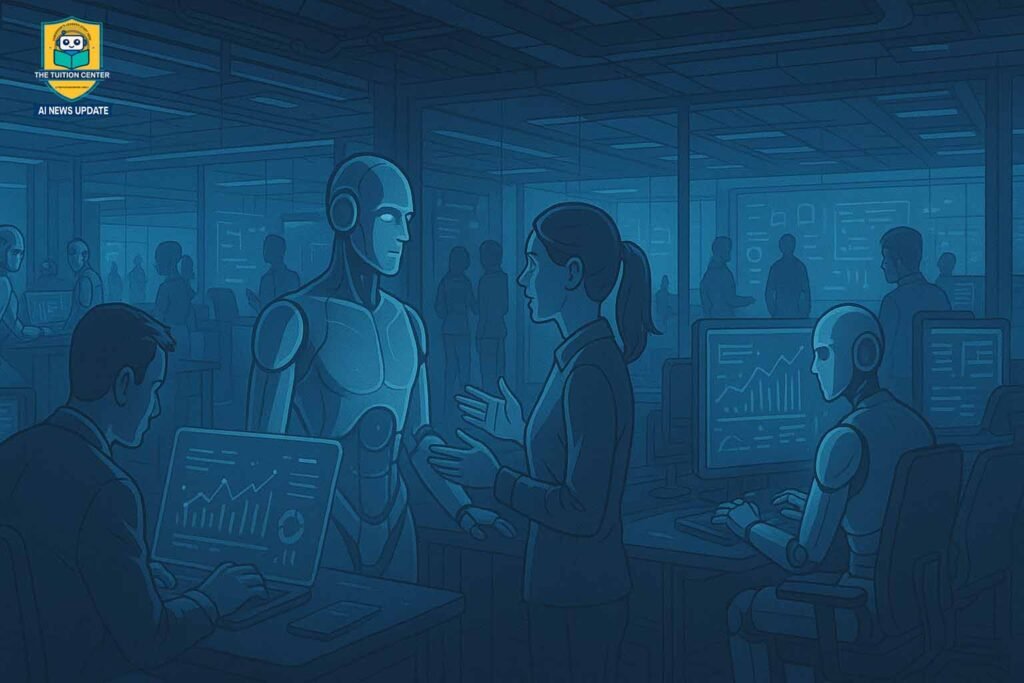
AI-Powered Schools of 2030: How Intelligent Learning Systems Are Transforming Global Education
Automation, personalization, and real-time analytics are redefining how children learn—and millions of students could benefit by 2030.
- Global EdTech investment in AI crossed $34 billion in 2024.
- India’s National Digital Education Mission is deploying AI grading and adaptive learning models.
- UNESCO forecasts that AI could reduce learning gaps by up to 30% worldwide by 2030.
Introduction
Education is entering a radical transition. Across the world, classrooms are no longer limited to chalkboards, textbooks, and fixed lesson plans. A powerful shift is underway: intelligent systems capable of understanding student behavior, predicting learning difficulties, customizing content, and creating interactive lessons on demand. These systems—powered by generative AI, cognitive analytics, and machine reasoning—are reshaping how teachers teach and how students learn.
“`
By 2030, experts estimate that over half of the world’s classrooms will integrate AI in some form. This includes automatic grading for assignments, real-time learning analytics dashboards for teachers, adaptive tests for students, and personalized tutors available 24/7 on mobile devices. Nations like India, Singapore, Finland, and South Korea are already leading in piloting AI-driven schooling models.
Key Developments
The last two years have seen a massive rise in innovation across the EdTech sector. Here are some of the most significant shifts:
1. AI Teachers and 24/7 Digital Tutors
AI tutors can now explain concepts in regional languages, generate examples tailored to each child, track emotional engagement, and adapt teaching styles in real time. These systems support teachers, not replace them, by handling repetitive tasks so educators can focus on mentoring and creativity.
2. Real-Time Learning Analytics
Schools are using dashboards that monitor learning speed, comprehension gaps, and progress patterns. These insights help teachers intervene early and adjust strategies for struggling learners.
3. Automated Exam Evaluation
AI models trained on millions of answer sheets now grade exams with 96–98% accuracy, even for long-form answers. This reduces administrative load and ensures unbiased evaluation.
4. Generative AI Textbooks
Dynamic textbooks update themselves with current research, local contexts, and personalized examples. Students receive material aligned with their learning pace and interest level.
5. Skill-Based Learning Models
AI-powered career predictors analyze student strengths and suggest tailored skill paths—from robotics and design to agriculture technology and entrepreneurship.
Impact on Industries and Society
The integration of AI in education has ripple effects far beyond classrooms. It affects workforce readiness, digital literacy, and national economic competitiveness.
Education
Students benefit from faster doubt resolution, personalized study plans, simulated experiments, and immersive VR/AR-based lessons.
Healthcare
AI-trained medical students can practice diagnosis through simulations, reducing pressure on hospitals while improving competence.
Economy
A more skilled workforce boosts innovation and improves employability across sectors.
Sustainability
AI reduces the need for physical textbooks and creates energy-efficient digital classrooms.
Expert Insights
“AI is not replacing teachers; it is empowering them with superhuman capabilities—automating evaluation, improving engagement, and giving each child the attention they deserve,” said a senior advisor at UNESCO’s Global Education Division.
“By 2030, students will learn through hybrid models—AI for personalization, humans for creativity. This combination will produce the most capable generation in history,” notes Dr. Kavita Rao, an Indian EdTech researcher.
India & Global Angle
India is one of the fastest adopters of AI in education. Initiatives like PM eVidya, DIKSHA, and the National AI Readiness Program are integrating AI lesson planners, virtual labs, and language models for rural schools. Globally, the US focuses on STEM innovation, Finland on pedagogy, and China on large-scale digital infrastructure.
Policy, Research, and Education
Governments are drafting AI-in-education frameworks covering privacy, bias mitigation, and digital safety. Universities are adding AI literacy in teacher training programs, while research bodies explore ethical guidelines for student data protection.
Challenges & Ethical Concerns
Despite enthusiasm, several concerns need attention:
- Data privacy and potential misuse of student information
- Algorithmic bias and unequal learning outcomes
- Overdependence on AI systems
- Digital divide in rural and low-income regions
Future Outlook (3–5 Years)
- AI-powered multilingual tutors will become standard in schools worldwide.
- Exams will shift to adaptive, personalized assessment models.
- Students will graduate with hybrid skills combining AI literacy with creativity and entrepreneurship.
Conclusion
The future of education belongs to those who can think critically, adapt quickly, and learn continuously. AI is not a shortcut—it is an enabler. It unlocks new ways of teaching and learning that were impossible before. As schools embrace intelligent technologies, students everywhere will gain the opportunity to learn at their own pace, discover their passions, and build careers that matter. For students, parents, and educators, the message is clear: evolution has arrived. The time to embrace AI-powered learning is now.