
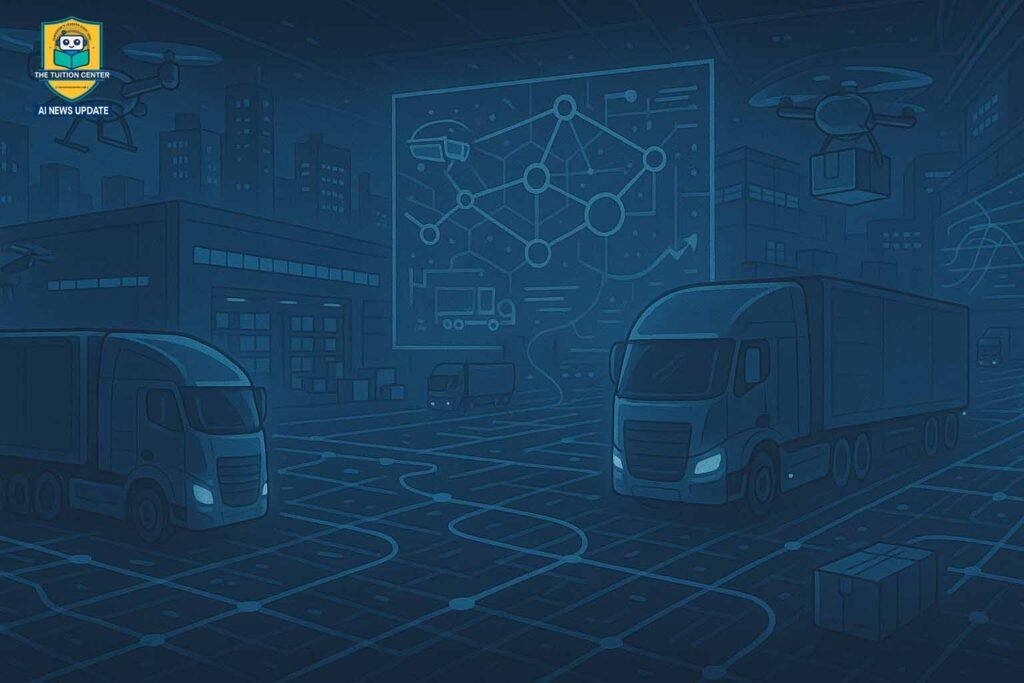
Autonomous Mobility & Logistics: How AI Is Rewiring the Global Supply Chain
Self-driving trucks, drone deliveries, AI-managed warehouses, and predictive traffic networks are redefining how goods move across the world.
- Autonomous mobility market crossed **$120 billion in 2024**.
- AI-managed warehouses improve efficiency by **40–60%**.
- Predictive logistics algorithms reduce shipment delays by **up to 30%**.
Introduction
The world’s supply chains are undergoing the biggest transformation since the invention of the shipping container. After decades of inefficiency, human dependency, and unpredictable disruptions, AI is now orchestrating movement across land, air, and sea with mathematical precision.
Autonomous mobility — once seen as a futuristic dream — is entering mainstream deployment. Self-driving delivery vans glide through cities. AI-guided drones deliver medicines and groceries. Smart warehouses operate with robotic arms, conveyor analytics, and digital twins. Traffic networks optimize routes in real time. And across global ports, AI predicts congestion before it happens.
The logistics industry, long plagued by delays and rising costs, is finally becoming intelligent.
Key Developments
1. Self-Driving Trucks on Highways
Autonomous trucks are becoming the backbone of long-distance logistics. Unlike human drivers, these vehicles operate 24/7, rest-free. They use LiDAR, radar, and AI vision to navigate highways safely, drastically cutting transit time.
Several countries, including the US, UAE, and China, cleared regulatory pilots for highway-only self-driving fleets in 2024–25.
2. Delivery Drones Take Off
Drone logistics has moved beyond prototypes. Thousands of drones now deliver medicines, blood units, emergency supplies, online orders, and e-commerce parcels in both rural and urban regions.
In India, Meghalaya and Karnataka deployed drone corridors for medical logistics with impressive success.
3. AI-Powered Warehouses
Modern warehouses use digital twins, automated guided vehicles (AGVs), robot arms, inventory prediction models, and real-time analytics systems to manage thousands of products with zero human error.
Amazon, Flipkart, Tata Logistics, and DHL operate fully automated centers where AI decides stocking, picking, packing, and dispatching orders.
4. Predictive Logistics Algorithms
AI analyzes historical data, weather conditions, fuel prices, road blocks, traffic congestion, and delivery urgency to recommend the fastest and cheapest shipping routes. These systems learn continuously, improving accuracy over time.
5. Autonomous Urban Pods
Compact self-driving pods now deliver goods in dense urban areas. They navigate alleyways, map internal traffic, and carry products to doorsteps without human involvement.
6. Smart Ports & Maritime AI
Ports use AI to schedule cargo loading, predict container demand, and automate crane operations. Maritime AI forecasts optimal sea routes to avoid storms and cut fuel costs.
Impact on Industries and Society
Retail
AI-driven logistics enable same-day or 2-hour delivery windows, even in large cities. Retailers gain speed, accuracy, and customer loyalty.
Healthcare
Autonomous mobility ensures rapid delivery of critical supplies — vaccines, organs for transplant, and emergency equipment.
Manufacturing
Factories rely on real-time logistics to keep assembly lines moving. AI reduces downtime caused by delayed parts.
Transportation
Autonomous vehicles reduce accidents caused by fatigue, improve fuel efficiency, and streamline route planning.
Environment
AI optimizes energy usage, decreases carbon emissions, and guides fleets toward sustainable operations.
Small Businesses
With logistics automated, smaller enterprises can compete with industry giants through faster delivery at lower cost.
Expert Insights
“The next revolution in logistics is invisible — it’s powered by algorithms optimizing the world’s movement patterns,” says mobility researcher Daniel O’Connell.
“India’s adoption of autonomous logistics will position it as a global supply chain nerve center,” states logistics expert Kiran Deshmukh.
“Autonomous mobility is not a luxury. It’s becoming the backbone of emergency healthcare and disaster response,” adds global resilience strategist Alyssa Morgan.
India & Global Angle
India is emerging as a key player. With rising e-commerce demand, new highways, and drone-friendly regulations, the country is preparing for an AI-powered logistics boom. Hyperlocal delivery companies are already testing autonomous bikes. Ports like Nhava Sheva and Mundra are integrating AI systems for container analytics.
Globally, the US leads self-driving truck operations, China dominates smart warehouses, Japan excels in robot manufacturing, and Europe focuses on sustainable logistics powered by AI-regulated emissions systems.
Policy, Research, and Education
Governments are drafting regulations for autonomous fleets, safety protocols, traffic interactions, and liability concerns. Universities are launching autonomous robotics programs, mobility engineering degrees, and AI–logistics specialization tracks to prepare students for this new era.
Research labs are studying safety, ethics, edge-case handling, and cross-border movement of autonomous systems.
Challenges & Ethical Concerns
- Urban congestion for autonomous fleets
- Cybersecurity vulnerabilities in connected vehicles
- Liability in mixed traffic environments
- Job transitions for traditional drivers and warehouse workers
- Dependence on high-quality map and sensor data
AI mobility must balance innovation with safety and human employment considerations.
Future Outlook (3–5 Years)
- Self-driving trucks will handle 40–50% of long-distance logistics.
- Drones will deliver 20–30% of urban e-commerce orders.
- Smart warehouses will be fully autonomous in major metros.
- AI traffic systems will manage real-time movement in tier-1 cities.
- Autonomous shipping routes will optimize international trade.
Conclusion
The future of logistics is autonomous, intelligent, and incredibly fast. AI mobility is shaping a world where goods move seamlessly, delays vanish, and sustainability becomes a default expectation. For students, entrepreneurs, and workers, this revolution brings enormous opportunity — from designing drone routes to developing warehouse robotics.
Autonomous logistics is not just the future of transport — it is the future of global economic stability.