
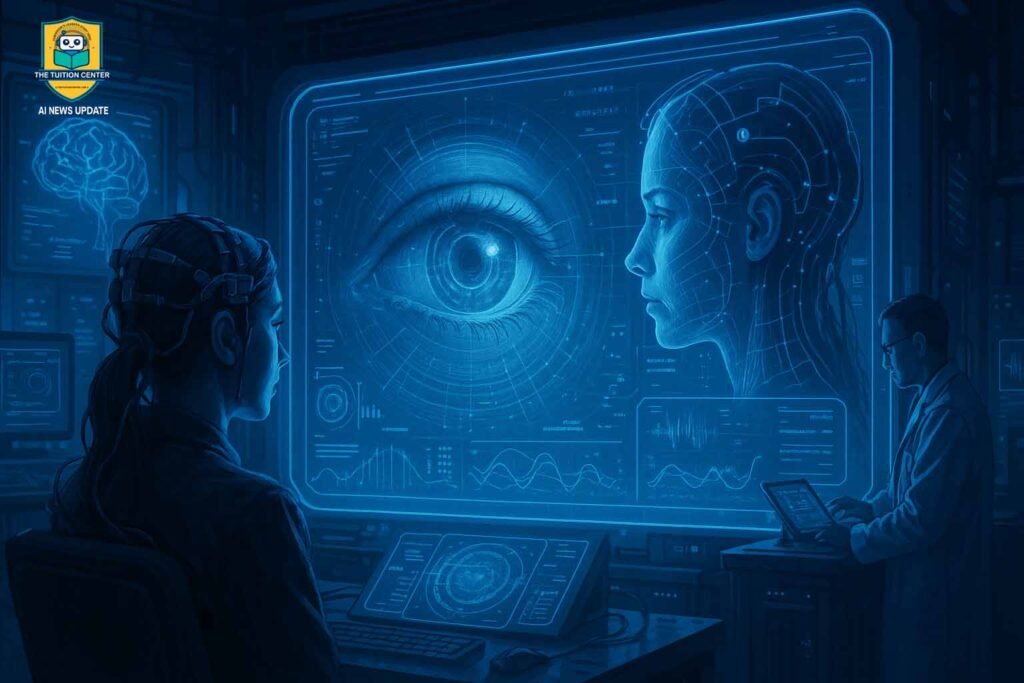
AI Understanding Emotions Through Eye Movements: The Science Behind the Next Generation of Human-Aware Machines
AI is learning to decode attention, anxiety, deception, confidence, and emotional states — all through microscopic eye-movement patterns.
- Eye-tracking AI now achieves **90–95% accuracy** in identifying cognitive load and emotional variations.
- Applications span classrooms, workplaces, mental health, law enforcement, and consumer research.
- Experts warn that ethical guardrails are essential to prevent misuse of behavioural insights.
Introduction
The eyes have always been considered “the windows to the soul,” but in 2025, they have become windows to real-time emotional intelligence for machines. Artificial intelligence powered by advanced eye-tracking systems can now detect cognitive overload, anxiety, distraction, deception, confidence levels, and even micro-emotional spikes in a matter of milliseconds.
From neuro-AI labs in Tokyo to EdTech companies in Bengaluru, researchers are building AI that understands humans at a depth previously impossible. The ability to analyze saccades (rapid eye movements), fixation points, blink rate, pupil dilation, and ocular micro-patterns has unlocked a powerful new frontier: behavioural emotion recognition without asking a single question.
Human-aware AI will not just respond to commands — it will respond to your emotional state.
Key Developments
1. Micro-Saccade Analysis
Micro-saccades are tiny, involuntary eye movements that occur when a person tries to hide stress or cognitive dissonance. AI models trained on millions of eye-movement sequences now detect them with high precision, helping identify true vs. concealed emotions.
2. Pupil Dilation & Cognitive Load Mapping
The size of the pupil changes based on mental effort, surprise, fear, or excitement. AI maps these patterns to estimate workload, honesty, and emotional intensity.
3. Blink-Pattern Behaviour Recognition
Anxiety increases blink frequency. Concentration reduces it. Confusion produces inconsistent blinks. AI reads these patterns to personalize teaching, optimize user interfaces, and detect early signs of stress.
4. AI Eye-Movement Heatmaps
Eye-tracking heatmaps are now used in classrooms, driver monitoring systems, advertising labs, and security agencies to analyze attention, engagement, and emotional response.
5. Neuro-Behavioural AI Models
New AI models combine neuroscience, psychology, and computer vision to read emotional intent — not just facial expressions.
Impact on Industries and Society
Education
AI can detect when a student is confused, overwhelmed, or bored without them saying a word. Teachers receive real-time insights to adjust teaching pace, simplify content, or provide extra support.
Mental Health
AI detects early signs of clinical anxiety, ADHD, autism-spectrum behaviours, and depression by analyzing eye patterns. Mental health apps use this data to offer calming exercises or connect users to counselors.
Autonomous Vehicles
Driver-monitoring AI prevents accidents by detecting micro-sleep, distraction, intoxication cues, or emotional instability.
Corporate Workplaces
AI tracks employee fatigue, meeting engagement, and cognitive overload to improve workflow and reduce burnout.
Security & Law Enforcement
Interrogation AI uses eye-movement cues to detect stress, deception, or emotional spikes — though experts urge caution to avoid over-reliance.
Customer Experience & Advertising
Companies analyze which parts of a product, advertisement, or website attract attention — revealing true emotional reactions.
Expert Insights
“Eye-movement analytics provide deeper emotional signals than facial recognition. The eyes are less controllable, making them highly reliable behavioural indicators,” says neuro-AI scientist Dr. Rafael Gomez.
“This technology can transform classrooms by giving teachers emotional visibility into student challenges,” notes EdTech researcher Priya Suresh.
“Without strong governance, emotion-tracking AI can become a tool for manipulation or surveillance,” warns EU ethics advisor Dr. Leon Fischer.
India & Global Angle
India is emerging as a leading hub for Eye-AI due to its strong EdTech ecosystem and diverse population datasets. Bengaluru-based startups are building multilingual emotion-AI engines tailored to Indian faces, dialects, and cultural expressions — improving accuracy dramatically.
Global trends:
- Japan leads in neuro-AI and human-robot emotional interaction.
- US companies focus on driver-safety and health analytics.
- Europe emphasizes ethical frameworks and strict regulation under the EU AI Act.
- UAE is testing emotion-AI in airports for stress-based crowd management.
Policy, Research, and Education
Governments worldwide are drafting policies regulating behavioural AI, especially in classrooms and workplaces. India’s National AI Mission is exploring consent-based frameworks, while universities are creating cross-disciplinary programs mixing AI, psychology, cognitive science, ethics, and design.
Research priorities include:
- Reducing cultural bias in emotion detection
- Privacy-preserving eye-tracking algorithms
- Explainable behavioural AI
- Safe integration into public systems
Challenges & Ethical Concerns
- Potential misuse in monitoring employees or students without consent
- Risk of emotional manipulation through ads or interfaces
- Bias due to uneven data across ethnicities
- Misinterpretation of emotional signals under stress
- Need for transparent opt-in policies for all users
Experts agree: eye-tracking AI should empower people — never exploit them.
Future Outlook (3–5 Years)
- Emotion-aware AI tutors will adapt teaching pace based on student eye movements.
- Mental health apps will monitor subtle stress indicators in real time.
- Smart glasses will integrate emotional feedback for health and productivity.
- Driver monitoring systems will become mandatory in autonomous cars.
- Behaviour-AI dashboards will appear in hospitals, classrooms, and workplaces.
Conclusion
Eye-movement AI is forging a new era of emotional intelligence for machines. It has the potential to improve education, enhance mental health care, make transportation safer, and personalize digital experiences like never before. But it also poses deep ethical questions about privacy, consent, and surveillance.
The challenge ahead is simple but urgent: use this power responsibly. The next generation of AI must not only be intelligent — it must be humane.
#AI #EmotionAI #EyeTracking #FutureTech #DigitalTransformation #BehaviourAI #AIForGood #TheTuitionCenter