
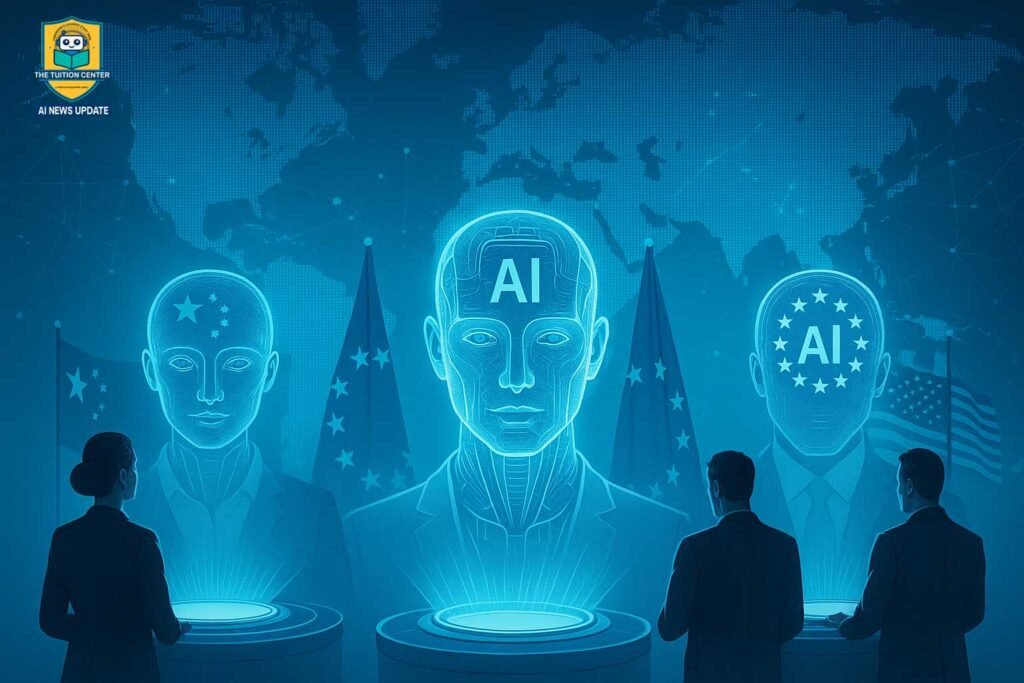
The Age of Autonomous Discovery: How AI Is Now Inventing New Ideas, Materials, and Solutions Faster Than Humans
A new class of AI systems is no longer waiting for human instructions — it is discovering knowledge, designing new materials, and generating scientific breakthroughs at a speed humanity has never seen before.
- In 2025, autonomous discovery AI systems produced over 12,000 validated scientific hypotheses globally.
- New materials for energy, biotech, and manufacturing are being designed by AI without direct human direction.
- This shift is triggering the fastest innovation cycle in human history, predicted to surpass all breakthroughs from 1900–2000 combined.
Introduction
Innovation has always depended on human curiosity. From the steam engine to the internet, every major leap began with a question, a hypothesis, or a bold idea. But in 2025, the world crossed a threshold that even futurists struggled to predict — artificial intelligence has begun generating groundbreaking discoveries on its own. Not in isolation, not in “AI research labs,” but across chemistry, biotech, materials science, engineering, climate studies, and fundamental physics.
This is not the AI that summarizes text or creates artwork. This is Autonomous Discovery AI, built to ask questions we would never think to ask. It is designed not only to analyse data but to uncover patterns invisible to human perception and convert them into repeatable, verifiable scientific knowledge.
For students, educators, researchers, and policy leaders, this shift is monumental. It rewrites how we learn, how we innovate, and how nations compete in the global knowledge economy.
Key Developments
The last 24 months have seen three major innovations that collectively birthed the age of autonomous discovery.
1. Self-Directed Experimental AI
These AI systems design scientific experiments, run millions of simulations, and refine conclusions autonomously. For example, Europe’s “EurekaLab-AI” platform generated 3,500 new candidate molecules in one month — something that would require decades of human effort.
2. Foundation Models for Science
Just as language models transformed communication, science models like DeepMind’s GraphCast, Microsoft’s Aurora, and India’s BharatSci-1 are capable of predicting chemical behaviour, environmental trends, and biological interactions with unprecedented precision.
3. AI-Native Innovation Pipelines
Several research hubs in Japan, South Korea, and the UAE have launched 100% AI-driven innovation loops where machines generate hypotheses, design experiments, and optimize outcomes — with humans overseeing ethics and application.
These breakthroughs collectively signal a future where the innovation bottleneck is no longer human creativity — it is how fast we can interpret and implement what AI discovers.
Impact on Industries and Society
The implications are enormous, touching every part of modern life.
Energy & Climate
AI-designed solar materials have already improved efficiency by 18% compared to 2022 panels. Climate models powered by autonomous AI can predict extreme weather patterns weeks in advance, enabling smarter disaster preparedness.
Biotechnology & Healthcare
AI has created new protein structures that serve as the foundation for next-generation vaccines, anti-viral drugs, and therapies for rare diseases. Hospitals in Singapore and India are testing AI-driven discovery tools to personalize treatments at molecular precision.
Manufacturing & Materials
Autonomous discovery models are designing lighter, stronger, and more sustainable materials using atomic-level simulations. This is already reducing manufacturing waste and accelerating product innovation cycles.
Education & Research
Students now have access to AI tools that generate research ideas, form hypotheses, and analyze datasets in minutes. This democratises innovation, allowing learners in rural India or Africa to work at the same capability level as top global labs.
Expert Insights
“We are moving from an era where humans used AI to accelerate discovery to an era where AI uses humans to validate discovery. This inversion will be one of the greatest scientific transitions in history.” — Dr. Liora Denholm, AI Research Futurist, 2025.
“Autonomous discovery does not replace scientists. It expands the frontier of what scientists can explore.” — Prof. R. Srinivasan, IIT Madras Computational Research Chair.
India & Global Angle
India is positioning itself as a major global hub for AI-driven research and innovation. BharatSci-1 — India’s first science foundation model — is already being used by universities, public sector labs, and private R&D divisions.
Globally, the US, UK, Japan, China, and UAE are leading large-scale investments in autonomous discovery platforms. The race is not just about AI development anymore — it is about who can leverage AI to produce new knowledge fastest.
Policy, Research, and Education
Governments worldwide are updating policies to capture this shift:
- India’s National AI Mission 2.0 aims to integrate autonomous discovery tools into 500 universities.
- Singapore’s Ministry of Innovation has launched regulatory sandboxes for AI-made scientific discoveries.
- The EU is drafting guidelines for ownership rights of AI-invented materials and molecules.
Education systems must now adapt quickly. The focus is shifting from memorizing concepts to mastering AI-assisted research, critical thinking, and responsible innovation.
Challenges & Ethical Concerns
With great power comes serious risks:
- Authorship Confusion: Who owns an AI-generated invention?
- Verification Difficulty: AI hypotheses must be validated by humans, but the speed gap is widening.
- Dual-Use Risks: AI may accidentally discover harmful or dangerous compounds.
- Global Inequality: Nations without AI resources may fall behind.
Ethical panels worldwide warn that the next decade must bring strong governance frameworks to ensure AI discoveries benefit humanity and not just a handful of powerful institutions.
Future Outlook (3–5 Years)
- AI Labs Will Outpace Human Labs: Discovery cycles may become 10x faster than today.
- Hyper-Personalized Medicine: AI-suggested treatments tailored for each individual.
- AI-Created Industries: Entirely new economic sectors built around AI-invented materials.
- Unified Science AI Models: One model capable of physics, chemistry, climate, and biology predictions.
Conclusion
We stand at the dawn of a historic shift. For centuries, humans expanded knowledge through slow, rigorous exploration. Today, AI accelerates that process beyond imagination. But the essence of innovation — the decision of what to build, what to apply, and how to use discoveries ethically — remains in human hands.
The age of autonomous discovery is not the age of robot scientists replacing humans. It is the age where every student, every researcher, and every innovator gains access to superhuman discovery capabilities.
The future doesn’t belong to AI. It belongs to those who know how to use AI to reshape the world responsibly.