
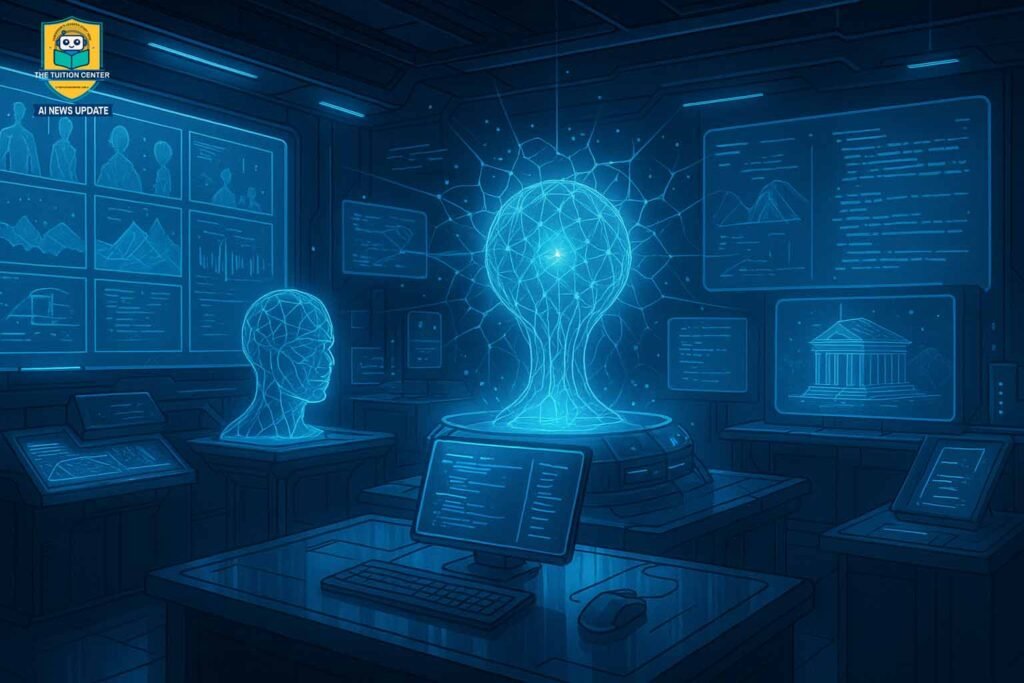
Synthetic Imagination: The New Wave of AI Systems That Create Concepts, Worlds, and Technologies Beyond Human Creativity
A breakthrough generation of AI models is now capable of producing original concepts, futuristic technologies, and imagined worlds far beyond the limits of human creativity — reshaping innovation across industries.
- 2025 marked the launch of synthetic imagination engines capable of creating technologies that don’t yet exist.
- AI creativity models are now used in architecture, biotechnology, space engineering, and entertainment worldbuilding.
- This shift positions AI as a co-creator of the future, not just a tool for productivity.
Introduction
Creativity was long considered the final frontier of human superiority — the one domain machines would struggle to conquer. Art, music, storytelling, invention, worldbuilding — these were seen as uniquely human pursuits, fueled by emotion, culture, and intuition.
But in 2025, the world witnessed the rise of Synthetic Imagination AI — systems designed not to mimic human creativity, but to surpass it by imagining concepts, technologies, ecosystems, and futures that no human mind has ever produced.
Instead of waiting for instructions, these models generate speculative science, fictional universes, novel materials, alien ecosystems, architectural structures, interstellar propulsion ideas, and even new branches of mathematics.
For the first time, humanity has a partner capable of expanding imagination itself — transforming how we innovate, plan, and dream.
Key Developments
1. Imagination Engines Trained on Conceptual Data
Unlike traditional AI, imagination engines are trained on patterns that represent creativity, abstraction, and speculative reasoning — including science fiction archives, futuristic patents, theoretical physics, and artistic worldbuilding.
2. Multiverse Simulators
These models can simulate entire theoretical worlds — ecosystems with their own laws, physics, biology, and society. Architects and futurists use them to explore utopian and dystopian scenarios.
3. Speculative Technology Designers
AI systems are now producing design blueprints for technologies that do not yet exist — quantum sails, AI-governed cities, bio-synthetic habitats, and future energy systems.
4. Creative Science Models
Instead of predicting what is known, these models generate hypotheses for what could be — proposing alternative laws, experimental pathways, and innovative scientific structures.
Together, these innovations represent a shift from AI as a tool to AI as an imagination catalyst.
Impact on Industries and Society
Architecture & Urban Planning
Architects now use imagination AI to generate structures inspired by natural forms, alien biology, or multidimensional space. AI has created designs for floating eco-cities, gravity-adaptive buildings, and bio-integrated apartments.
Entertainment, Media & Gaming
Filmmakers and game studios are using AI to create fully developed worlds — complete with history, culture, languages, landscapes, and mythology. This reduces worldbuilding time from years to days.
Science & Research
Synthetic imagination models propose alternative physics theories, new propulsion designs for space travel, and theoretical biological organisms adapted for other planets.
Product Design & Innovation
Companies use AI to brainstorm entirely new product categories — wearable cognition boosters, self-healing materials, sensory-adaptive interiors, and more.
Education
Students can explore worlds imagined by AI, visualize theoretical concepts, or co-create speculative scientific hypotheses — elevating curiosity to a new level.
Expert Insights
“Synthetic imagination does for creativity what industrial machines did for manual labor — it amplifies human ability and extends it far beyond natural boundaries.” — Dr. Elaine Morris, Creative AI Research Institute.
“We are entering an era where innovation is co-authored by AI. The ideas we generate together will redefine our path as a species.” — Prof. Miguel Torres, University of Barcelona, Future Systems Lab.
India & Global Angle
India’s animation, gaming, and creative industries are rapidly adopting imagination AI for storytelling and concept design. Bangalore, Hyderabad, and Mumbai studios now use AI for worldbuilding and speculative architectures.
Globally, the US West Coast, Japan, and UAE are pioneering synthetic imagination labs that develop speculative technologies, experimental materials, and futuristic concept ecosystems.
Policy, Research & Education
Governments and institutions are adapting quickly:
- Creative AI Regulation: defining ownership for AI-generated concepts and inventions.
- Academic Integration: introducing AI-aided creativity studios in universities.
- Innovation Sandboxes: allowing companies to explore AI-generated technologies without regulatory barriers.
- Intellectual Rights Reform: addressing AI as a co-author or co-inventor.
Educational institutions are shifting from rote learning to speculative thinking — teaching students to use imagination AI as a partner in future design.
Challenges & Ethical Concerns
1. Authenticity Crisis
As AI-generated art and ideas proliferate, defining originality becomes harder.
2. Over-Imagination Risks
AI might propose technologies that are impossible or dangerous, requiring human oversight.
3. Cultural Homogenization
If AI imagination material dominates globally, diverse cultural creativity may be overshadowed.
4. Dependence on AI Creativity
Humans must maintain the ability to imagine independently — AI should amplify, not replace, human creativity.
Future Outlook (3–5 Years)
- AI-Designed Future Cities: entire blueprints for sustainable cities imagined by AI.
- Interstellar Speculative Engineering: new propulsion ideas for deep space missions.
- AI-Generated Films: worlds, characters, and scripts created entirely by imagination engines.
- Neural Creativity Interfaces: students co-imagining with AI in real time through brain-computer links.
Conclusion
For centuries, imagination drove human progress — from the wheel to the internet. But the limits of imagination were always the limits of the human mind.
With synthetic imagination, those limits vanish.
We now stand at the edge of a revolution where AI expands imagination beyond what biology allows — giving humanity the power to envision worlds, technologies, and futures that transcend the boundaries of reality itself.
The future will not just be built by engineers and scientists. It will be co-created by imagination engines and dreamers working together to design what comes next.