
AI Temporal Engines: The Rise of Predictive Time Models That Forecast Social, Economic, and Technological Futures With Unprecedented Accuracy
A groundbreaking generation of AI systems is now capable of modelling the future like a dynamic timeline—forecasting social behaviour, economic shifts, climate cycles, and technological breakthroughs with a precision never seen before.
- The year 2025 marked the debut of multi-layered temporal AI systems.
- These engines simulate multiple futures using real-time global data streams.
- Governments and corporations are using them to guide policy, innovation, and risk planning.
Introduction
For decades, humans tried to predict the future using historical data, trend lines, and intuition. Economists forecasted markets. Climate scientists modelled weather. Sociologists predicted behavioural shifts. But at the core, the challenge remained the same: reality is messy, unpredictable, and multidimensional.
In 2025, a breakthrough emerged that changed everything: AI Temporal Engines. These systems combine massive datasets, behavioural modelling, multi-agent simulations, economic signals, and sociocultural patterns to generate highly accurate forecasts of future possibilities.
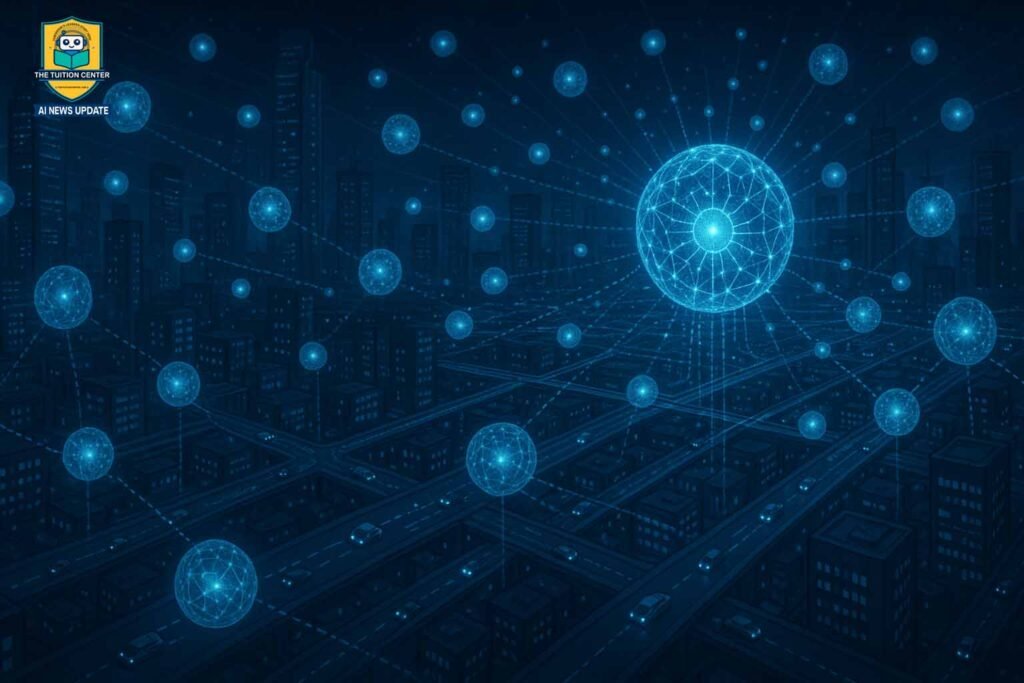
Temporal engines do not predict “one future.” Instead, they simulate millions of branching futures—accounting for human behaviour, natural systems, technology adoption, political movements, and economic turbulence.
For the first time, humanity has a way to see not just where we are, but where we are heading — and how our decisions can change the path.
Key Developments
1. Multi-Future Simulation Models
Temporal engines simulate 10,000+ possible futures at once, allowing analysts to spot the most likely pathways and avoid catastrophic scenarios.
2. Behavioural Chrono-Analytics
These models predict how groups of people may behave in specific contexts — elections, pandemics, social trends, consumer shifts, education choices, and migration patterns.
3. Tech Innovation Timelines
Temporal engines now forecast technological breakthroughs such as new battery materials, healthcare innovations, drug discovery timelines, and industrial automation milestones.
4. Policy Impact Forecasting
Governments use temporal engines to test how policies might unfold in different futures — helping avoid unintended consequences.
5. Real-Time Global Data Integration
Unlike old prediction systems, temporal AI ingests live data from global markets, climate sensors, social platforms, and scientific databases to adjust forecasts dynamically.
Impact on Industries and Society
Governance & Public Policy
Nations use temporal engines to model inflation, unemployment, demographic shifts, infrastructure demands, and social unrest probabilities.
Ministries can now avoid policy failures before implementing them.
Economic & Finance
Banks and investment groups run temporal simulations to forecast market crashes, safe investments, emerging sectors, and currency shifts.
Climate & Environment
AI models predict monsoon variations, drought cycles, flood risks, and climate stability patterns for decades ahead.
Healthcare & Medicine
Temporal engines forecast disease spread, vaccination outcomes, aging demographics, and biotechnology adoption timelines.
Education & Workforce
These systems predict which jobs will rise or disappear, what skills future students must learn, and how industries will transform.
Expert Insights
“Temporal engines don’t tell us what will happen — they show us what could happen, and how our choices influence the path.” — Dr. Livia Harding, Global Futures Institute.
“For the first time, we can test policies, technologies, and social movements against thousands of possible futures. This is humanity’s ultimate decision-making tool.” — Prof. Michael Chang, Stanford Foresight Lab.
India & Global Angle
India has become one of the fastest adopters of AI temporal systems. The Government of India’s “Future Bharat Simulation Grid” (FBSG) predicts economic trends, agricultural risks, city population growth, and education needs for 2040.
Globally:
- The EU is using temporal AI to forecast energy and climate transitions.
- The US is using it for defence and economic stabilization strategies.
- China is building a national future-planning AI grid.
- African Union is using it to simulate climate impact on agriculture and migration.
Policy, Research & Education
As temporal engines become central to governance and industry, nations are building frameworks around:
- Data + Ethics Protocols for future predictions.
- Transparency Standards for how AI arrives at future scenarios.
- Future Literacy Curriculum for students and policymakers.
- Simulation Labs in universities to train future researchers.
“Future Literacy” becomes the new global skill — the ability to understand and interpret AI-based futures.
Challenges & Ethical Concerns
1. Overreliance on Predictions
Humans may blindly trust AI’s future scenarios without questioning assumptions.
2. Manipulation of Future Models
Biased data could shift predictions unfairly — influencing elections, policies, or investments.
3. Privacy & Surveillance
Predictive models require massive behavioural data, raising ethical concerns.
4. Global Risk Inequality
Nations without temporal AI will fall behind in strategic planning and foresight.
5. Future Shock
Seeing too many possible futures may overwhelm individuals, organizations, and governments.
Future Outlook (3–5 Years)
- Predictive Governance: Nations governed with AI-simulated policy outcomes.
- Corporate Foresight Dashboards: Companies predicting market shifts with 90% accuracy.
- Personal Future Companions: AI tools that forecast career, health, and financial paths.
- Temporal Education: Schools teaching students to shape their futures using simulations.
- Global Future Networks: A shared AI platform predicting humanity’s next 50 years.
Conclusion
AI Temporal Engines redefine humanity’s relationship with the future. For the first time, we are not walking blind into tomorrow — we can explore it, model it, and actively redesign it.
The future is no longer a mystery — it is a simulation we can shape.
And those who learn to interpret and guide these AI-powered futures will be the leaders of the next era.