
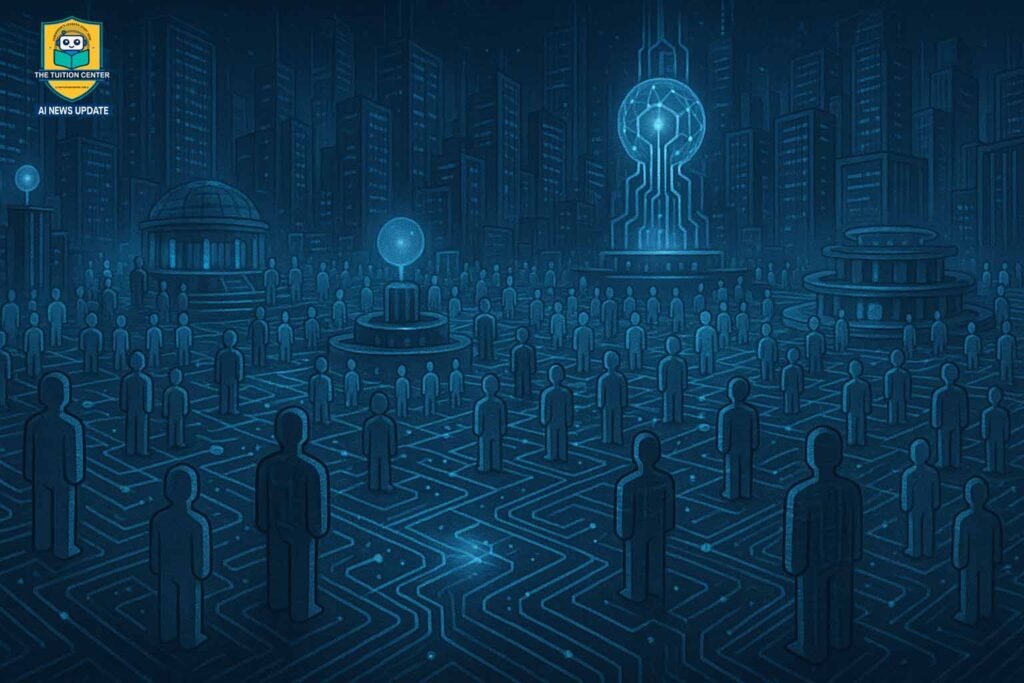
Self-Assembling AI: How Modular Intelligence Blocks Are Combining Themselves to Build New Skills, Tools, and Capabilities Automatically
The next era of AI has arrived: systems made of modular intelligence blocks that combine, detach, reorganize, and co-create new abilities — without human intervention.
- 2025 saw the first commercial launch of self-assembling AI frameworks.
- These models reconfigure their internal components like digital Lego blocks.
- Enterprises are adopting them to accelerate automation, research, and product innovation.
Introduction
For most of AI’s history, intelligence was monolithic — one massive model attempting to solve dozens of unrelated tasks. These systems were powerful, but rigid. If you wanted a new skill, you retrained the entire model. If you needed a specialized capability, you built a separate model.
But in 2025, AI entered a new evolutionary stage: Self-Assembling Modular Intelligence. Instead of a single massive network, AI now functions as a living library of smaller “intelligence blocks” — each block performing a unique cognitive task.
Like Lego. Like DNA. Like neurons.
These blocks connect, disconnect, and reorganize themselves to solve new problems — without humans engineering the process. The AI discovers which skills are needed, merges the relevant modules, and builds a custom capability instantly.
This is one of the biggest breakthroughs since transformer models. It shifts AI from a trained tool to a self-building system.
Key Developments
1. Intelligence as “Micro-Modules”
AI is now broken into hundreds of small blocks — language understanding blocks, math blocks, vision blocks, physics simulation blocks, reasoning blocks, safety blocks, emotional-pattern blocks, etc.
Each block can be independently improved, swapped, versioned, or recombined.
2. Automatic Self-Assembly Algorithms
These algorithms let AI detect which combination of modules is required to perform a task.
Example: For a complex engineering simulation, the AI may assemble blocks for fluid dynamics, materials science, geometry, and language explanation — forming a temporary “intelligence organism.”
3. Real-Time Recombination
Self-assembling AIs reconfigure themselves mid-task. If one module hits a limit, the AI replaces it with another or adds more micro-modules to strengthen reasoning.
4. Emergent Composite Skills
New capabilities emerge automatically when modules combine — skills no single block was trained for individually.
Impact on Industries and Society
Software Development
Developers no longer build standalone apps. They instruct AI to self-assemble toolkits for any need — analytics, chatbot modules, scheduling engines, automation scripts. The software builds itself.
Engineering & Manufacturing
Factories use modular AI to assemble specialized QC (quality control) pipelines, predictive maintenance engines, or robotic coordination systems instantly.
Medical Science
Doctors use self-assembling diagnostic AIs that pull together micro-modules for cardiology, radiology, lab analytics, genomics, and patient behaviour — creating a custom medical intelligence for each case.
Education
Students receive personalized “AI tutors” built from modular blocks — adjusting difficulty, explanation style, and pace dynamically.
Creative Industries
Artists and studios use modular AI to combine storytelling, animation, music, and design modules to generate complex creative outputs.
Expert Insights
“Self-assembling AI is the closest we have come to artificial cognitive epigenetics — intelligence that reconfigures itself based on need.”
— Dr. Lena Hoffman, Neural Modular Systems Institute.
“We no longer code AI. We curate modules, and the AI does the rest.”
— Prof. Amir Jalal, Imperial College London, Modular Intelligence Lab.
India & Global Angle
India is emerging as a major hub for modular AI architecture. Bangalore’s AI parks and IIT research centres have launched India’s first “Intelligence Block Repository” — a national library of modular cognitive units.
Globally:
- The US is using modular AI for autonomous research labs.
- Japan is building self-assembling robotics for aging-care support.
- The UAE has created modular AI governance assistants for smart cities.
- Europe is building modular sustainability engines for climate policy.
Policy, Research & Education
Governments are updating frameworks due to modular AI’s dynamic nature:
- Version Transparency: Each module must be tracked for upgrades and risks.
- Safety Enclosures: Some block combinations should be restricted.
- AI Literacy: Students need to understand modular intelligence architecture.
- Regulation of Emergent Abilities: What happens when AI spontaneously develops new skills?
Universities worldwide are introducing “Modular AI Design” and “AI Assembly Systems” as new engineering specializations.
Challenges & Ethical Concerns
1. Unpredictable Combinations
Self-assembling AI could create unexpected capabilities if modules interact in unforeseen ways.
2. Traceability Issues
When AI combines dozens of blocks dynamically, auditing the reasoning chain becomes harder.
3. Security Risk
Malicious actors could try to inject harmful modules into an AI assembly system.
4. Regulatory Complexity
Laws built for static AI models don’t match the dynamic nature of modular systems.
5. Ownership Questions
If a new ability emerges from the combination of modules, who owns it?
Future Outlook (3–5 Years)
- AI-Built Startups: Entire businesses created automatically by self-assembling AI systems.
- Hyper-Specialized Intelligence: AIs built from thousands of micro-modules for niche industries.
- Modular Robot Swarms: Physical robots assembling and disassembling like intelligent hardware blocks.
- Autonomous Scientific Discovery: Research AIs that assemble instrument-specific intelligence clusters.
- AI App Stores: Markets where intelligence blocks are traded like software plugins.
Conclusion
Self-assembling AI marks the beginning of a new era where intelligence is not trained — it is constructed. It evolves dynamically by assembling the right pieces at the right moment.
This unlocks an unimaginable future: AI that builds itself, improves itself, and adapts instantly to any challenge.
Students, innovators, and policymakers must understand this shift to stay ahead.
The next frontier of intelligence won’t be monolithic AI giants — it will be modular intelligence ecosystems assembling themselves in real time.