
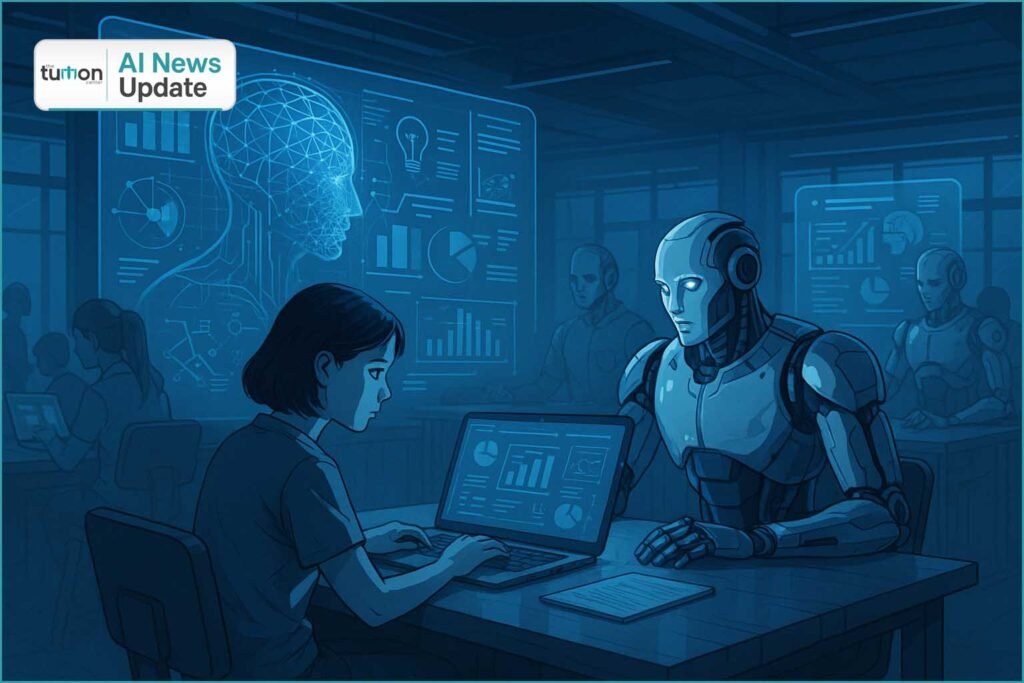
By 2025, AI agents are no longer support tools—they are becoming autonomous digital workers transforming companies, governments, and global labour markets.
- Over 40 million businesses globally now use AI agents for core operations.
- Digital workers are handling customer support, analytics, procurement, compliance, sales funnels, and HR.
- Governments are exploring AI agents for citizen services, education, and administrative processes.
Introduction
For decades, automation meant machinery, scripts, and static software. But 2025 is the year the world began recognizing a new category of digital intelligence: AI agents—autonomous systems that understand goals, analyze contexts, perform tasks, and improve over time. They are not “AI tools.” They are digital workers capable of handling responsibility.
Analysts predict that by 2030, AI agents could contribute nearly USD 7.3 trillion to the global economy. Companies are restructuring their teams, governments are drafting new labour frameworks, and educational institutions are racing to prepare students for a hybrid human–AI workforce.
Key Developments
AI agents have moved from labs to real-world operations at breathtaking speed. Platforms like OpenAI’s autonomous agents, Google’s TaskGraph systems, Microsoft Deployment AI, Meta’s open-agent ecosystems, and rising Asian and Middle Eastern agent platforms have made it possible for businesses to deploy digital workers in hours.
In 2025:
- Customer support agents solved over 14 billion global queries without human intervention.
- AI sales agents closed deals worth an estimated USD 110 billion.
- AI legal assistants reviewed more than 900 million pages of contracts.
- AI procurement agents negotiated supplier terms autonomously in multiple industries.
Meanwhile, governments experimented with AI agents for public service delivery. Dubai, Singapore, and South Korea achieved some of the world’s first agent-led citizen service models—handling everything from permit approvals to public grievance tracking.
Impact on Industries and Society
The impact is deep, broad, and fast.
1. Corporate Operations
AI agents are now running daily business operations—preparing reports, sending emails, analyzing data, summarizing meetings, and coordinating tasks across teams.
2. Education
Schools, universities, and EdTech ecosystems leverage AI agents as teaching assistants, assessment graders, and curriculum designers. Students are learning how to “manage” AI teams—just like future workplace managers will.
3. Healthcare
Hospitals deploy AI clinical agents to monitor vitals, analyze patient risk, schedule treatments, and assist doctors. AI nurses support documentation and basic triage.
4. Finance
Banks use AI agents for fraud detection, risk scoring, customer onboarding, and portfolio predictions—cutting operational inefficiencies dramatically.
5. Government
Administrative processes such as land records, taxation filings, welfare distribution, and public compliance tracking are being augmented by agent-based automation systems.
Expert Insights
“AI agents are not here to replace humans—they are here to replace inefficiency,” says Prof. Daniel Reaves, MIT AI & Society Lab. “We are entering an era where human intelligence and machine autonomy must work together as partners.”
“A company’s competitiveness in 2025 is determined by how effectively it deploys AI agents,” notes Priya Nair, Global Head of Digital Transformation at a major consultancy. “This is no longer optional—it is survival.”
“Agentic AI is becoming the new infrastructure. Organisations that ignore this shift will fall behind by a decade,” says Dr. Laura Shin, Stanford Automation Group.
India & Global Angle
India is one of the fastest adopters of AI agents. With its massive service-sector ecosystem, the demand for automated digital workers is enormous.
BPO firms, financial institutions, EdTech platforms, hospitals, and startups are using AI agents to scale productivity.
Meanwhile:
- The US leads enterprise-grade agent deployment.
- China leads large-scale industrial agent automation.
- Japan and South Korea lead robotics + AI agents integrations.
- UAE leads AI agents in government workflow automation.
- EU leads ethical guidelines and AI labour rights frameworks.
Policy, Research, and Education
Governments worldwide are drafting policies around:
- AI workforce regulation
- Human-AI job coexistence
- AI agent accountability and liability
- Data governance for autonomous systems
- Reskilling programs for workers affected by automation
Universities are launching new programs in:
- AI agent management
- AI operations engineering
- Automation ethics
- Hybrid workforce design
- AI-systems auditing
Students entering the workforce in 2030 will be the first generation expected to lead teams of AI agents as naturally as teams of human colleagues.
Challenges & Ethical Concerns
With autonomy comes risk. AI agents raise important concerns:
- Over-reliance on machine decision-making
- Job displacement fears
- Deepfakes and AI-initiated fraud
- Transparency of agent decision pathways
- Bias in automated workflows
- Data exposure during agent-led tasks
Ethical frameworks demand that humans remain accountable for decisions—even if executed by machines. AI agents must be audited, monitored, and constrained through robust safeguards.
Future Outlook (3–5 Years)
- AI agents will evolve into multi-modal digital collaborators managing entire business units.
- Hybrid workplaces will pair human managers with fleets of digital employees.
- AI agents will gain emotional intelligence and real-world awareness for high-context tasks.
Conclusion
AI agents represent one of the most transformative shifts in human history. They are not competitors—they are collaborators.
For students, the opportunity is massive: learn how AI agents work, learn how to manage them, and learn how to build them.
For professionals, the challenge is real: adapt fast or get left behind.
For nations, the stakes are high: invest in AI infrastructure or fall behind the global economic curve.
The future belongs to those who work smart—alongside intelligent machines.