
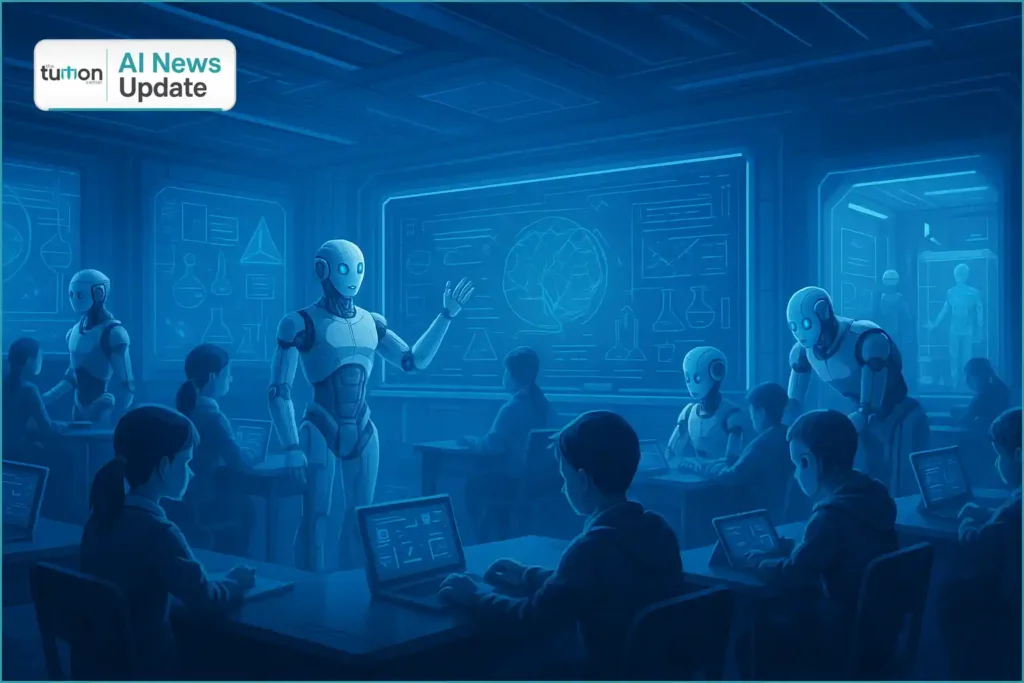
Autonomous AI agents are transitioning from experimental tools to frontline digital workers — reshaping learning, startup innovation, global economies, and public policy frameworks.
- Major tech companies have deployed fully autonomous agents for workflows across education, research, customer service, and software development.
- India, the U.S., Singapore, and the UAE are launching AI workforce readiness frameworks for public and private sectors.
- Startups globally are shifting from “AI tools” to “AI teams” that run operations independently.
Introduction
Only a year ago, the idea of AI agents acting as independent workers felt experimental. In late 2025, that world has arrived — and it is evolving faster than any earlier technological shift. Autonomous agents are no longer limited to coding assistants or chatbots. They are becoming full-fledged digital workers capable of running campaigns, managing schedules, evaluating documents, creating content, summarizing regulations, tracking business performance, designing, planning, and in some institutions, even teaching.
The shift is massive. Schools are rewriting their curricula to teach students how to work with agents instead of competing against them. Startups now hire a mix of human and AI team members. Governments are quietly testing autonomous agents to manage citizen services, compliance, and administrative tasks. The global economic map is being redrawn around agentic AI — and the countries that adapt fastest will lead the next decade.
Key Developments
Across the world, several major developments have pushed AI agents into the mainstream workforce:
1. AI Workflows Become Autonomous
Agents can now trigger tasks, run analysis, fetch new data, initiate actions, correct themselves, collaborate with other agents, and report outcomes — all without human supervision. This level of autonomy marks a shift from “AI as an assistant” to “AI as an operational unit.”
2. Agentic Platforms Dominate Startup Ecosystems
In the U.S., Europe, India, and Southeast Asia, more than 40% of early-stage startups now operate with 30–80% of their functions being AI-driven. These include marketing, customer success, analytics, and even product design. AI-first companies are emerging faster than traditional startups can compete.
3. Enterprise Adoption Becomes Aggressive
Financial institutions, hospitals, logistics companies, and telecom operators are deploying multiple layers of AI decision-making agents. They streamline workflows, detect anomalies, reduce delays, and offer predictive insights.
4. Educators Begin Using AI Agents as Co-teachers
Schools and colleges across India, Singapore, and the UAE are piloting AI teaching agents that handle personalized doubt-solving, formative feedback, quiz generation, progress tracking, and classroom analytics.
Impact on Industries and Society
The growth of AI agents is not just a technological shift — it is a socioeconomic one. Across industries, agents are altering roles, expectations, and productivity levels:
Education: Teachers integrate AI agents to deliver personalized learning plans, monitor student progress, translate content into multiple languages, and generate interactive assessments. Students increasingly rely on AI study companions that help them grasp concepts faster and more effectively.
Healthcare: Agents manage medical records, flag potential diagnosis patterns, create recommendations for doctors, assist in triaging patients, and speed up administrative workflows. This reduces operational load and allows medical professionals to focus on patient care.
Business & Startups: Autonomous AI sales teams, AI HR executives, and AI project managers are becoming real. Many startups now run marketing campaigns entirely through AI, generating growth strategies, audiences, A/B tests, and reporting in minutes.
Government Services: Some countries are testing AI agents for reviewing legal drafts, analyzing public feedback, monitoring infrastructure, and even responding to citizen service queries.
Expert Insights
“AI agents are not replacing human workers — they are reshaping how we define work. The winners of this decade will be the people and nations who learn to collaborate with agents, not compete against them.”
“In 2026, we’ll see companies hire ‘Chief Agent Officers’ — leaders responsible for orchestrating large clusters of autonomous AI teammates.”
India & Global Angle
India stands at a pivotal point in the global AI landscape. With its massive youth population, strong engineering ecosystem, and fast-growing AI startup base, the country is uniquely positioned to become a global hub for agentic AI transformation. Initiatives like the IndiaAI Mission, Digital Public Infrastructure (DPI), and new GenAI skilling frameworks are laying the groundwork for mass adoption.
Globally, the U.S., China, Singapore, Japan, South Korea, and the UAE are aggressively deploying multi-agent AI systems across finance, health, transport, cybersecurity, and public policy decision support.
Policy, Research, and Education
Governments are under pressure to regulate AI agents without slowing innovation. Key priorities include:
- Ensuring transparency in agentic decision-making
- Mandatory human oversight for high-risk domains
- Interoperability standards across agent ecosystems
- Reskilling programs for the future workforce
- AI in education frameworks to support safe adoption
Challenges & Ethical Concerns
Despite the progress, widespread adoption of AI agents raises several concerns:
- Bias in agentic decision-making
- Over-reliance on auto-generated insights
- Deepfake and misinformation risks
- Regulatory lag and oversight issues
- Job displacement fears
Future Outlook (3–5 Years)
- AI agents will become capable of managing full business units autonomously.
- Students will have lifelong AI mentors that understand their learning history.
- Governments will build “AI civil servants” to support administrative functions.
Conclusion
AI agents are not coming — they are already here. The real question is not whether they will become part of our lives, but how quickly we learn to harness them. For students, professionals, startups, and policymakers, the next decade will be defined by one skill: learning to collaborate with intelligent machines. Those who embrace this shift early will lead the future. Those who resist will struggle to catch up.