
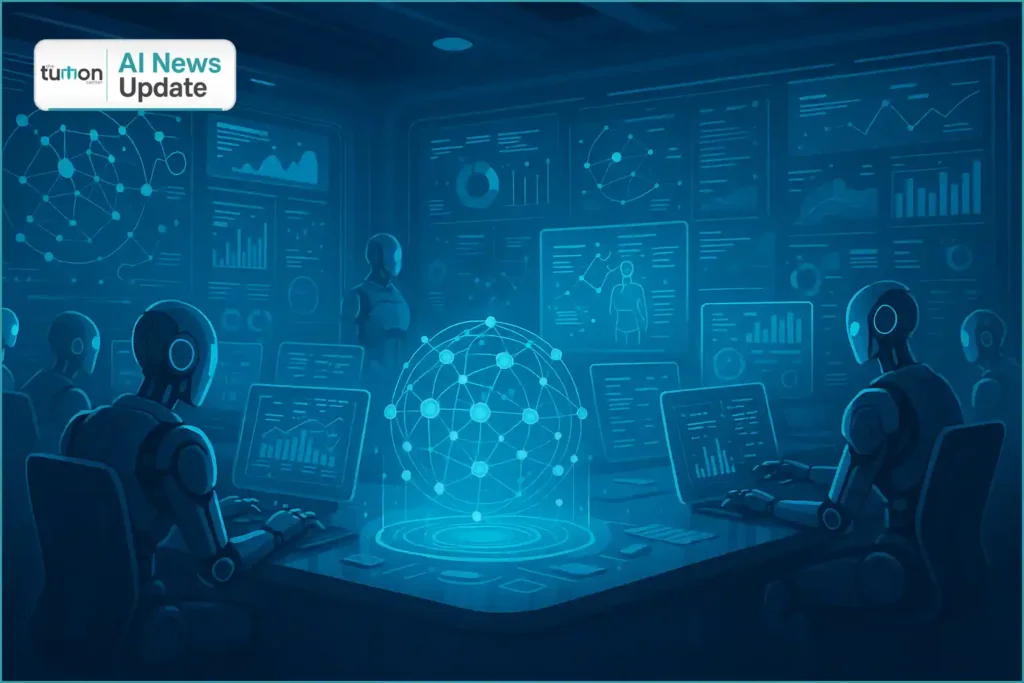
Autonomous AI agents are no longer prototypes — they’re performing tasks, running workflows, and transforming industries at breakneck speed.
- AI agents can perform multi-step tasks with human-level precision and 10x faster execution.
- Startups and big tech companies have shifted from “AI tools” to “AI workers” that run end-to-end workflows.
- India is emerging as a global hub for enterprise-grade agentic automation.
Introduction
For decades, artificial intelligence was seen as a tool — an assistant that acted only when instructed. Then came large language models, multimodal systems, and real-time reasoning engines. And now, in 2025, we are witnessing the next evolutionary leap: autonomous AI agents that behave like digital workers, capable of planning, decision-making, and execution.
Across industries, companies are shifting from using AI for simple tasks to deploying agents that independently run entire workflows. These agents browse the web, analyze data, complete documentation, coordinate with other agents, and even initiate processes based on triggers — all without constant human supervision.
The implications are massive. Productivity is rising. Costs are dropping. Small teams are accomplishing what once required 50–100 employees. And individuals are discovering that learning to command and orchestrate AI agents is becoming a career superpower.
This story explores the rise of autonomous AI agents — what they are, how they work, why they matter, and how they’re reshaping everything from education and software development to logistics, healthcare, finance, and governance.
Key Developments
AI agents exploded from research labs into mainstream use between late 2024 and 2025. Major triggers accelerated adoption:
1. Multi-Agent Frameworks Became Standard
Systems like AutoGen, CrewAI, LangGraph, and GPT-based agentic runtimes enabled agents to collaborate, negotiate, and divide tasks dynamically. Instead of executing single commands, agents could now plan complex sequences, evaluate progress, and retry intelligently.
2. Memory + Long-Context Reasoning Reached New Milestones
Agents gained advanced context retention, enabling them to recall past decisions, adjust strategy, and maintain continuity across sessions. This made them feel more like consistent digital colleagues, not one-time tools.
3. Real-Time Web Access Turned Agents Into Researchers
From analyzing market trends to drafting compliance reports, AI agents with live web access became capable of independently learning and updating themselves within strict ethical boundaries.
4. Workflow Orchestration Became Plug-and-Play
Platforms like n8n, Zapier, Make.com, and enterprise OS tools integrated AI agents directly into operations. A single agent could now call 10 other agents, triggering dynamic chains of automation.
5. Companies Began Hiring “Agent Managers”
As AI workers became common, humans skilled in prompting, designing, and supervising agent workflows emerged as a new job category — now considered one of the most in-demand skills of 2025.
Impact on Industries and Society
1. Education: Personalized Learning & Automated Academic Workflows
AI agents are acting as personal mentors, assignment helpers, curriculum generators, and evaluation assistants. Schools are using multi-agent systems to design lesson plans, automate grading, and analyze student performance in real time.
2. Healthcare: Case Management & Diagnostics Support
Hospital agents now summarize medical histories, schedule appointments, process insurance claims, and generate diagnostic suggestions for doctors to review. They act as a “super-assistant” layer across the system.
3. Finance & Banking: Compliance, Reporting & Fraud Monitoring
Status reports that once took teams two weeks can now be produced in 15 minutes by coordinated AI agents. Fraud detection agents independently scan anomalies 24/7.
4. Software Engineering: Autonomous Coding & Debugging
Developer agents can now plan features, write code, debug errors, run tests, and deploy builds. Many startups now run “agent-only sprints” where humans only review outputs.
5. Media & Journalism: Content, Research & Verification
Full newsrooms powered by agentic research are emerging. Agents validate facts, analyze policy changes, generate reports, and prepare publication-ready content for human editors.
6. Logistics: Autonomous Planning & Inventory Control
Agents forecast demand, optimize delivery routes, reorder stock, and dispatch fleet instructions without waiting for human approvals.
Expert Insights
“AI agents are not tools — they’re digital co-workers. The companies that understand this early will lead the next decade.” — Global AI Research Leader
“90% of enterprise workflows can be partially or fully agent-automated by 2028.” — Future of Work Council, 2025
“Students who learn to work with AI agents will outperform those who only use AI as a simple chatbot.” — EdTech Innovation Forum
India & Global Angle
India
India is quickly becoming the world’s largest market for agentic AI solutions. With its massive workforce, IT ecosystem, and startup growth, the adoption curve is steep. Indian companies are using AI agents to:
- automate customer support
- handle compliance and documentation
- conduct financial analysis
- manage HR workflows
- run sales pipelines
Government departments are also experimenting with agent-based grievance redressal and data analytics.
Global
In the US, Singapore, UAE, Japan, and Europe, companies are restructuring teams around “human + agent hybrid models.” The trend is accelerating faster than cloud adoption did a decade ago.
Policy, Research, and Education
Governments and universities are redefining training requirements. New programs in AI orchestration, agent management, and automated operations have emerged.
Policy bodies are focusing on:
- transparency of autonomous decisions
- limiting agent independence in high-risk sectors
- ensuring audit trails for all agent actions
- cybersecurity protection against rogue agents
Challenges & Ethical Concerns
1. Loss of Control
Over-independence of agents can lead to runaway tasks or unapproved actions if not regulated by guardrails.
2. Workforce Disruption
Entry-level roles are being replaced, necessitating reskilling at scale.
3. Security Risks
If compromised, an agent with access to enterprise systems can cause major damage.
4. Bias & Decision Transparency
Agents must be trained on ethically curated datasets to prevent biased outputs.
Future Outlook (3–5 Years)
- Enterprises will employ more AI agents than human workers for operational workflows.
- Every student will have a personal AI agent for learning, exams, and career planning.
- AI agents will become standard in government, healthcare, and financial systems.
Conclusion
AI agents represent the biggest shift in work since the internet. They are fast, competent, scalable, and endlessly adaptable. But the benefits will favour those who embrace the change early — not those who resist it.
For students, creators, entrepreneurs, and professionals, the message is clear: learn to work with agents, build with agents, and manage agents. The next decade belongs to those who collaborate with intelligent digital workers.
`#AI #AIAgents #FutureOfWork #Automation #AIInnovation #AIRevolution #DigitalWorkforce #TheTuitionCenter