
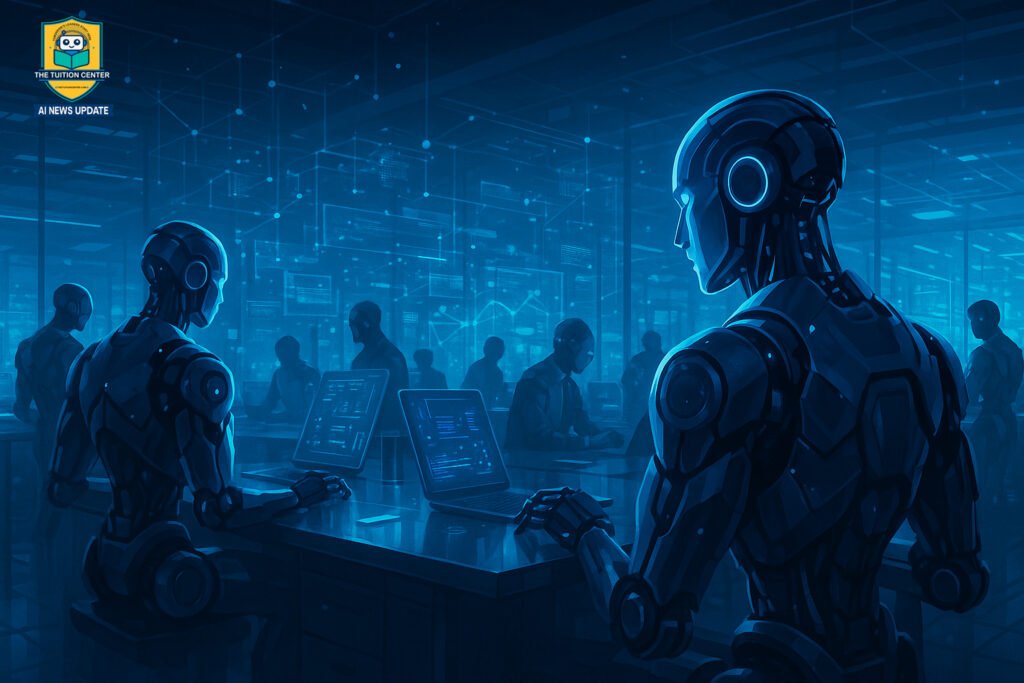
From smart service delivery to predictive governance, AI agents are quietly becoming the backbone of next-gen governments worldwide.
- 35+ countries have deployed AI agents for public-sector operations.
- AI improves delivery speed of citizen services by 30–70%.
- Governments now use AI for forecasting crime, allocating budgets, drafting regulations, and monitoring welfare programs.
Introduction
Around the world, governments are grappling with the same challenges—population growth, complex public demands, rising cyber threats, shrinking administrative capacity, and the need to deliver services faster and more transparently.
Enter AI agents: autonomous digital systems capable of analysing data, executing multi-step tasks, generating reports, predicting risks, and interacting with citizens 24/7.
In 2025, these agents evolved from small pilots to full-scale adoption. They now support governments in:
- welfare delivery and subsidy verification
- transport and infrastructure planning
- financial auditing and budget forecasting
- agriculture and climate-risk management
- disaster response and early warning
- crime prevention and cyber policing
- document drafting, legal research, and regulatory design
What was once manual, slow, and error-prone is becoming intelligent, proactive, and citizen-centric.
Key Developments
1. AI-Powered Public Service Portals Become the Global Norm
Governments in India, UAE, Singapore, Estonia, Japan, and Australia now run AI-first citizen portals where AI agents:
- answer public queries
- fill forms automatically
- schedule appointments
- resolve service requests
- track applications
These systems decrease human workload dramatically while improving service quality.
2. AI Agents for Policy Drafting and Legislative Research
Ministries around the world use AI to:
- analyse policy impact
- simulate future scenarios
- prepare parliamentary briefs
- draft proposals and amendments
- cross-reference international laws
Early reports suggest a 50–60% reduction in policy drafting time.
3. Crime Prediction & Smart Policing
Law enforcement agencies deploy AI agents to:
- monitor cyber threats
- identify criminal networks
- predict hotspots using real-time data
- analyse CCTV, drone feeds, and communication logs
- assist investigators with evidence structuring
This is significantly improving response time and transparency.
4. AI Agents for Social Welfare Verification
Welfare leakages are a major global challenge. AI agents now:
- verify beneficiary eligibility
- flag duplicates or misuse
- track subsidy use
- predict fraud patterns
- generate household vulnerability scores
This has saved billions in public funding.
Impact on Industries and Society
1. Faster Service Delivery
Waiting times for certificates, licenses, and applications have dropped from weeks to hours in many regions.
2. Increased Transparency
AI systems maintain logs, create digital trails, and reduce opacity in government processes.
3. Public Trust Improves
Citizens feel more confident engaging with predictable AI-driven systems rather than overloaded bureaucracies.
4. Optimised Resource Allocation
AI-driven forecasting helps governments plan infrastructure, disaster response, and budgets more accurately.
Expert Insights
“AI agents will be the backbone of 21st-century governance. They scale faster than any human workforce and create unprecedented administrative efficiency.” — Dr. Markus Ellington, World Governance Forum
“The question is no longer ‘Will governments use AI?’ but ‘How responsibly will they use it?’” — Justice Amina Roy, International Policy Institute
India & Global Angle
India is at the forefront of AI-driven governance:
- AI for agriculture forecasting in multiple states
- AI-powered grievance redressal dashboards
- predictive policing pilots
- AI-assisted public health modelling
- AI-enabled municipal operations in smart cities
Internationally, nations like UAE, Estonia, UK, and Singapore lead in AI-powered governance maturity.
Policy, Research, and Education
Governments are building frameworks for:
- AI accountability in public decisions
- ethical use of autonomous systems
- data privacy for citizen information
- AI audit trails for transparency
Schools and universities now include public sector AI courses.
Challenges & Ethical Concerns
AI in governance must be approached carefully:
- risk of algorithmic bias in public services
- concerns over surveillance misuse
- data security threats
- lack of clarity in liability for AI decisions
- potential erosion of human judgment in policy
Future Outlook (3–5 Years)
- Every ministry will operate with dedicated AI agent teams.
- AI-driven decision support systems will become mandatory for policy-making.
- Global AI governance standards will emerge across nations.
Conclusion
AI agents in government are the beginning of a new governance era—one where public services become faster, more equitable, transparent, predictive, and citizen-first.
The challenge for the future is not whether AI will change governance—it already has.
The true question is whether governments can shape AI with ethical responsibility, accountability, and human-centered philosophy.
#AI #AIInnovation #FutureTech #DigitalTransformation #AIForGood #GlobalImpact #Education #LearningWithAI #TheTuitionCenter