
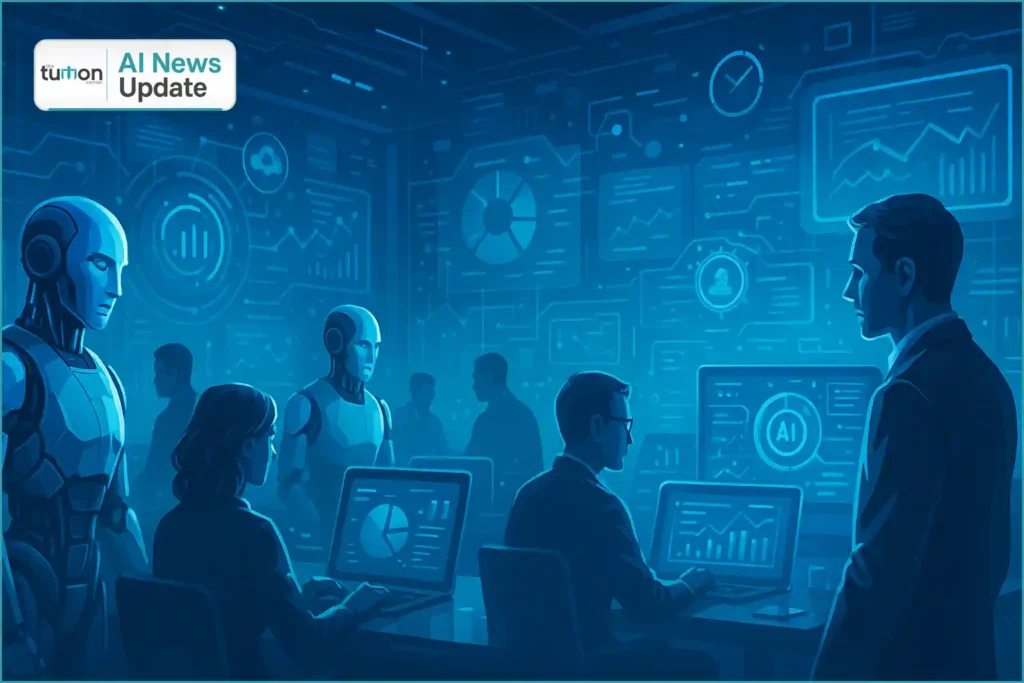
From autonomous agents and AI copilots to hybrid teams and skill-based hiring, 2025 marks a new era where work is being rewritten at breathtaking speed.
Key Takeaway: AI isn’t just automating tasks — it’s redefining the meaning of work, shifting the global job market toward creativity, problem-solving, critical thinking and AI orchestration.
- AI agents are now executing multi-step workflows across industries.
- New job roles are emerging around AI management, orchestration and training.
- The biggest career advantage in 2025 is understanding how to collaborate with intelligent systems.
“`
Introduction
The idea that “AI will take away jobs” has dominated public debate for years. But in 2025, the conversation has evolved into something more nuanced — and far more transformational. Work is not disappearing. Work is changing. The workplaces of today don’t look like the offices of the past. Laptops have replaced paper. Messaging platforms have replaced memos. Now AI agents, copilots and autonomous systems are taking over large segments of repetitive, mechanical and analytical tasks.
Every major company — from tech giants to manufacturing firms — is redesigning how work happens. Humans no longer do everything themselves; they direct intelligent systems. The new rule is simple: If a task has clear steps, AI can perform it. If a task requires creativity, empathy or complex judgment, humans remain essential.
For students, professionals, educators and job-seekers, this shift brings both opportunity and responsibility. The winners of the future aren’t the ones who fear AI — but the ones who know how to use it.
Key Developments
1. AI Agents Become the New Digital Workforce
AI agents are the fastest-growing class of automation. They can plan, organize, analyze and execute workflows with minimal human supervision. In marketing, finance, HR, software engineering and logistics, agents work like digital employees — taking instructions, working in teams, and producing results.
2. Copilots Embedded in Every Department
From writing emails to drafting reports to generating insights, AI copilots are everywhere. Doctors have medical copilots. Teachers have lesson-planning copilots. Lawyers have research copilots. And engineers have coding copilots.
3. Hybrid Human–AI Teams Become Standard
Companies are restructuring teams around hybrid workflows: humans leading with judgment and creativity, AI handling execution and optimization. This is creating new types of collaborative environments where roles are fluid and dynamic.
4. Skill-Based Work Replaces Degree-Based Hiring
Organizations now hire based on capability, portfolio and problem-solving skills, not just traditional degrees. AI literacy is becoming a universal expectation — like digital literacy was in the 2000s.
5. Rise of the “AI Operations” Function
AI Ops teams manage models, agents, data flows, guardrails and performance checks inside companies. This is one of the fastest-emerging career fields globally.
Impact on Industries and Society
1. Software Engineering Transformed
AI copilots write code, debug errors, generate tests and deploy applications. Engineers now focus on design, architecture and quality control. Junior developers are shifting toward AI-assisted engineering roles.
2. Sales & Marketing: Personalization at Scale
AI systems generate proposals, optimize ads, handle customer communications, and recommend strategies. Sales teams use AI to analyze leads, predict conversions and tailor campaigns.
3. Healthcare: AI-Supported Decision Making
Doctors use AI to review reports, recommend treatment pathways, analyze patterns and identify at-risk cases. Nurses use AI for triage, documentation and patient monitoring.
4. Manufacturing & Logistics: Autonomous Planning
Supply-chain agents manage routing, forecasting, reordering and dispatch coordination. Manufacturing plants use predictive maintenance and automated quality control.
5. Finance & Banking: Automation of Core Processes
Fraud detection, compliance checks, risk assessment, financial modeling — all are increasingly AI-driven. Human teams validate, audit and guide decisions.
6. Education: AI-Supported Learning & Teaching
Students use AI to learn, teachers use AI to teach, and institutions use AI to monitor performance and design better curricula.
Expert Insights
“AI won’t replace people — people who know how to use AI will replace those who don’t.”
“The future belongs to hybrid workers: humans who can collaborate with AI agents and automate 70% of their routine tasks.”
“If you’re not training your workforce for AI collaboration, you’re preparing for economic decline.”
India & Global Angle
India
India is experiencing one of the biggest shifts in workforce behavior. With its large young population and massive IT & service sector, India is turning into a global center for AI-enabled jobs. Companies are rapidly adopting AI-first processes across customer support, finance, engineering, education, retail and governance.
New job roles like AI workflow designers, prompt engineers, agent supervisors and data governance leads are expanding faster than universities can prepare talent.
Global
Developed economies face shortages in technical expertise, pushing them to adopt AI for efficiency. Middle-income countries are leapfrogging entire generations of infrastructure using AI-powered automation. Globally, the competition is fierce — countries that move fastest will dominate new industries.
Policy, Research, and Education
1. Governments Are Updating Labor Laws
Policymakers are redefining employment categories, worker protections and accountability in AI-driven environments.
2. Reskilling Is Becoming Mandatory
Major companies require employees to undergo AI-literate training. Universities are offering short-term microdegrees in AI operations, data literacy, and automation management.
3. AI Ethics & Governance Programs Rise
As AI becomes more autonomous, new frameworks are emerging around transparency, accountability, performance auditing and human oversight.
Challenges & Ethical Concerns
1. Job Displacement Risks
Routine roles in customer service, documentation, data entry and basic analysis are shrinking. Workers must transition to higher-value tasks.
2. Inequality in AI Access
Workers without access to AI tools fall behind quickly. Ensuring equitable access is essential for social balance.
3. Productivity Pressure
AI creates expectations of continuous efficiency. Organizations must balance efficiency with worker well-being.
4. Ethical Use of Automation
Companies must ensure AI-driven decisions follow fairness, transparency and social responsibility principles.
5. The Skills Gap
There is a widening gap between the skills workers have and the skills AI-driven economies demand.
Future Outlook (3–5 Years)
- AI agents will perform 60–80% of repetitive office work.
- Every professional will use at least one personal AI assistant daily.
- AI-first companies will outperform traditional companies by huge margins.
- New job categories will emerge around AI auditing, agent orchestration and workflow automation.
- Creative, empathetic and strategic skills will become the most valuable human traits.
Conclusion
Work in 2025 is not about doing everything yourself — it’s about knowing what to do with the intelligent systems at your side. AI is transforming jobs, industries and economies at breathtaking speed, but it is also unlocking opportunities for millions of people to rise faster than ever before.
The question is no longer “Will AI replace me?” The real question is: “Will I learn to work with AI before others do?”
The future belongs to those who collaborate with intelligent systems, not compete against them. Students, professionals, founders, educators — this is your moment. The world is being rewritten. And you get to decide your role in what comes next.
#AI #FutureOfWork #Automation #AIAgents #CareerGrowth #DigitalTransformation #TheTuitionCenter