
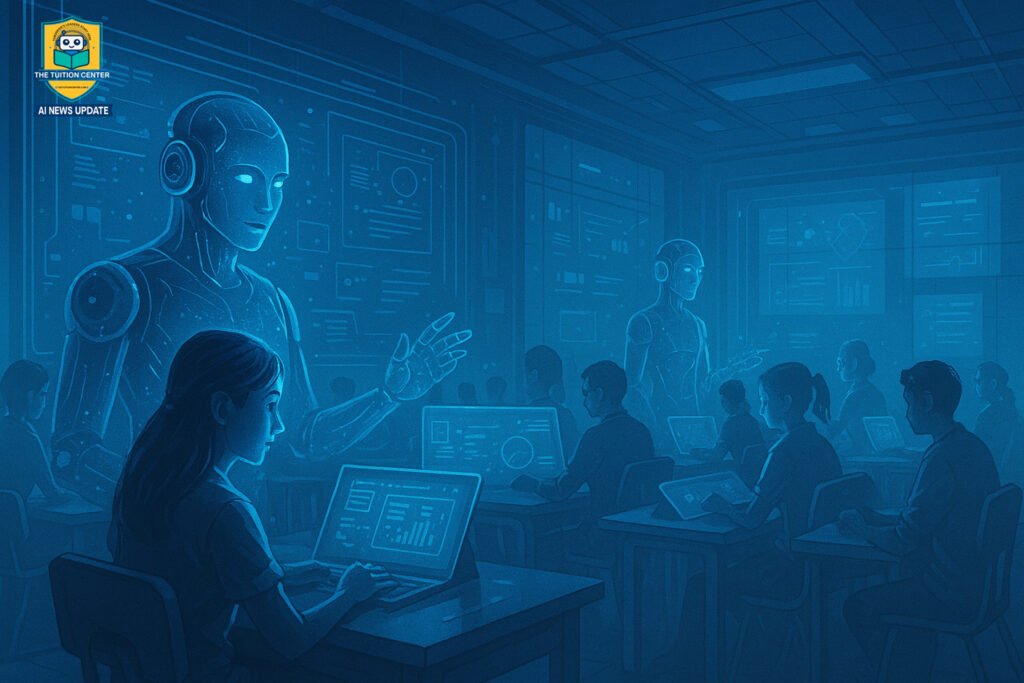
The global creative economy is being rewritten as AI becomes a collaborator, co-creator, and catalyst for new forms of artistic and intellectual expression.
- The global generative creativity market crossed $310 billion in 2025.
- AI now co-produces books, films, music, architecture, and educational content.
- 70% of creative professionals use AI daily for ideation, design, editing, or production.
Introduction
Creativity has always defined humanity—stories, symbols, paintings, songs, architecture, and inventions. But in 2025, a new collaborator has emerged: generative artificial intelligence.
For the first time in history, we are co-creating with machines.
Generative AI tools—capable of producing art, writing, music, images, animations, 3D models, and even entire films—are changing how the world thinks about imagination. They don’t just follow commands; they understand context, emotions, patterns, culture, and aesthetics.
Creativity is no longer limited by skill—it is limited only by imagination.
Key Developments
1. AI Becomes a Creative Partner, Not a Tool
Unlike software of the past, AI co-ideates.
It suggests compositions, colour palettes, story arcs, cinematic sequences, and even emotional tonality.
Artists now use AI to break creative blocks and explore ideas they never considered.
2. Entire Films and Animated Shorts Are Now AI-Enhanced
Studios in India, Japan, Korea, and the US use AI for:
- storyboarding
- visual effects
- character design
- background generation
- voice synthesis
- scene ideation
Independent creators who once needed entire teams can now produce high-quality media alone.
3. Publishing Enters the Age of AI-Augmented Writing
Authors use AI to:
- generate drafts
- refine plot twists
- build character arcs
- translate stories into 40+ languages instantly
Global literacy initiatives now use AI to produce culturally relevant children’s books at scale.
4. Architecture & Product Design Experience AI Breakthroughs
Architects use AI to simulate:
- building safety
- materials impact
- energy efficiency
Designers use AI to generate product prototypes within minutes.
5. Social Media Creativity Explodes
AI-generated:
- short videos
- filters
- motion graphics
- trend-based reels
- AI avatars and influencers
dominate feeds.
Even micro-creators now produce studio-grade content.
Impact on Industries and Society
1. Democratizing Creativity
Anyone can create art now—regardless of background, training, or skill.
AI breaks the barrier that once separated “professionals” from “amateurs.”
2. Enabling New Employment Channels
AI creativity birthed new careers:
- AI art directors
- AI scriptwriters
- AI prompt designers
- creative agents for brands
- AI editing specialists
3. Boosting Global Cultural Exchange
Translation and localisation tools allow:
- Indian creators to reach Latin America
- African storytelling to reach Europe
- Japanese art styles to influence the Middle East
Creativity becomes global by default.
4. Hyper-Personalized Consumer Experiences
AI systems tailor:
- ads to personality traits
- music to emotions
- stories to mood
- art styles to individual tastes
Expert Insights
“AI is not replacing creative people—it’s replacing the limits of creative people.” — Dr. Elaine Foster, Centre for Creative Intelligence
“The future belongs to hybrid creators who understand how to partner with AI to build worlds, stories, and emotions.” — Rahul Verma, Head of Media Innovation, Singapore Global Arts Lab
India & Global Angle
India is rapidly becoming a global hub for AI-driven creativity:
- Bollywood & regional cinema adopt AI for production
- graphic designers and photographers use AI for editing
- advertising agencies run AI-optimized campaigns
- EdTech platforms generate localised learning content
Globally, creative AI powerhouses include:
- Japan — anime and character design
- South Korea — music & K-pop production
- USA — cinema, VFX, virtual actors
- UAE — AI-powered media cities
Policy, Research, and Education
Governments and institutions now debate:
- copyright ownership of AI-generated works
- misuse of synthetic media
- deepfake regulations
- training data transparency
Universities worldwide have launched “AI + Creativity” degrees focused on:
- generative design thinking
- AI storytelling
- ethical creative systems
Challenges & Ethical Concerns
The creative AI boom comes with risks:
- deepfakes and identity misuse
- copyright disputes
- bias in training data affecting art styles
- over-dependence on AI aesthetics
Future Outlook (3–5 Years)
- AI will co-direct films and co-author global bestsellers.
- AI-generated concerts, performances, and exhibitions will flourish.
- Creators will manage multi-agent AI studios generating content simultaneously.
Conclusion
AI creativity is not the end of human imagination—it is the expansion of it.
We are entering a world where imagination has no technical limits, where creation becomes faster, more democratic, more expressive, and more global.
The creators of tomorrow will not choose between human and AI—they will combine both to build new worlds of beauty, meaning, and innovation.