
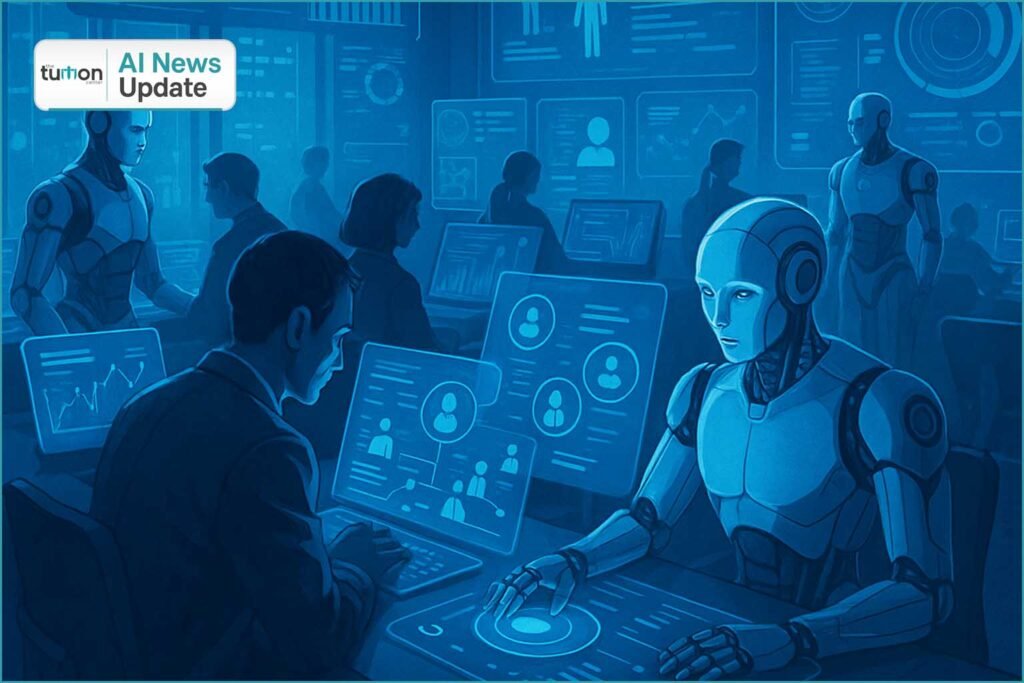
Cyber threats have outgrown traditional defences. In 2025, AI-driven autonomous security systems are becoming humanity’s first line of protection against global digital attacks.
- Global cyberattacks increased 470% from 2023 to 2025.
- AI-based autonomous defenders are now used by 80% of Fortune 500 companies.
- India, USA, Israel, South Korea, and UAE lead AI-cyber defence innovation.
Introduction
Cybersecurity has entered a new era — one where human analysts alone cannot keep up. The digital world is now a battlefield where attacks evolve automatically, strike across continents, and mutate faster than traditional defence systems can respond.
In 2025, the world witnessed a major shift: AI took center stage not as a support assistant, but as a frontline defender capable of autonomous decision-making.
GenAI-enabled hacking tools, AI-scripted malware, autonomous botnets, and deepfake-powered social engineering scams are pushing cybercrime to historic levels. To counter this, nations and enterprises have deployed a new kind of guardian — **AI cybersecurity agents** that monitor networks, detect anomalies, predict breaches, and automatically neutralize threats.
For the first time, defenders are as fast, adaptive, and intelligent as attackers.
Key Developments
Cybersecurity has undergone three major transformations:
1. Autonomous Threat Detection
2025’s most significant breakthrough is the evolution of AI agents capable of:
- identifying anomalies within 300 milliseconds
- blocking attacks before they reach critical infrastructure
- learning continuously from global threat data
- coordinating with other AI agents worldwide
These defenders operate 24×7 without fatigue and respond much faster than human teams.
2. AI vs. AI Cyber Warfare
For the first time, both attackers and defenders are using AI.
This has triggered:
- AI-driven ransomware that adapts to defences
- malware that rewrites its own code
- deepfake workflows capable of bypassing biometric systems
- AI-phishing engines generating personalised attacks
The battle is now machine vs. machine — with humans supervising strategy.
3. Predictive and Preemptive Defence
Modern AI security frameworks can anticipate attack vectors days or even weeks before they occur, based on:
- pattern clustering
- threat origin mapping
- global attack correlation
- vulnerability predictions
This shift from reactive to predictive cybersecurity is the biggest step forward in 20 years.
4. National AI Cyber Command Centers
Multiple countries have launched AI-powered defence hubs that synchronise:
- critical infrastructure protection
- telecom network security
- banking and fintech defence systems
- transportation and aviation cybersecurity
India’s National Cyber AI Shield, launched in early 2025, is one of the world’s fastest-growing models.
Impact on Industries and Society
Nearly every sector feels the impact of AI-driven cybersecurity:
1. Banking & Finance
AI systems monitor millions of transactions per second, flagging fraud before customers even notice.
Banks with AI-defence systems have reported a **65% drop in digital fraud losses**.
2. Healthcare
AI agents protect patient data, prevent ransomware attacks on hospitals, and secure medical IoT devices like pacemakers and monitors.
3. Education
Universities deploy AI to secure exam platforms, digital records, and student data.
EdTech platforms use AI to detect suspicious login behaviour and impersonation.
4. E-commerce and Startups
AI defences have become essential for protecting customer payments, personal data, logistics routes, and warehouse automation systems.
5. Government Services
AI shields citizen databases, tax portals, public grievance platforms, and digital identity systems.
Expert Insights
“Cybersecurity without AI is now statistically impossible. Human teams simply cannot match the scale or speed of modern attacks.”
— Dr. Monica Feld, Global Cyber Defence Alliance
“We are witnessing the birth of autonomous defence — digital guardians that protect systems before humans even become aware of the threat.”
— Rahul Mehta, CEO, India CyberShield Technologies
“Attackers are using AI, so defenders must use AI. It is the only realistic future of cybersecurity.”
— Prof. Jerome Klein, MIT Cybernetics Division
India & Global Angle
India is emerging as a cybersecurity powerhouse, driven by:
- a large IT sector
- rapid digital public infrastructure growth
- billions of monthly digital transactions
- massive Aadhaar-linked identity network
The government has invested heavily in:
- AI-run SOC (Security Operations Centers)
- national threat libraries
- predictive defence clusters
- AI forensic investigation systems
Globally:
- Israel leads innovation in cyber-autonomous defence.
- USA dominates enterprise-grade AI security platforms.
- South Korea leads telecom cyber-protection for 6G networks.
- Japan focuses on securing robotics and manufacturing automation.
- UAE has launched one of the world’s first AI-led public defence grids.
Policy, Research, and Education
The education sector is adapting — and fast.
Universities are launching programs in:
- AI-driven Cyber Defence
- Autonomous Security Systems
- Digital Forensics with AI
- Threat Intelligence Engineering
- AI Governance for Cyber Laws
Meanwhile, governments are developing:
- AI safety audits for cyber tools
- national cyber risk indices
- AI-controlled emergency response systems
- deepfake regulation policies
Schools are teaching cyber hygiene from early grades, preparing students for a world where AI-powered cyber threats are everyday realities.
Challenges & Ethical Concerns
As AI becomes central to defence, new challenges emerge:
- What if AI defenders make wrong decisions?
- How do we prevent rogue AI from misidentifying threats?
- What happens when autonomous systems disagree?
- Who is responsible for AI-driven defence errors?
- How do we avoid over-surveillance?
Experts believe that “human-in-the-loop” oversight is essential.
AI must operate autonomously — but never without accountability frameworks.
Future Outlook (3–5 Years)
- AI defenders will gain emotional-intelligence layers to detect social-engineering attacks.
- Autonomous defence protocols will integrate with national security systems.
- AI will protect quantum computing infrastructure and space-based networks.
Conclusion
AI cybersecurity has become the invisible shield of modern civilization.
It protects banks, hospitals, classrooms, airports, defence systems, homes, and digital identities.
The rise of autonomous defenders is not just a technological milestone — it is a societal necessity.
For students and professionals, mastering AI security is no longer an option.
It is one of the most critical career paths of the next decade.
The digital world has changed — and now, so must we.