
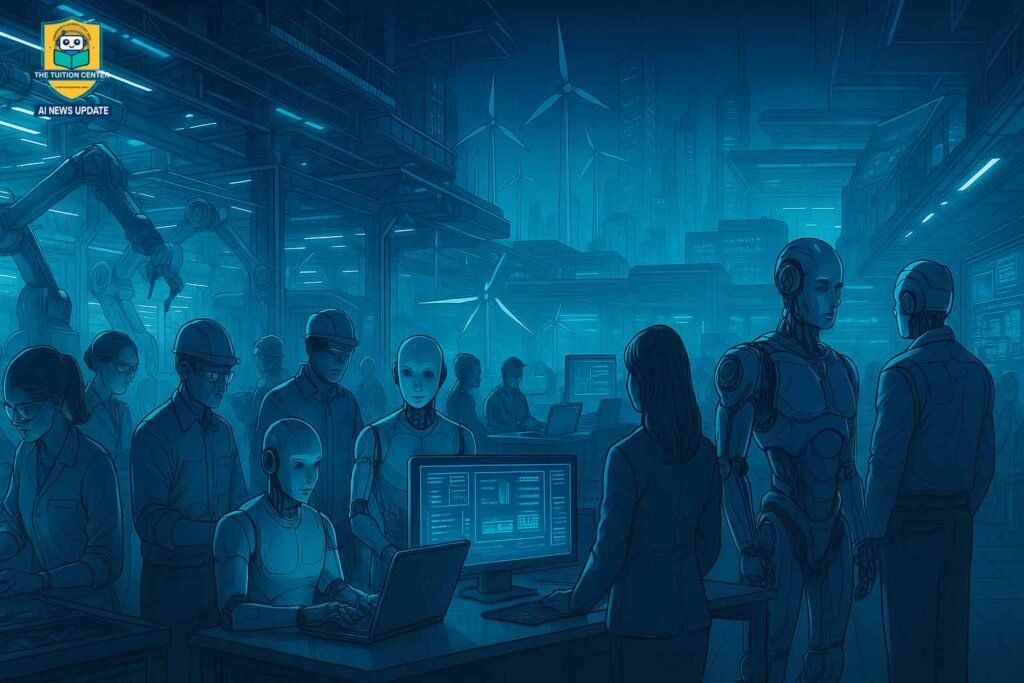
AI “Digital Employees” Are Reshaping the Global Workforce in 2025 — Automation Enters a New Era
Autonomous AI workers — capable of handling sales, HR, coding, analytics, design, compliance, logistics, and customer service — are rapidly becoming part of everyday teams worldwide.
- In 2025, over 48% of Fortune 500 companies deployed at least one AI digital employee.
- India, USA, Singapore, and UAE are leading adoption in operations, support, and engineering.
- AI workers now handle up to 70% of enterprise workflows in some industries.
Introduction
The world of work is undergoing the most profound transformation in its modern history. Artificial intelligence has moved beyond being a tool — it has become a participant. The emergence of “digital employees,” AI-powered autonomous workers that can operate 24/7 without supervision, is redefining how companies function.
These AI agents schedule meetings, create presentations, respond to customers, generate code, run financial models, manage warehouses, and even collaborate with human colleagues in real time. In 2025, they are not futuristic experiments — they are everyday members of the workforce in thousands of companies.
Key Developments
1. Rise of AI Workforce Platforms
Companies like OpenAI, Google, Microsoft, and multiple Indian startups have launched platforms enabling businesses to recruit AI digital employees — complete with job roles, KPIs, personality settings, and performance dashboards. These AI agents integrate directly into Slack, Teams, WhatsApp, ERP systems, and CRM platforms.
2. Customer Support Transformed
The biggest leap has been in customer support. AI agents now resolve over 80% of service tickets in industries like telecom, fintech, retail, and aviation. They understand tone, escalate intelligently, handle refunds, and maintain full context across conversations.
3. HR & Recruitment Automation
HR teams are using AI workers to screen resumes, analyze candidate fit, schedule interviews, and generate standardized feedback. A midsized company in Bangalore reduced its hiring time by 61% using AI recruitment bots.
4. AI “Shadow Teams” in Software Development
Software companies now deploy AI shadow developers who write, debug, and refactor code in real time. Human engineers supervise complex design decisions, while AI handles the heavy lifting.
5. Compliance and Risk Monitoring
Banks and NBFCs use AI compliance officers that monitor transactions, generate audit reports, track suspicious patterns, and ensure regulatory adherence. Efficiency improved by nearly 45%.
Impact on Industries and Society
AI digital employees are not simply replacing tasks — they are enabling industries to operate with new levels of precision, speed, and intelligence.
1. Healthcare
Hospitals use AI admin agents for appointment scheduling, reports summarization, triage support, and insurance claims management — reducing patient wait time by 30–40%.
2. Education
Schools and ed-tech companies use AI teaching assistants to personalize learning paths, grade assignments, create quizzes, and support multilingual teaching. Teachers spend more time guiding and less time on routine administration.
3. Manufacturing & Logistics
Smart factories rely on AI operations managers who track inventory, optimize energy use, schedule machine maintenance, and coordinate supply chains autonomously.
4. Finance & Banking
AI financial analysts create investment models, analyze portfolios, and draft reports with instant insights. Trading firms now run AI risk dashboards that detect anomalies in seconds.
Expert Insights
“We’re witnessing the birth of a parallel digital workforce. Humans are moving toward creative, strategic roles — AI handles the rest.”
— Dr. Irene Brooks, MIT Workforce Futures Lab
“Companies adopting AI employees early will scale 3× faster and operate with 50% lower administrative overhead.”
— Sameer Agarwal, Founder, India AI Workforce Forum
India & Global Angle
India is becoming a global hub for AI workforce deployments, especially in IT, BPO, logistics, and retail. Startups in Bengaluru, Gurugram, and Hyderabad are building digital employees specialized in vernacular languages — a major advantage for India’s diverse markets.
Globally, the USA and Singapore are leading high-tech adoption, while UAE and Saudi Arabia are integrating digital workers into government service channels.
Policy, Research, and Education
Governments are now working on frameworks to regulate and standardize AI workers:
- AI Worker Identification IDs for accountability.
- Skill certifications for AI digital employees.
- Mandatory human oversight for sensitive workflows.
- AI workforce integration in university career curriculums.
Universities in India, Japan, and the EU have launched Master’s programs in AI Workforce Management, focusing on hybrid teams and automation governance.
Challenges & Ethical Concerns
The rise of AI workers also raises important debates:
- Job displacement: Workers fear losing routine roles.
- Accountability: Who is responsible for AI-generated errors?
- Security: AI employees linked to core systems pose cyber risks.
- Bias: AI recruitment and financial models still show algorithmic bias.
- Human-AI boundaries: Overuse can reduce human judgment quality.
Future Outlook (3–5 Years)
- Most companies will have hybrid teams where humans lead, and AI executes operations.
- AI employees will become specialized (legal AI, medical AI, logistics AI, audit AI).
- AI humans may evolve into multi-role digital twins of senior executives.
- Governments will launch AI worker registries for safety and oversight.
- New job roles will emerge: AI team managers, automation coordinators, and AI ethic supervisors.
Conclusion
The workplace of 2025 is no longer limited by human hours, fatigue, or administrative burden. Businesses are becoming faster, sharper, and more scalable because AI workers operate constantly at peak performance.
Yet, the future belongs to those who know how to lead these hybrid teams. Human creativity, empathy, and decision-making paired with AI speed and consistency will become the defining formula of global success.