
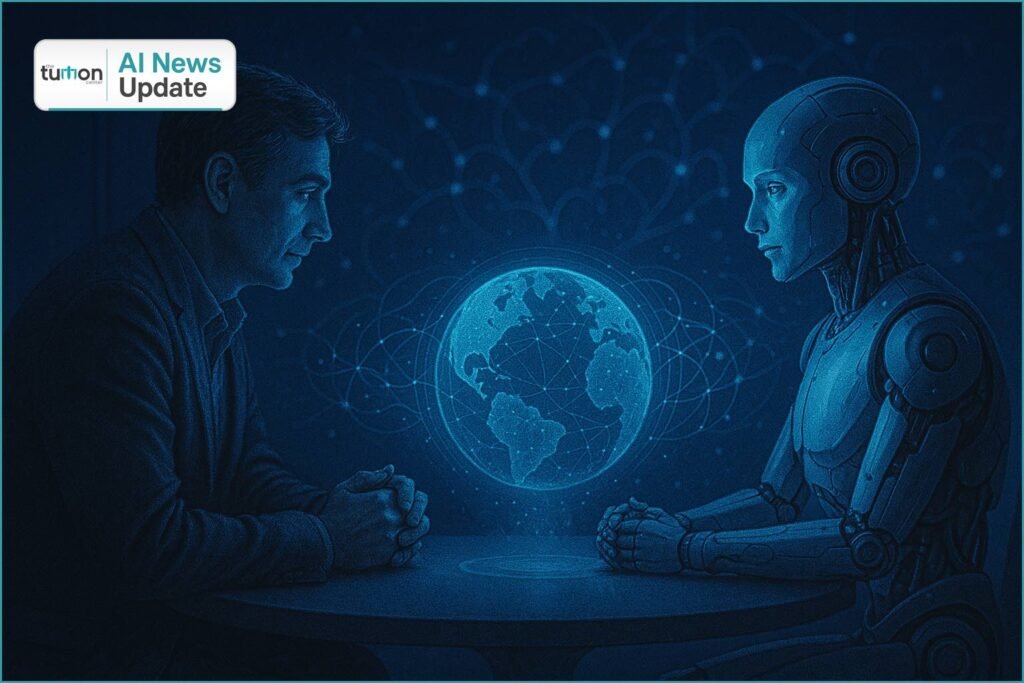
Inspired by Dr. Fei-Fei Li’s philosophy, this week’s Future Quote explores how AI mirrors human intent, creativity, and compassion—and why our future depends on aligning machine intelligence with moral imagination.
- Quote Origin: Dr. Fei-Fei Li, Stanford University, “AI for Humanity” talk, 2024.
- Context: Aligning large-scale AI development with human-centered values.
- Focus: Empathy, reflection, and co-evolution of human and machine intelligence.
Introduction
When Dr. Fei-Fei Li, one of the most influential voices in modern AI, says, “AI is not our replacement—it’s our reflection,” she’s not speaking poetically. She’s issuing a challenge. The challenge is to see AI as an extension of our collective mind, shaped by our data, designed by our decisions, and directed by our desires. The tools we build inherit our biases and brilliance alike; the reflection they cast is both beautiful and cautionary.
In 2025, as generative models permeate classrooms, offices, and policy rooms, this quote feels more urgent than ever. The line between creation and curation is thinning. What remains is a simple but profound truth: the ethics of AI are the ethics of its makers.
“`
Key Developments
In recent months, AI has crossed milestones that were once pure speculation. GPT-5 models now reason multimodally—understanding voice, text, and vision in one continuous thread. AI companions are used in education to support differently-abled learners. Emotional analytics, long seen as a fringe pursuit, have found use in healthcare and psychology for empathy training. Each of these advances strengthens Fei-Fei Li’s argument that AI’s evolution is a reflection of human aspiration.
But reflection also means responsibility. The way we train, deploy, and interact with AI systems determines the moral landscape of our digital century. If AI reflects us, we must decide what image we wish to project.
Impact on Industries and Society
Education: AI tutors and adaptive learning systems are reshaping classrooms, offering personalized feedback loops that honor the pace and pattern of each student. Teachers are shifting from content deliverers to empathy-driven mentors who guide students in responsible use.
Healthcare: AI diagnosis tools now analyze emotions as well as symptoms, detecting early signs of depression and burnout through tone and facial cues. These systems are not meant to replace therapists—they extend their reach.
Creative Industries: AI-generated art, music, and film are sparking a global debate: where does human creativity end and machine contribution begin? Artists are increasingly collaborating with AI, using it as an amplifier of vision rather than competition.
Governance: Policymakers are integrating AI ethics into public policy, creating frameworks to ensure inclusivity and transparency. India’s AI Ethics Charter, currently in consultation, aligns directly with these global ideals of reflection and accountability.
Expert Insights
“AI is a mirror. If we feed it empathy, it becomes empathetic. If we feed it fear, it becomes manipulative. The machine is not moral; the maker is.” — Dr. Fei-Fei Li
“Humanity’s challenge is not building machines that think, but ensuring they think with us, not for us.” — Satya Nadella, Microsoft CEO
“When technology learns our emotions, the goal must not be control—but compassion.” — Dr. Roshni Verma, Cognitive Scientist
India & Global Angle
India’s AI journey reflects this philosophy in real time. Government initiatives such as “AI for All” and NITI Aayog’s Responsible AI framework are designed to democratize access while embedding human values. AI-driven literacy programs are reaching rural learners, and inclusive design principles are guiding developers to create systems that understand multiple Indian languages and cultural nuances.
Globally, institutions from Stanford to Tokyo University are exploring AI’s ethical evolution—not as regulation, but as education. The focus is shifting from control to consciousness, from “what can AI do?” to “what should AI do?”
Policy, Research, and Education
Educational programs worldwide are rethinking their foundations. AI ethics is no longer a seminar topic—it’s a mandatory pillar of computer science and business education. UNESCO’s 2025 AI Ethics Curriculum, co-developed with India, emphasizes reflective design: understanding human consequences before coding functionalities.
At the research frontier, scholars are studying “value alignment learning,” where models are tuned not just for accuracy but for alignment with human well-being. The next step in responsible AI is not explainability alone—it’s empathy in architecture.
Challenges & Ethical Concerns
Bias Reflection: If data mirrors society, then discrimination risks are embedded by default. Developers must audit not just code, but the worldview that feeds it.
Dependency: Emotional AI companions can blur the line between assistance and attachment, especially for children or isolated individuals.
Transparency vs. Complexity: The deeper models become, the harder it is to explain their moral reasoning. Explainability must evolve into “accountable interpretability.”
Education Gaps: Developing nations risk a new divide—not digital, but ethical—if AI literacy doesn’t grow alongside infrastructure.
Future Outlook (3–5 Years)
- Reflective AI Design: Developers embed “moral imagination” principles—scenario testing, empathy scoring, and cultural context mapping—into training cycles.
- Emotionally Intelligent Systems: Healthcare and education adopt emotion-aware AI that personalizes care and learning with empathy metrics.
- Human-AI Co-Creation: The boundary between tool and teammate fades; workplaces evolve into “cognitive partnerships.”
Conclusion
Fei-Fei Li’s statement reminds us that the future of AI isn’t about machines replacing people—it’s about people redefining what it means to be human through machines. Every prompt, dataset, and decision adds to the reflection we’ll one day confront. The smarter the AI, the deeper the mirror. Let’s ensure that when we look into it, we like what looks back.