
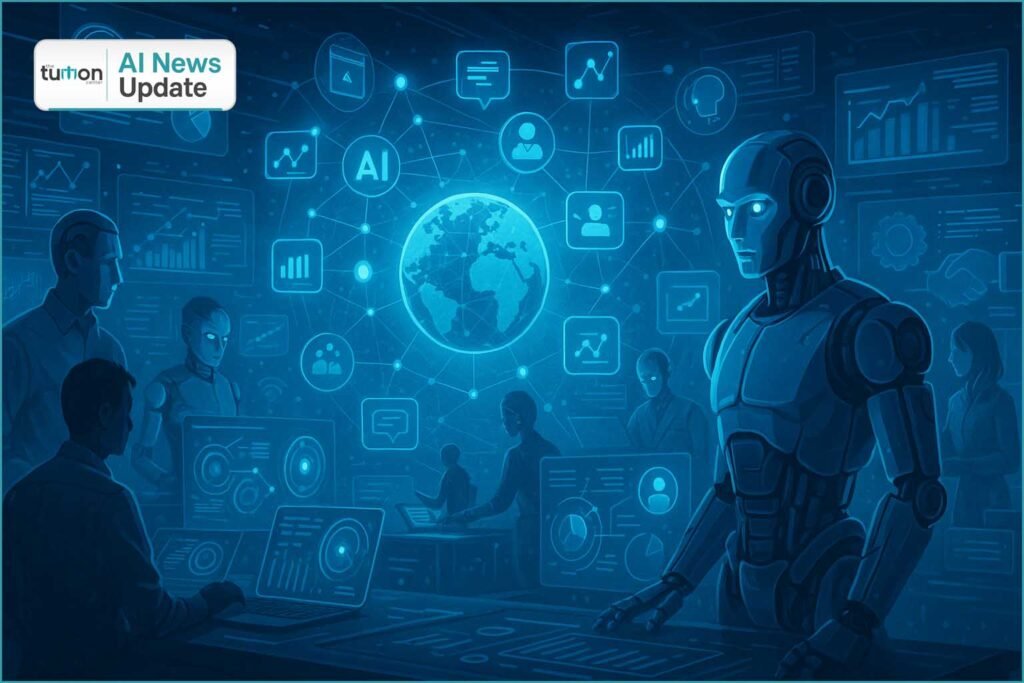
A new era of hyper-personalized, AI-driven learning is emerging worldwide — and it’s evolving faster than institutions can adapt.
- Over 1.5 billion learners now interact with AI tutoring systems globally as of 2025.
- India, the US, China, and UAE are leading adoption in schools, EdTech, and corporate skilling.
- Experts predict AI tutors will reduce learning inequality drastically by 2030.
Introduction
Education has always evolved slowly. From chalkboards to smartboards, from libraries to the internet — each shift took decades. But 2025 is different. For the first time in history, the core model of teaching itself is being rewritten by AI. Not the tools, not the content, but the actual experience of learning: personalised tutoring, adaptive explanations, voice-driven doubt clearing, and emotional-aware feedback. The rise of AI personal tutors is no longer a future experiment — it’s a present-day movement touching 1.5 billion learners.
The reason is simple: education systems worldwide face impossible pressure. Teacher shortages, outdated curricula, low student engagement, rising unemployment, and the explosive growth of AI-related jobs are forcing a reimagination of how learning works. AI tutors are stepping into this gap — not to replace teachers, but to multiply their impact.
Key Developments
Over the past 24 months, adoption of AI personal tutors has accelerated across nations. India’s National Digital University has integrated AI tutors into several pilot programs. The United States has introduced personalised learning AI for K-12 math and reading. China’s Ministry of Education is deploying AI-driven competency trackers to rural schools. Meanwhile, private EdTech players like Khan Academy’s “Khanmigo”, Google’s LearnLM, OpenAI’s study assistants, and multiple national AI platforms across Asia are redefining instruction at massive scale.
In 2025 alone, an estimated 220 million new students were introduced to AI-driven learning systems. Developers are reporting exponential improvements in contextual clarity, emotional tone detection, and multimodal reasoning — enabling students to learn through conversation, diagrams, voice explanations, and step-by-step logic.
Impact on Industries and Society
The biggest disruptions appear in four verticals: K-12 education, higher learning, corporate reskilling, and competitive exam preparation. For K-12, AI tutors are boosting personalised attention — something impossible for a single teacher handling 45–60 students. In higher education, AI assistants are streamlining complex coursework in engineering, medicine, law, and management. Corporates are using AI to retrain employees at scale, especially in cybersecurity, AI tools, finance, and operations.
Society is also witnessing psychological shifts: students feel more confident asking questions to AI than humans, especially when embarrassed or under pressure. AI tutors are patient, tireless, available 24×7, and capable of repeating explanations endlessly. This is eliminating a major emotional barrier in traditional classrooms.
Expert Insights
“AI tutors don’t replace teachers — they replace the fear of asking a question,” says Dr. Aisha Pradhan, an education psychologist based in Singapore.
“When a child feels seen and supported, learning accelerates naturally.”
According to Stanford’s AI Learning Lab: “The biggest shift is not automation, but augmentation. Students learn twice as fast when AI tutors complement human teaching.”
India & Global Angle
India is uniquely positioned to become the world’s AI-education powerhouse. With 260 million school students, thousands of test-prep ecosystems, and one of the world’s largest young populations, AI tutors solve real structural problems. From CBSE to state boards to NEP-aligned digital platforms, personalised learning is rapidly gaining ground.
Globally, UAE is pioneering AI-first classrooms; Finland is integrating AI literacy into school curriculum; Mexico is using AI tutors for rural education; and Japan is combining robotics with AI learning companions.
Policy, Research, and Education
Governments are drafting AI-in-education guidelines for safety, accuracy, child protection, and responsible student engagement. India’s Ministry of Education is preparing an AI Learning Charter, expected to be announced in early 2026. UNESCO is advising nations to deploy AI tutors ethically, transparently, and securely.
Universities worldwide are launching “AI Teaching Assistant” programs. Some are testing “AI class shepherds” — systems that monitor class engagement and support teachers in real time.
Challenges & Ethical Concerns
The rise of AI tutors also raises serious questions: Will students become too dependent? How to avoid misinformation? How much data should AI systems collect? What about algorithmic bias? These are not small issues — they have implications for children’s thinking, creativity, and mental development.
Experts warn that AI should guide learning, not dictate it. AI tutors must be transparent, fair, and grounded in pedagogical research. Governments and companies must ensure that human teachers remain central to learning.
Future Outlook (3–5 Years)
- AI tutors will become multilingual, hyper-contextual, and emotionally adaptive.
- Schools will shift from content delivery to problem-solving, creativity, and leadership training.
- AI-generated personalised learning pathways will replace static textbooks and fixed syllabi.
Conclusion
The future of education isn’t AI replacing teachers — it is AI empowering every learner with personalised, world-class support. Students will learn faster, deeper, and with greater confidence. Teachers will focus more on mentorship and real-life guidance. And countries that embrace this shift early will lead the next global wave of skilling.