
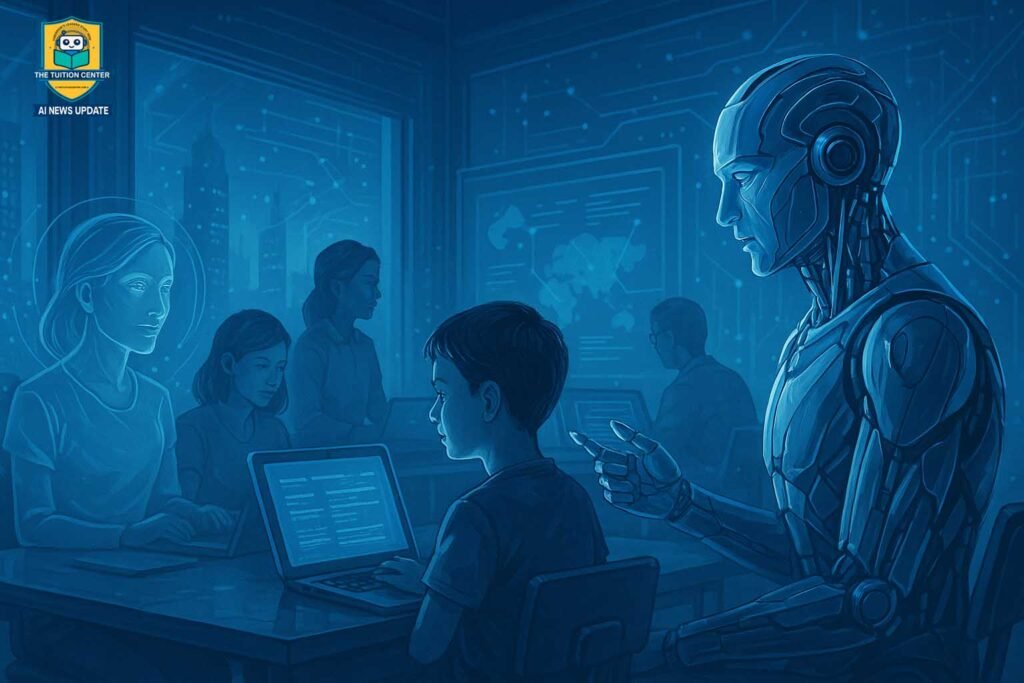
Homework 2.0: AI-Powered ‘Learn by Doing’ Systems Are Rewriting Education
The days of rote-based homework are ending as AI-powered interactive experiences transform how students practice, learn, and master concepts — without ever opening a notebook.
- 15+ countries are piloting AI-based homework alternatives.
- Students using AI practice systems show up to 40% higher retention.
- School boards are preparing to phase out pen-and-paper homework by 2028.
Introduction
For over a century, homework has been considered a fundamental part of schooling. Yet research has repeatedly shown that repetitive written homework often creates stress, reduces curiosity, and provides limited long-term learning benefits. Students copy answers, rely on shortcuts, or complete assignments mechanically — without actual understanding.
In 2025, a global shift has begun: countries are phasing out traditional homework and replacing it with AI-powered “Learn by Doing” systems — interactive environments where students practice concepts through simulations, challenges, real-time feedback, and personalised tasks that adapt to their understanding.
These systems are powered by next-generation AI models capable of sensing progress, attention, cognitive load, and areas of struggle. Instead of worksheets, students solve puzzles, explore simulations, perform micro-projects, interact with stories, and complete real-life scenarios designed to build deeper comprehension.
The result? Students learn faster, stress less, retain more — and actually enjoy practice. Schools in Japan, UAE, Finland, India, and Canada are already reporting dramatic improvements in engagement and mastery. Homework as we know it is disappearing — replaced by something far more intelligent, human-centred, and effective.
Key Developments
Several technological breakthroughs in the last 24 months have made AI-based homework replacements not only possible but inevitable.
1. Adaptive Learning Engines
AI now identifies a student’s exact learning stage — confused, curious, ready to advance, or needing revision — and adjusts the task instantly.
2. Immersive Problem Solving
Students practice math, science, and language skills through story-based interactive challenges rather than static questions.
3. Emotion-Aware Task Adjustment
If a student shows frustration, AI slows down and explains concepts differently. If the student is performing well, AI increases difficulty automatically.
4. Real-Time Skill Maps
Every task updates a dynamic skill graph that shows exactly what the student has mastered and what gaps remain.
5. AI Tutors on Demand
Instead of waiting for teachers, students get immediate guidance — “Show me,” “Explain differently,” “Give hint,” “Give example.”
No delays. No guessing.
Together, these innovations create a learning experience that no traditional homework method can match.
Impact on Industries and Society
The shift away from homework is changing more than schooling — it’s reshaping parenting, teaching, EdTech innovation, and even child psychology.
1. Students Are Less Stressed and More Curious
Studies show that students using AI-based practice systems feel:
- More confident
- More engaged in learning
- Less pressured by deadlines
- More willing to try difficult tasks
Because the system adapts to them, not the other way around.
2. Teachers Gain Powerful Insights
Instead of checking piles of notebooks, teachers see:
- Real-time accuracy graphs
- Concept mastery breakdowns
- Patterns of misunderstanding
- Areas needing classwide review
This makes teaching more efficient and targeted.
3. Parents See True Progress — Not Guesswork
Mobile dashboards show parents:
- What child practiced today
- Where they improved
- Where they struggled
- Suggested support activities
4. Schools Save Time and Resources
Homework no longer requires printing worksheets, distributing assignments, reviewing stacks of copies, or managing manual tracking.
AI automates it all.
5. EdTech Industry Transformation
Companies are rushing to build AI-based practice ecosystems.
Traditional worksheet and textbook-based models are becoming obsolete.
Expert Insights
“Homework was designed for an era without technology. AI enables practice that is personalised, engaging, and far more effective than worksheets ever were.” — Dr. Fiona Lewis, Global Learning Futures Institute.
“The shift from homework to interactive AI practice is the most important education reform since the invention of public schooling.” — Prof. Manish Kumar, IIT Bombay.
“Ask any student — they don’t hate learning, they hate boring tasks. AI solves that problem beautifully.” — Sarah Helton, Finland National Curriculum Board.
India & Global Angle
India is at the forefront of the AI homework revolution. With DIKSHA 2.0, NDEAR, and IndiaAI Mission, national platforms will soon integrate adaptive AI practice for millions of students.
Several states — including Delhi, Karnataka, Maharashtra, and Telangana — are piloting AI-based practice systems that replace written homework entirely.
Globally, Japan, the UAE, South Korea, Finland, and the U.S. are the fastest adopters, each building their own “AI Homework Alternatives” within government school systems.
Policy, Research, and Education
As school boards phase out traditional homework, governments and research institutions are rewriting educational frameworks to support AI-driven practice learning. Policymakers are setting new standards for safety, ethics, accessibility, and curricular alignment.
1. National Homework Reform Policies
Countries like Japan, UAE, Finland, and India have initiated task forces to review:
- How homework affects child psychology
- How AI-based practice can improve learning outcomes
- What guidelines ensure safe and ethical use of adaptive AI
- How much daily practice time is ideal for different grades
India’s NEP (National Education Policy) Committee is evaluating “AI-Based Practice Periods” to replace written homework across CBSE and state boards.
2. Brain and Learning Research
Neuroscience studies across Japan, Canada, and Germany indicate:
- Learning retention improves with active practice — not passive repetition.
- Emotional engagement increases neural imprinting of new information.
- Real-time feedback strengthens conceptual clarity.
- Small, adaptive tasks outperform long, static assignments.
This research validates the shift away from traditional homework.
3. Training Teachers for AI-Powered Classrooms
Teachers now need skills in:
- Interpreting AI-generated learning analytics
- Designing interactive classwork aligned with AI practice
- Supporting students based on personalised learning profiles
- Integrating AI tutorials with classroom activities
Rather than eliminating teachers, AI empowers them with deeper insight into how each child learns.
Challenges & Ethical Concerns
The end of homework does not come without concerns. Schools and parents face new questions about screen time, data usage, and AI dependency.
- Screen Time: If not managed properly, AI-based practice may increase digital exposure.
- Equity & Accessibility: Not all children have devices or stable internet for AI tasks.
- Data Privacy: Governments must safeguard learning behaviour data.
- Over-Adaptation: Systems that adjust too quickly may reduce natural perseverance.
- Human Touch: Parents worry emotional connection to learning may weaken if AI dominates.
- Algorithm Bias: AI may misjudge student ability due to skewed training data.
Experts recommend a “balanced tri-model” — human explanation, AI practice, and real-world application — to ensure holistic growth.
Future Outlook (3–5 Years)
- Homework Will Disappear in Most Countries: AI-based “Learn by Doing” systems will fully replace written tasks.
- AI Practice Will Be Integrated Into School Timetables: A dedicated 20–30 minute slot daily.
- AI Learning Profiles: Every child will have a personalised skill map from age 6 onwards.
- Gamified Real-World Assignments: Practice will resemble interactive missions, not worksheets.
- Hybrid AI Teachers: AI will provide practice; teachers focus on deep teaching and mentorship.
- Global Standardisation: Countries will adopt common frameworks for adaptive learning systems.
By 2030, traditional homework may be as outdated as chalkboards — replaced by interactive, personalised, and engaging AI-driven learning ecosystems.
Conclusion
The shift to AI-powered “Learn by Doing” systems marks a radical transformation in global education. It eliminates the stress, monotony, and inefficiency of traditional homework, replacing it with meaningful practice that adapts to each child’s needs.
This evolution doesn’t just improve academic outcomes — it builds confidence, curiosity, and lifelong learning habits. As countries modernise their education systems, AI-based practice will become the global standard, ensuring every student gets the right challenge at the right moment.
Homework is ending — and learning is becoming smarter, fairer, and more joyful than ever before.