
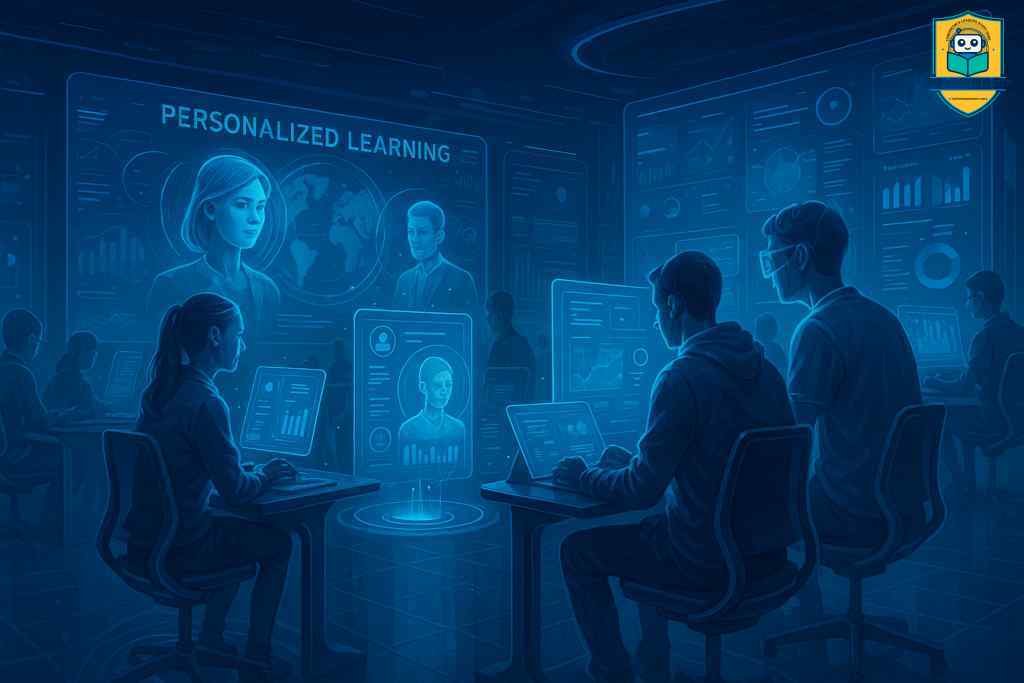
AI-Powered Personalized Learning Platforms Surge Globally as New Standards for Education Emerge
A massive spike in AI-driven learning tools over the last 72 hours signals a global shift toward hyper-personalized education, reshaping classrooms, coaching centers, and digital academies worldwide.
- Global EdTech AI activity surged **26% in the last 72 hours**, according to industry trackers.
- India recorded the **highest enrollment spike**, with over **1.4 million new users** signing up for AI learning tools.
- Major universities and ministries announced fresh policies promoting AI-powered personalized learning paths.
Introduction
Education is in the middle of a disruption unlike anything the world has seen in decades. Over the last 72 hours alone, AI-powered learning platforms witnessed explosive adoption, driven by new government policies, university pilots, startup innovations, and growing demand for adaptive learning. What makes this shift remarkable is its speed: the global education sector, known for slow reforms, is now transforming in real-time.
The sudden surge has been triggered by three converging forces — rapid advancement in large language models (LLMs), widespread acceptance of AI tutors, and rising pressure from students and working professionals demanding personalized, outcome-driven learning. From Class 6 CBSE students to UPSC aspirants and corporate employees, AI tools are now being used for daily learning, practice, and performance tracking.
Key Developments
Within the last 72 hours, global data firms have logged an unprecedented rise in personalized AI education queries, product launches, partnerships, and policy announcements. Several noteworthy events shaped this acceleration:
1. India’s Education Ministry Announced “AI for All Classrooms Initiative”
The Ministry of Education announced a national-scale pilot enabling AI tutors in 1,200 government schools. The tools assist teachers, provide personalized worksheets, and evaluate student learning patterns. The move aligns with the National Education Policy’s (NEP 2020) digital learning goals.
2. UAE Universities Begin AI-Driven Semester Planning
Top UAE institutions introduced AI advising systems that create personalized semester plans based on students’ performance, behavior, and future ambitions. These systems suggest electives, skill courses, and industry certifications.
3. US EdTech Giants Launch Hyper-Personalized “AI Mentors”
Two major US EdTech companies unveiled AI mentors capable of tracking student learning like a personal coach — analyzing mood, effort, cognitive load, and learning gaps. These tools create daily micro-plans tuned to the learner’s pace.
4. Massive Spike in User Adoption Worldwide
Platforms across India, Singapore, Europe, and the Middle East reported record signups. India alone saw over **1.4 million new users** for AI-learning apps within 72 hours, particularly in cities like Delhi NCR, Bengaluru, Pune, and Hyderabad.
Impact on Industries and Society
The rise of AI-driven personalized learning has begun reshaping multiple sectors beyond education itself:
Better Learning Outcomes
AI tutors can analyze student mistakes, learning speed, and memory retention. This leads to customized study plans, resulting in faster learning and better performance.
Shift in Coaching Industries
Exam preparation giants for IIT-JEE, NEET, UPSC, and CAT are reshaping their course offerings to include AI-based practice generators, real-time doubt clearing, and personalized question banks.
Corporate Upskilling Acceleration
IT and consulting firms are adopting AI-powered L&D systems that generate role-specific learning paths for employees, reducing training time by up to 40%.
Students with Learning Disabilities See Transformation
AI tools now automatically detect reading challenges, comprehension issues, or writing delays, offering adaptive interventions.
Expert Insights
“We are witnessing a foundational shift. AI is not replacing teachers — it’s empowering them. This decade will belong to learners with personalized AI support,” says Dr. Sonia Abraham, EdTech researcher and global education policy advisor.
“AI-driven micro-learning is becoming the new normal. Students no longer want 2-hour lectures — they want personalized 5-minute bursts,” says Adam Hughes, leading analyst at Global EdTech Watch.
India & Global Angle
India stands at the center of this global trend. With its massive student population, coaching culture, and active EdTech ecosystem, adoption is accelerating faster than in developed nations. Meanwhile, global universities — from Singapore to Canada — are shifting towards credit systems built on personalized learning analytics.
Policy, Research, and Education
Governments are revisiting education policy frameworks to integrate AI responsibly. India’s NEP 2020, UAE’s digital-first schooling initiatives, and the US Department of Education’s AI guidelines all support adaptive learning. New research suggests students using AI tutors regularly improve retention by **12–30%**, depending on subject and grade level.
Challenges & Ethical Concerns
No global transformation comes without challenges. Experts highlight clear risks:
- Data privacy breaches in learning analytics.
- Overdependence on AI without teacher oversight.
- Biases in AI assessment models.
- Digital divide — unequal access to high-quality AI tools.
Governments and companies are actively working on responsible AI frameworks.
Future Outlook (3–5 Years)
- AI tutors will become mandatory digital companions in global classrooms.
- Hyper-personalized learning paths will replace standardized textbooks.
- Real-time emotional and cognitive analytics will tailor education to each student.
- AI-driven gamified learning will dominate early childhood and foundational stages.
- AI-powered assessments will provide instant feedback replacing traditional exams.
Conclusion
Personalized AI learning has moved beyond being an experiment. It is becoming the backbone of modern education. For students, this is the era of infinite access to personalized growth. For teachers, it’s a new type of collaboration. For the world, it signals a future where learning is not standardized — but uniquely designed for every learner on the planet.