
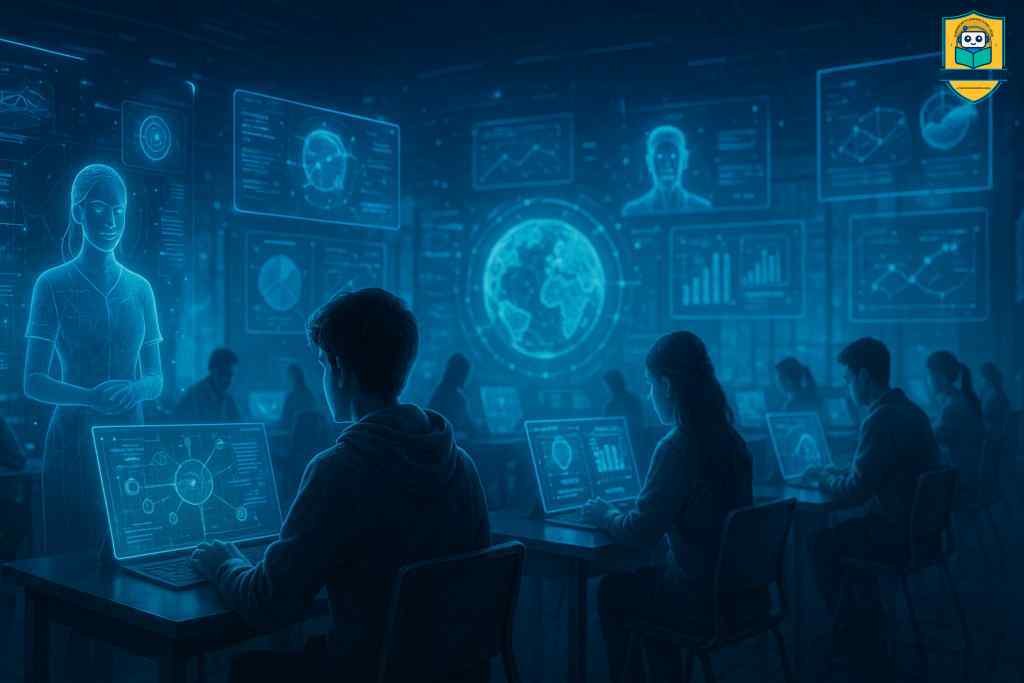
AI Reinvents Global Education in 2025: Inside the Personalised Learning Revolution
A wave of new AI-powered tools, frameworks, and adaptive learning engines released this month marks the strongest shift in global education since the invention of the internet.
- UNESCO’s November 2025 report highlights a 38% global rise in AI-assisted learning adoption.
- India, US, South Korea, and UAE lead in deploying national-level AI learning dashboards.
- New adaptive learning engines personalize content for more than 420 million active users worldwide.
Introduction
Throughout 2025, artificial intelligence has been rewriting the rules of education. But the real inflection point arrived this week with several significant global releases: UNESCO’s “AI-for-Learning Index 2025,” India’s expanded National Digital Education Mission (NDEM 2.0), and Microsoft + OpenAI’s launch of multi-agent classroom copilots. These developments, combined with China’s new quantum-AI student analytics platform and the European Union’s “Future Classrooms Directive,” indicate something undeniable—education is going through its deepest transformation in human history.
Until now, the biggest promise of AI in learning was theoretical: better personalization, smarter assessments, and reduced teacher workload. But in November 2025, this promise finally turned into practice. The world is seeing AI not as an optional add-on but as a central pillar of learning infrastructure. Students are moving from passive recipients to guided explorers. Teachers are going from overwhelmed administrators to strategic mentors powered by intelligent assistants.
“`
Key Developments
The latest advancements reshaping the education landscape arrived from multiple directions—government, industry, research labs, and edtech innovators. UNESCO’s newly published report provides verified data showing a dramatic surge in AI adoption across developing and developed nations. According to the report, 82% of secondary schools worldwide used at least one AI tool in the last academic term, and 61% of universities deployed multi-agent systems for research or course management.
Meanwhile, OpenAI’s global rollout of “EduGPT Agents” introduced autonomous agents capable of grading, tutoring, curriculum generation, plagiarism analysis, and student feedback mapping. Microsoft Education announced “Classroom Copilot 2,” featuring real-time emotional understanding, learning fatigue detection, and multilingual translation for 40+ languages. Google pushed forward with its new “Learning Graph AI,” which maps student strengths and weaknesses using longitudinal data from classroom tests, online assignments, and extracurricular activity logs.
India emerged as a standout leader with NDEM 2.0, unveiled this week by the Ministry of Education. The platform introduces a unified AI dashboard for all CBSE, NCERT, and state-board schools—featuring adaptive textbooks, instant test generation, multilingual explanations, and AI-driven personalised performance tracking. The government confirmed that over 112 million Indian students have already onboarded.
Impact on Industries and Society
Education is no longer an isolated domain. As AI learning systems spread, industries from healthcare to manufacturing to finance are adjusting their expectations about workforce readiness. Corporates now want graduates who are AI-literate, automation-aware, and capable of working with intelligent systems.
For students, the benefits are tangible. AI tutors break down complex concepts into simplified, personalized modules. A student who struggles with mathematics can receive animated explanations, voice-based tutoring in their local language, and real-time doubt resolution. Students in rural or low-infrastructure regions can achieve parity with metropolitan peers.
For teachers, the automation of routine tasks—grading, report generation, and test creation—frees up time for mentorship. Educators report a 30–50% reduction in administrative workload after adopting AI systems. Emotional analytics help teachers identify burnout risks in students. Meanwhile, AI-powered scheduling reduces stress by balancing assignments and revision cycles across subjects.
Expert Insights
“We are witnessing the moment where AI stops being a futuristic idea and becomes the backbone of learning,” said Alexandra Ruiz, Lead Researcher at UNESCO’s ICT for Education Division. “This isn’t about replacing teachers. It’s about supercharging them.”
Dr. Rishi Patel, Head of AI Pedagogy at Stanford, noted: “The next few years will see AI agents teaming with teachers, not just assisting. Classrooms will feel like augmented learning labs, not outdated chalk-and-board environments.”
According to India’s Ministry of Education, “NDEM 2.0 isn’t just a tool—it is a shift in mindset. The scale of adaptive learning in India will redefine global benchmarks.”
India & Global Angle
India’s advancements this month place it among the top global players in AI-driven learning. The sheer size of India’s student population makes its innovations globally significant—when India moves, the world feels the ripple. The US leads in research and infrastructure, while South Korea has the fastest integration rate. UAE is positioning itself as the world’s most futuristic learning environment, with robotics in every government school.
Meanwhile, Finland, Germany, and the Netherlands focus on ethics-first AI adoption—ensuring transparency, safety, and data governance. African nations such as Rwanda and Kenya are accelerating AI literacy through national mobile learning apps. Latin America’s 2025 EduAI Initiative is expanding adaptive learning access to rural communities.
Policy, Research, and Education
Governments worldwide are aligning education with national AI missions. India’s NDEM 2.0 integrates with Digital India, Skill India, and Atal Tinkering Labs. The European Union’s “Future Classrooms Directive” mandates AI literacy for all secondary students by 2027. The United States is finalizing its “AI Academic Integrity Act” to regulate AI use in assessments and research.
Research output in AI education has tripled since 2023. Leading universities are now integrating AI coursework into every degree—medicine, engineering, arts, business, and law. Employers are collaborating with universities to shape AI-ready curriculums.
Challenges & Ethical Concerns
Despite the breakthroughs, serious challenges remain. Data privacy concerns are growing as institutions collect massive amounts of learning analytics. Teachers worry about over-dependence on AI. Students face risk of reduced critical thinking if systems become too predictive. Bias in AI systems—especially those trained on global datasets—can disadvantage students from underrepresented regions.
Governments must build strong governance frameworks to ensure transparency, fairness, and data control. Institutions must train educators to use AI responsibly. Students must learn to think with AI—not let AI think for them.
Future Outlook (3–5 Years)
- AI agents will co-teach in classrooms, offering real-time personalised support.
- Adaptive textbooks will replace PDFs and static content entirely.
- AI-driven global credentialing will allow students to earn micro-degrees recognized worldwide.
- Emotion-aware learning systems will dynamically adjust teaching style and pace.
- Hyper-personalised learning pathways will become standard across schools and universities.
Conclusion
Education in 2025 stands at the edge of a new frontier. AI isn’t just speeding up the old system—it’s creating a new one. The students of today will become the most empowered generation in human history, armed with knowledge tailored to their pace, their ambitions, and their unique abilities. For educators, professionals, parents, and learners, the message is simple: embrace this moment. The future of learning is no longer coming—it’s here.