
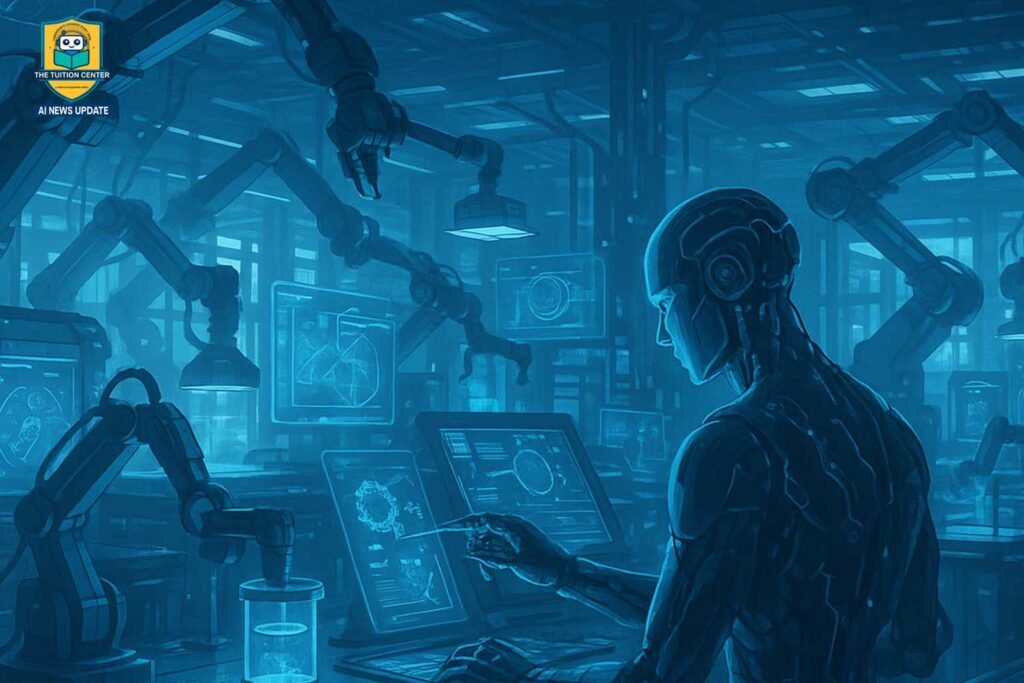
Autonomous Scientific Discovery: AI That Designs Its Own Experiments
A transformative new wave in research is emerging — AI systems that generate hypotheses, design experiments, run robotic labs, analyze results, and improve their own methods without human direction.
- AI-driven labs can run 10,000+ experiments per day with robotic assistance.
- Autonomous discovery engines have already produced new materials, catalysts, medicines, and climate solutions.
- This revolution is reshaping research in India, the US, UK, Singapore, and Japan.
Introduction
For centuries, scientific discovery relied on human intuition. A scientist formulates a hypothesis, designs experiments, runs trials, studies results, and adjusts methods. But this iterative process is slow, limited by patience, and constrained by human imagination.
Artificial intelligence has now shattered that ceiling. A new class of AI systems — known as Autonomous Scientific Discoverers — can independently create hypotheses, design thousands of experiment variations, execute them in robotic labs, analyze data, and refine future experiments without human direction.
This isn’t automation. It’s a new form of scientific intelligence.
From discovering new antibiotics to designing sustainable materials, these AI engines uncover possibilities humans might never consider. They explore chemical universes, model biological pathways, and simulate physical systems at a scale impossible for manual science.
The result? Discoveries that would take decades are emerging within weeks. The pace of innovation is accelerating so fast that it may become one of the most transformative forces of the 21st century — especially for countries like India that are rapidly expanding their R&D capabilities.
Key Developments
1. Self-Generated Hypotheses
AI models trained on vast scientific literature now propose new research ideas — combinations of molecules, biological interactions, material structures, or reactions that humans have never tested.
2. Autonomous Robotic Labs
Robotic labs integrated with AI can execute experiments 24/7, pipetting chemicals, analyzing spectral data, synthesizing compounds, and adjusting parameters based on real-time results.
3. Closed-Loop Discovery Systems
AI models create experiments → robots execute → sensors capture results → AI analyzes → system self-corrects → cycle repeats.
This loop enables rapid optimization and breakthrough discovery.
4. AI-Driven Chemical Search
AI can scan millions of possible chemical reactions and predict outcomes instantly. Standard lab workflows cannot match this speed or scale.
5. India’s Entry Into Autonomous Research
IIT Madras, IISc, and several private labs in Hyderabad and Pune are building “robotic AI labs” for drug discovery, synthetic materials, and agricultural research.
Impact on Industries and Society
Healthcare & Drug Discovery: Medicines Invented by AI
Traditional drug discovery takes years, costs billions, and requires enormous trial-and-error. Autonomous research labs collapse the timeline by generating and testing chemical candidates at unprecedented speed.
AI can now:
- design new molecules for cancer, diabetes, and infections
- predict side effects before synthesis
- run thousands of experiments overnight
- optimize chemical reactions in real time
In 2025 alone, multiple AI-designed anti-inflammatory molecules moved into early-stage trials globally — a milestone once considered impossible.
Climate Solutions: AI-Discovered Materials for Carbon Capture
Autonomous scientific discovery engines are now generating breakthrough materials that capture CO₂, purify air, and absorb methane. Some materials have structures no human researcher imagined.
Energy: AI-Optimized Solar, Storage & Clean Fuels
AI labs designed new types of battery electrolytes, solar coating materials, and hydrogen catalysts — each discovered through thousands of AI-generated simulations followed by automated testing.
Agriculture: AI-Engineered Seeds, Fertilizers & Soil Additives
AI-driven labs are generating synthetic fertilizers, microbial soil boosters, and genetically optimized seed coatings that improve crop resilience and yield. These breakthroughs emerge from rapid experimentation cycles that would take human scientists decades to run manually.
The agricultural sector stands to gain enormously:
- drought-resistant microbial agents
- nitrogen-fixing bacteria engineered for Indian soil conditions
- AI-optimized enzymes for organic pest control
- synthetic nutrients designed to regenerate dead soil
India’s reliance on agriculture means this revolution could dramatically impact food security and economic stability.
Manufacturing & Materials Science: Super-Materials Designed by AI
Autonomous research systems have discovered:
- ultra-lightweight alloys stronger than steel
- self-healing plastics
- meta-materials that manipulate light with extreme precision
- heat-resistant polymers for aerospace
These materials unlock possibilities in aerospace, automotive, electronics, renewable energy, and defense. The ability to design materials atom-by-atom allows industries to overcome long-standing engineering limitations.
Education & Research: A New Era of Scientific Learning
Students studying biology, chemistry, physics, and engineering will soon be working alongside AI discovery systems. Future labs will include:
- AI experiment planners
- robotic lab assistants
- real-time simulation engines
- AI hypothesis generators
Science education will shift from manual experimentation to human-AI co-discovery — enabling faster learning and deeper insight. Students will focus more on interpretation, creativity, ethics, and scientific reasoning, while AI manages labour-intensive experimental cycles.
Expert Insights
“Autonomous scientific discovery is the biggest leap in research productivity since the invention of the computer.
We are compressing decades of discovery into months.”
— Director, MIT AI Research Lab
“AI scientists will design materials no human chemist would even imagine.
This is the beginning of a new scientific species — computational researchers.”
— Lead Scientist, Oxford Materials Innovation Group
“India has the potential to become a global powerhouse in autonomous research,
especially in drug discovery and sustainable materials.”
— Senior Fellow, India Science and Technology Forum
India & Global Angle
India is rapidly integrating AI-driven research into national laboratories, biotech hubs, and academic institutions. With one of the world’s largest talent pools in engineering and data science, India is positioned to ride this wave aggressively.
India’s Progress
- IIT Madras is running autonomous chemistry labs with robotic automation.
- IISc Bangalore is using AI to simulate protein interactions for drug discovery.
- Private labs in Hyderabad are integrating AI with robotic labs for materials research.
- Startups in Pune and Gurgaon are piloting AI-based agricultural discovery engines.
Government missions under DST, DBT, and India-AI initiatives are accelerating funding and infrastructure for autonomous labs.
Global Developments
- US leads with autonomous drug-discovery engines.
- UK has robotic labs designing clean-energy materials.
- Japan deploys AI to accelerate semiconductor research.
- Singapore builds fully automated biology labs.
- Switzerland runs AI metabolism simulators creating novel life pathways.
These global ecosystems point toward a radical future — where science progresses exponentially faster than today.
Policy, Research, and Education
1. National AI Research Frameworks
Governments must establish clear guidelines for AI-driven discovery — including ownership of AI-generated inventions, safety protocols, and ethical boundaries.
2. Education Overhaul
Universities must train students in:
- AI-based scientific modeling
- robotic lab operations
- scientific ethics in autonomy
- interpreting AI-generated hypotheses
3. Open Science + AI
A new movement of open scientific literature feeding AI models is emerging — enabling fair global access to autonomous discovery systems.
4. Patent & Intellectual Property Reform
Who owns a discovery made entirely by an AI system? Nations must build global standards to address this growing challenge.
Challenges & Ethical Concerns
- AI Misinterpretation of Data: Incorrect conclusions could lead to harmful experiments.
- Biosecurity Risks: Autonomous biology labs must be heavily regulated.
- Overdependence on AI: Human scientific intuition may weaken.
- Economic Displacement: Traditional lab roles may shrink.
- Ethical Ambiguity: AI may propose experiments humans consider unsafe or unethical.
These risks require careful policy-making, interdisciplinary oversight, and transparent scientific governance.
Future Outlook (3–5 Years)
- AI Co-Scientists working alongside human researchers in every major lab.
- Hyper-Speed Discovery Cycles reducing R&D timelines by 80–90%.
- Autonomous Biology Factories producing medicines, materials, and organisms at scale.
- Space Research Labs using autonomous systems to study life-support chemistry on Mars and the Moon.
- Global Scientific Exchange Engines where AI collaborates across nations in real time.
Conclusion
Autonomous scientific discovery is more than a technological shift — it is a new chapter in human progress. AI is evolving from a tool to a research partner, accelerating innovation at a pace no civilization has ever witnessed.
For India and the world, the message is clear: nations that embrace AI-driven research will unlock medical breakthroughs, create new materials, transform agriculture, solve climate challenges, and generate the scientific revolutions of the future.
The next Einstein may be an AI — and the next scientific revolution has already begun.